Automatic Scooters
Heavier Riders on a Hanoi Rental Scooter: Payload, Suspension Sag and Seat Size
About 8 minutes to read
If you are tall, broad or simply heavier than average, and you plan to carry a backpack, a camera bag or a passenger as well, the question is not only whether a scooter feels comfortable. Every scooter is built around a maximum load, and the closer you get to it, the harder the brakes, suspension and tyres have to work. This guide explains what that load figure covers, how to add up your own total, what to look at on the suspension and seat when you collect the bike, and how to ride when the bike is carrying a lot. It does not give one number that suits every rider, because every model has its own.
The short answer
Ask the shop for the maximum load of the exact scooter you will ride, then add your weight, any passenger and everything you will carry. Leave a margin below the figure rather than riding right at it. At pickup, sit on the bike while it is firmly on its stand and watch how far the rear sinks, check that you can put your feet down securely, and make sure the seat does not push you forward. If the total is close to the limit, or the rear sinks almost to the end of its travel as soon as you sit down, ask for a different bike, carry less, or split people and luggage across two bikes.
What the maximum load figure actually covers
The maximum load is a total, not a rider limit. Yamaha’s owner’s manual for the GPD125-A scooter is a clear example: its specifications list a maximum load of 168 kg, and a footnote defines it as the total weight of rider, passenger, cargo and accessories. Its loading advice says the same thing in other words: operator, passenger, accessories and cargo together must stay within that limit.
That figure belongs to one model. The scooter you are offered may be lighter or heavier duty, so treat 168 kg as an illustration of how the number is defined, not as the limit of your bike. The figure for your bike is in its owner’s manual or on its specification label, and the shop should be able to tell you. Ask for the number of the exact bike rather than going by its name or how big it looks.
Add up your own total
The arithmetic takes a minute. Write down each item, add them, and compare the result with the figure the shop gives you. The example below uses invented round numbers purely to show the method; replace every line with your own.
| Item | Example only (kg) | Your figure |
|---|---|---|
| Rider, dressed, with helmet | 100 | |
| Passenger, if any | 0 | |
| Backpack or day bag | 8 | |
| Things in the under-seat compartment | 4 | |
| Rain gear, water, accessories | 3 | |
| Total to compare with the bike’s maximum load | 115 |
Then leave a margin. On a rough road or under hard braking, the forces on the bike are greater than the static weight you added up, so a total sitting just under the limit leaves little in reserve. If you are over or close to the figure, switch to a bike with a higher rating, carry less, or split the load between two bikes. Adding a passenger changes the sum completely; the separate guide to two people on one rental bike covers the law and the load for riding two-up.
Storage compartments have their own limits
A roomy under-seat compartment does not mean it can take heavy items. The same Yamaha GPD125-A manual sets a 5 kg limit for the rear storage compartment and 1.5 kg for the front compartment, separately from the 168 kg limit for the whole vehicle. Other models have different figures, but the principle holds: do not fill the compartment with heavy things just because there is space. The manual also advises packing the heaviest items as close to the centre of the vehicle as possible, and never attaching large or heavy items to the handlebar, front fork or front fender.
Checks at pickup: suspension, seat and stance
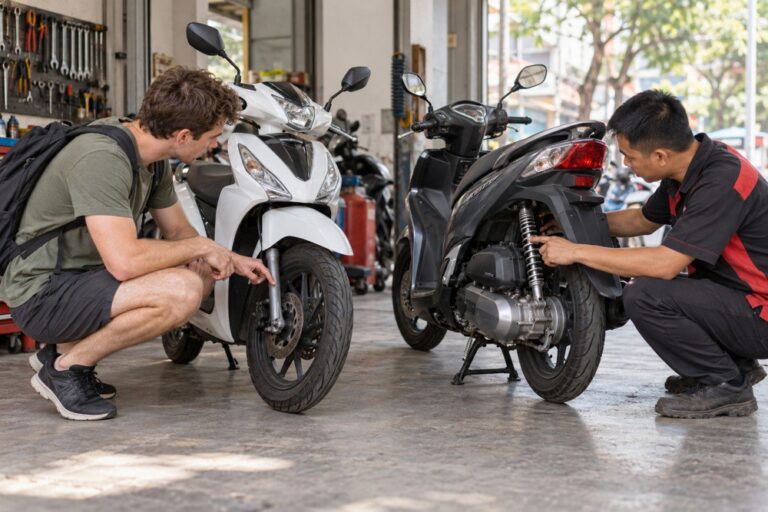
These checks take a few minutes with the bike on firm, level ground. Ask the shop whether you can sit on the bike while it is firmly on its stand, and let staff hold it for any check you cannot do safely yourself.
| What to check | How | Sign to raise with the shop |
|---|---|---|
| Rear suspension sag | With the bike held steady, sit in your normal riding position and watch how far the rear sinks | The rear drops close to the end of its travel as soon as you sit down |
| Rebound | Ask staff to hold the bike and press the rear down with the engine off | It bounces several times, knocks, or you see oil on the shock |
| Seat width and shape | Sit for a few minutes as you would on the road | The seat is narrow, pinches, or slides you forward |
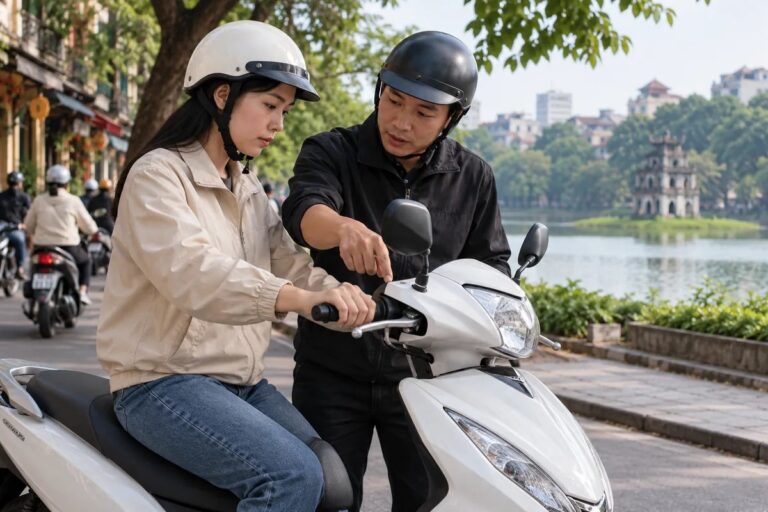
| Feet down | Come to a stop position and put your feet on the ground | You are on tiptoe or struggle to hold the bike upright |
| Stand | Check the bike sits firmly on its stand on level ground before you sit on it | The bike rocks or leans on the stand |
If the suspension already sinks deeply with only you on board, that bike is not a good match and it is reasonable to ask for another. Some scooters have adjustable rear preload; whether to change it is the shop’s decision, and rear suspension preload explains why to ask rather than adjust it yourself. For seat height and reach, the stationary fit test for short and tall riders goes into more detail.
Tyre pressure and a heavier load
Tyres carry the whole load, so pressure matters more when the total is high. Use the figures on the bike’s label or in its manual, measured with the tyres cold. For the GPD125-A, Yamaha lists the same cold pressures for one person and for two (150 kPa front, 250 kPa rear), and notes that pressure has to suit the riding speed and the total load approved for the model. Other scooters may list different values for a heavier load. Ask the shop to set the pressures to the bike’s specification before you leave, and have them checked if the bike feels soft or vague.
Riding a scooter that is carrying a lot
- Brake earlier. A heavier bike needs more distance to stop, so leave a bigger gap to the vehicle in front.
- Slow down for potholes and speed bumps. A loaded rear suspension reaches the end of its travel more easily.
- Corner more gently. Slow down before the turn rather than in it.
- Pull away smoothly. A big handful of throttle on a heavily loaded scooter can unsettle the bike.
- Keep luggage low and central, and secure it. Nothing heavy on the handlebar.
- Watch how the bike behaves. A rear that bottoms out, steering that feels light or vague, or stops that take much longer than expected are signs to carry less.
Hanoi streets add their own tests, from patched surfaces to steep ramps into basements. If your routes include rough roads, wheel size and rear suspension are worth comparing when you choose the bike.
When to change the bike or the plan
- Your total is close to or above the bike’s maximum load.
- The rear sinks deeply as soon as you sit down, or bounces hard when pressed.
- The seat is too narrow or too high for you to hold the bike steady at a stop.
- You plan a long ride with hills or rough roads while carrying a lot.
In any of these cases, ask the shop for a larger or sturdier bike, or split people and luggage across two bikes.
Questions to ask the shop
- What is the maximum load of this exact scooter, and does it include luggage and accessories?
- Can I sit on it before I take it, with the bike held on its stand?
- Do you have a bike with a wider seat or a higher load rating?
- Are the tyre pressures set to the specification for this bike?
Frequently asked questions
Is there a weight limit for renting a scooter in Hanoi?
The limit that matters is the bike’s maximum load, set by the manufacturer for each model and covering the total of rider, passenger, cargo and accessories. Ask the shop for the figure of the bike you will ride and add up your own total.
Does the maximum load include my backpack?
Yes. On the Yamaha GPD125-A, for example, the maximum load is defined as the total weight of rider, passenger, cargo and accessories, so everything on the bike counts.
Can I put heavy things in the under-seat compartment?
Only within its own limit. The GPD125-A manual sets 5 kg for the rear compartment and 1.5 kg for the front one. Check the figures for your bike and keep heavy items low and central.
The rear sinks a lot when I sit on the bike. Is that a problem?
If it drops close to the end of its travel with only you on board, there is little suspension left for bumps. Report it and ask for the bike to be checked or swapped.
Should I carry a passenger if I am already near the limit?
No. A passenger adds their whole weight to the total. Use two bikes, or a car for that trip.
Thuê xe máy Nguyễn Hà is at Ngõ 5 Nguyễn Văn Cừ, Bồ Đề ward, Long Biên, Hanoi (near Gia Lâm bus station), open 09:00–21:00 every day. If you want to check whether a scooter suits your height and total load before you book, see our Hanoi motorbike rental options, then call or message 0334 699 969.
Source checked
- Yamaha Motor, GPD125-A owner’s manual (loading, storage compartments, specifications, tyre pressure): yamaha-motor.eu