Automatic Scooters
Should You Warm Up a Scooter Engine on a Cold Hanoi Morning?

On this page
When Hanoi feels cold and damp in the morning, should you leave a petrol scooter idling for five minutes before riding? There is no reliable five-minute rule for every scooter. A fuel-injected engine, an older carburettor model and a scooter with a particular manufacturer’s starting procedure may behave differently. The owner’s manual for the exact bike is the first source to follow.
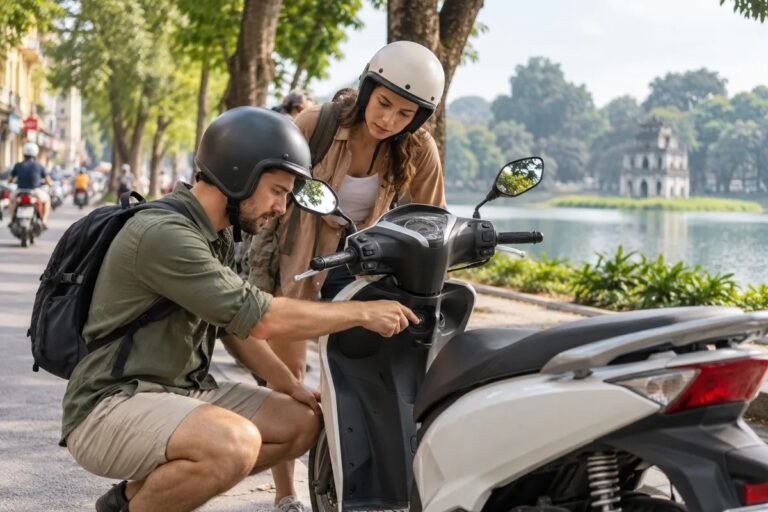
For a rental scooter, the sensible approach is to ask the shop how to start that model, allow the engine to settle as instructed and ride gently at first. Do not repeatedly rev a cold engine or keep it idling for a long, arbitrary period. Never start or warm up a petrol scooter inside an enclosed garage, room or basement: exhaust gases can be dangerous even when the doors seem partly open.
Why riders give conflicting advice
Some riders remember older carburettor bikes that needed help to run smoothly from a cold start. Others ride newer electronically controlled scooters whose systems adjust fuelling during start-up. Both experiences are real, but neither justifies advice that every scooter must idle for the same number of minutes.
Weather also affects the rider, tyres and visibility. On a chilly morning, you may notice damp roads, fogged visor glass or a slightly different feel from the brakes. Those conditions deserve attention whether the engine starts perfectly or not.
Start with the manual, not a timer
Ask the rental shop for the starting instructions of the exact model. If the paper manual is unavailable, ask the staff to demonstrate its normal procedure. Some scooters require a particular brake lever to be held, or have a side-stand switch. Other models have an idle-stop system that behaves differently after an initial start.
The point of this check is not to learn how to adjust or repair the engine. It is to know which controls you can safely use and which symptoms mean you should contact the shop. Do not copy a mechanic’s procedure from a different motorcycle onto your rental.
A calm start-up routine for a rental scooter
- Prepare yourself first: fasten your helmet, adjust mirrors and put your phone away before starting.
- Position the scooter outside in a well-ventilated area with a clear space around it.
- Check the stand, brake lever and ignition controls according to the model’s instructions.
- Start the engine using the demonstrated method; avoid twisting the throttle unless the manual specifically instructs you to do so.
- Allow the engine to settle for the period recommended by its manual, without assuming a fixed universal duration.
- When safe and legal to proceed, accelerate gently and avoid harsh throttle use during the initial period of riding.
Some scooters may run steadily very quickly, while others may have a specified cold-start routine. If you have no clear instructions, ask before departing instead of inventing a routine from social media advice.
Why prolonged idling is not a magic solution
Leaving a petrol engine running while stationary consumes fuel, produces exhaust and is not the same as operating a warmed vehicle gently under normal load. It also increases the time an unattended or poorly supervised bike could move unexpectedly. If the manufacturer’s instructions do not require a long warm-up, avoid introducing one by habit.
Never warm up the scooter in a basement, indoor parking space or enclosed corridor. Carbon monoxide in exhaust can cause serious harm without any warning smell. Moving the bike outdoors before starting is a more important safety step than choosing a favourite warm-up duration.
Fuel injection and carburettors: what changes?
A fuel-injected scooter uses sensors and electronic control to manage fuelling, while a carburettor uses a different mechanical system. That difference can affect cold-start behaviour, but the exact result depends on the model, its condition and maintenance. Neither system guarantees flawless starting in every weather condition.
For a detailed comparison of starting symptoms, read fuel injection versus carburettor scooters in Hanoi’s cold weather. This article addresses the warm-up decision; the related guide addresses the technology itself.
What if the engine stalls just after starting?
Do not respond by repeatedly racing the engine. Check only the ordinary start-up controls that the shop has shown you, then note whether the engine cuts out immediately, idles unevenly or shows a warning light. A weak battery, fuel-system issue or another fault could be involved, but none can be identified from one symptom alone.
After a safe, limited attempt following the manual, contact the rental shop if the scooter remains unreliable. Tell them the time, outside conditions, what you observed and whether the warning light stayed on. Avoid opening panels, changing settings or attempting roadside mechanical adjustments.
What if the starter sounds weak?
If the electric starter turns slowly while the lamps dim, the battery or electrical system may need inspection. Repeated long starter attempts can make matters worse. Stop and seek the shop’s instructions instead of exhausting the battery.
Remember that the rider also needs to warm up
Cold fingers can make a brake lever or throttle harder to control precisely. Wear gloves that fit without interfering with the grips and choose clothing that keeps you warm without loose ends near moving parts. Make sure your footwear allows a stable stop.
In winter drizzle or fog, reduced visibility and a wet road surface matter more than whether the engine has idled for an exact number of minutes. Clean the visor and mirrors, check the lights before departure, slow down and create more following distance. See our guide to winter drizzle, fog and grip for riding-environment checks.
Brakes, tyres and the first part of the journey
Without making assumptions about a particular tyre compound, it is reasonable to treat wet, painted or dirty surfaces cautiously. Braking and cornering feel can change when the road is damp. Test ordinary brake response safely before entering dense traffic and do not attempt sharp acceleration to see if the engine is “warm”.
If braking feels abnormal, stop riding and report it. A problem with a brake is not something to solve by simply waiting longer for the engine to heat up. Mechanical and road-surface issues must be distinguished from the temperature of the engine itself.
What about automatic stop-start systems?
Some newer scooters switch their engine off while stationary and restart when the rider prepares to move. Whether the system is ready immediately after a cold start varies by model. Do not defeat the system, modify wiring or repeatedly toggle controls in search of a general warm-up rule. Ask the shop how that specific feature behaves.
At a traffic light, keep the scooter stable and the controls under supervision. Read any unusual dashboard indicator in the vehicle manual rather than interpreting every blinking light as a failure.
Common advice: what to keep and what to question
| Claim | Better response |
|---|---|
| “Every scooter needs five minutes of idling.” | Check the exact model’s starting instructions. |
| “No modern scooter ever needs a settling period.” | Do not generalise from one model; follow the manual. |
| “Rev the engine hard to warm it faster.” | Avoid unnecessary harsh throttle use when cold. |
| “The engine matters more than the weather.” | Prepare for cold hands, reduced visibility and wet roads too. |
Three questions for the rental shop
- What is the correct cold-start procedure for this exact scooter?
- Does it use fuel injection, a carburettor or an automatic idle-stop function?
- What number should I call if the scooter stalls or will not start in the morning?
For available models and a handover conversation, visit Nguyen Ha’s automatic scooter rental page. Call 0334 699 969 to confirm the actual bike and pickup details. This guide does not promise that a particular scooter is in stock.