Food & Cultural Stops
Choosing a Pavement Food Stall in Hanoi: What to Look at Before You Sit Down
On this page
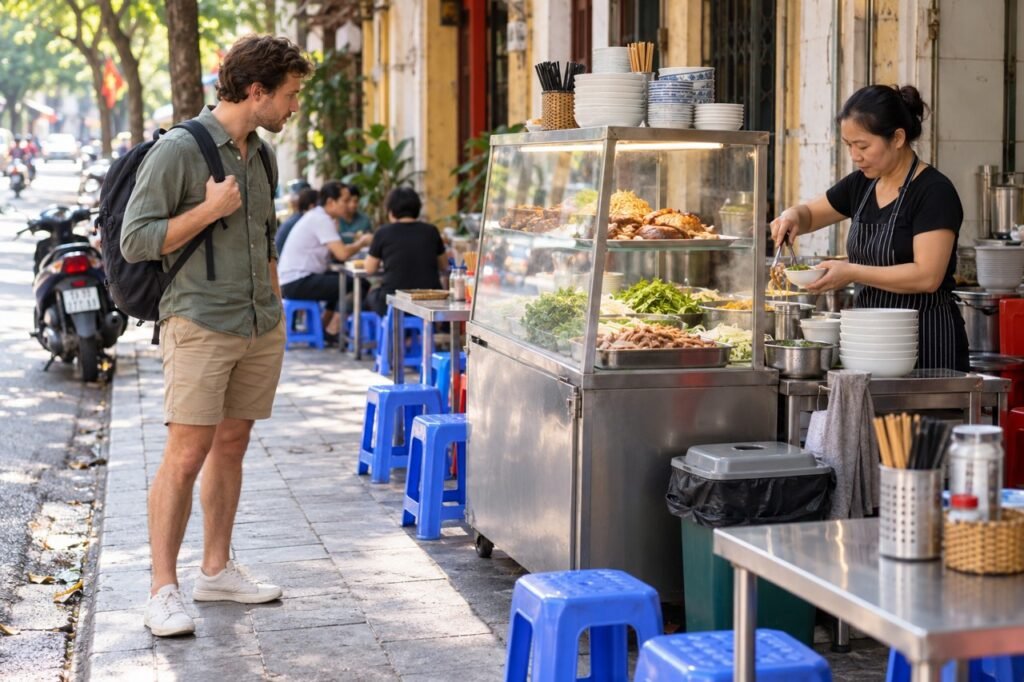
You are standing in front of a pavement stall in Hanoi: the stools are full, the wok is hot and the seller is busy. How can you judge it before you sit down, without relying only on online reviews? Spend a few minutes looking at the prep area, raw and cooked food, hot dishes, water and ice, the bowls and how the seller handles food and money; if something bothers you, walk on before you order. Reviews describe the stall at another time, while what you can see now is current.
This is a way of looking, not proof that the food is safe, and this guide does not rate or name any stall. The CDC’s hand hygiene guidance notes that ordinary wet wipes can make hands look clean but are not a reliable way to remove germs. In the same way, the look of a stall, gloves or a pot on the boil do not confirm that the whole process is safe.
Four things to look at from the pavement before you pull up a stool
- Stand a few steps back and take in the whole scene: the tables, the floor, the bin and any smells.
- Look at the prep area: are the chopping board, knives and trays tidy and clean, and are raw and cooked foods kept apart?
- Watch how the seller works: what they use to pick up food, who takes the money, and the state of their hands and apron.
- Look at food that is already prepared: is it covered, which dishes are hot and which have been left to cool?
If any of the four leaves you uneasy, you can walk on; until you order, you have lost nothing.
What to look at and what you might see
| Where to look | What you can observe (not proof of safety) | Signs to consider another stall |
|---|---|---|
| Prep area | Tables, boards and trays look clean and tidy; the seller wipes down when needed | Sticky residue, standing dirty water, utensils piled together |
| Raw and cooked food | Kept apart and covered; separate utensils for each | Raw and cooked food on the same tray, board or knife |
| Hot food | Cooked or reheated in front of you and served hot; the stock pot on the heat | Cooked food left to cool or out in the open for a long time, uncovered |
| Water and ice | Ask where the water and ice come from; a lidded box or clean tongs do not prove the water is safe. Drinks should be in their original sealed containers | Ice left open, scooped by hand, or with dirt visible in the box |
| Bowls, chopsticks and spoons | Look clean, with no residue or old grease; clean water where the washing-up is done | Residue, damp and dirty, or washed in a basin of cloudy water |
| The seller | Watch what they use to pick up food and whether handling money is kept separate; gloves alone do not confirm hygiene | Handling money and then picking up food with bare hands |
| Surroundings | Rubbish in a bin; waste water not running onto the seating area | Flies or insects on uncovered food; rubbish spilling onto the walkway |
The table does not confirm that a dish is safe. The CDC’s food and water advice for travellers recommends avoiding street food; if you choose it anyway, avoid raw food and choose food that is cooked and served hot. A clean appearance cannot tell you about the water source, the temperature inside the food or how it has been stored.
Ordering, drinks and ice
- Hot dishes: choose dishes cooked fresh and hot, and eat them while they are still hot.
- Raw food: avoid raw or undercooked food. Food prepared in advance needs to be kept at a suitable temperature; do not infer that it is safe because it looks clean or sits on ice.
- Drinks: when you are unsure of the water, choose bottles or cans still in their original seal and avoid ice of unknown origin. Taking the ice out of a drink made with unsafe water does not make that drink safe.
- Hands and utensils: wash your hands with soap and clean water before eating where you can. If you cannot, use a hand sanitiser with at least 60% alcohol according to its label, then wash when you can; ordinary wet wipes do not replace this. If the chopsticks or spoons do not look clean, ask for another set.
If you are with young children, older people, anyone with a long-term health condition or someone with a sensitive stomach, take extra care, and if you are worried, ask their doctor.
What not to do
- Do not choose a stall only because you can park right outside or sit down straight away.
- Do not decide a stall is clean or dirty just because it is busy or quiet.
- Do not rely entirely on online reviews and ignore what is in front of you.
- Do not photograph the prep area or the seller without asking first.
- Do not ignore odd smells, flies or dirty dishes because you feel awkward about getting up.
- Do not look at the stalls along the road while riding; stop somewhere safe first, then look.
- Do not park across the entrance to a stall just to take a quick look.
For where parking outside an eatery is allowed, see our guide to parking on the pavement outside a Hanoi restaurant.
If you are uneasy, or feel unwell after eating
- You have not ordered yet and feel uneasy: just walk on; no long explanation is needed.
- You have ordered and see something worrying: tell the seller politely and ask whether you can change the dish or stop. Be ready to pay for what you have had.
- You feel unwell after the meal: rest somewhere safe, and do not ride while dizzy or with stomach pain. Only take small sips if you are alert and able to swallow; do not try to make someone drink while they are vomiting or drowsy. If symptoms are severe or do not settle, contact a medical facility or call for emergency help; this guide does not diagnose or give advice on medicines.
- You need a doctor or emergency care: put care first and call for help when needed, without delaying to take photos or sort out the bike. A companion can keep the parking ticket and the key and tell the shop, if that does not slow down care.
- The stall is busy and there is nowhere to park: ask the parking attendant or the owner, or find another car park nearby; do not park across the entrance.
Whether to take your helmet with you or leave it on the bike is covered in our guide to leaving a helmet on the bike while you eat.
What the sources do not say
- Neither CDC page is about Hanoi or names any stall; both give general advice.
- Neither page gives a way to judge water or ice at a particular stall by looking; the source of the water and ice can only be asked about.
- Neither page names dishes that are safe at Vietnamese pavement stalls.
- This guide does not name, rate or recommend any stall, and has not tested any food, water or ice.
Sources checked
- CDC, frequently asked questions on hand hygiene: cdc.gov
- CDC, food and water safety for travellers: wwwnc.cdc.gov
Leaving a rental bike outside a pavement stall
Use an attended car park rather than leaving the bike in the way of the stall. Keep the ticket and check the fee before you hand over the bike; our Hanoi motorbike parking checklist covers what to do.
Message to send the shop
Hello Nguyen Ha, I am going out for street food near [area] on [date]. If I feel unwell and cannot ride back, can I leave the bike at a car park there and tell you where it is?
Frequently asked questions
Is street food in Hanoi safe to eat?
No look at a stall can confirm that. The CDC advises travellers to avoid street food and, if they choose it, to avoid raw food and pick dishes cooked and served hot.
Is the ice in drinks at Hanoi street stalls safe?
You cannot tell by looking. Ask where it comes from; when unsure, choose sealed bottles or cans and skip ice of unknown origin.
Are wet wipes enough before eating?
The CDC says ordinary wet wipes are not a reliable way to remove germs. Wash with soap and clean water, or use a hand sanitiser with at least 60% alcohol until you can.
Nguyen Ha Motorbike Rental: Ngõ 5 Nguyễn Văn Cừ, Bồ Đề, Long Biên, Hanoi, Vietnam, open 09:00–21:00 daily. Call +84 334 699 969 if you need to leave the bike somewhere and cannot ride back.