Hanoi Routes & Sightseeing
Lang Pagoda in Hanoi: Its Origins, the Spring Festival in the Third Lunar Month and How to Avoid the Busiest Times
On this page
Planning to ride to Lang Pagoda (chùa Láng) in Hanoi, you may wonder what there is to see, why some days draw large crowds and when to go for a calmer visit. What do the pages say? The pagoda, also called Chieu Thien tu, dates from the 12th century and is linked to the Zen master Tu Dao Hanh; its festival runs from the 5th to the 8th of the third lunar month and draws large crowds, and Chua Lang street can be jammed in the morning rush hour, so the calmest choice is a day outside the festival, outside the rush hour. No page gives gate hours, tickets or parking, so follow the signs and staff on the spot.
Lang Pagoda is the name of an old pagoda, of the street it stands on and of a festival season in the third lunar month along the To Lich river. This guide gathers what seven pages read on 27 October 2026 say: a page from the Department of Cultural Heritage, the Lang ward portal, the Hanoi Hoc (Hanoi Studies) site and four newspaper articles. Because the pages give no gate hours, ticket prices or parking, neither does this guide; if a sign or a member of staff says something different, follow the instructions on the spot.
Chieu Thien tu: the story of Tu Dao Hanh and what you can see through the gate
The Department of Cultural Heritage page (dsvh.gov.vn) gives the pagoda’s formal name as Chieu Thien tu, says it was built in the 12th century under King Ly Anh Tong, and says it worships the Buddha and the Saint and is linked to the Zen master Tu Dao Hanh and King Ly Than Tong. On the Hanoi Hoc site of Hanoi Metropolitan University, Dr Le Thi Cuc (Hanoi University of Culture) cites the Tuc Le stele still kept at the pagoda for the date under Ly Anh Tong (1138–1175), mentions the older name chùa Cả, and retells the legend that Tu Dao Hanh was reborn as King Ly Than Tong; because of that story, Ly Anh Tong had the pagoda built to worship his father.
The same article lists repairs in 1656, 1666, 1869 and 1901: the pagoda’s appearance has changed over the generations, but according to the author it still stands in its original place.
The heritage page records taboos tied to worship and the festival: the pagoda does not worship the Five Tigers, the procession has no tiger, and Lang village families do not keep tiger pictures, all from the legend of King Ly Than Tong’s illness of “turning into a tiger”; villagers also avoid the names Loan, the taboo name of the Saint’s mother, and Hanh, the Saint’s own name, when naming people. According to the same page, folk belief sees Tu Dao Hanh as monk, Buddha, king and the founder of traditional puppetry. Hanoi Hoc quotes the folk couplet “Nhớ ngày mồng bảy tháng ba / Trở về hội Láng, trở ra hội Thầy”, roughly: remember the seventh of the third month, go back to the Lang festival, go out to the Thay festival.
Going through the gate, these two pages suggest looking out for:
- The gate: four square pillars and three curved roofs, the middle one higher than the two at the sides (Hanoi Hoc). The heritage page says the pagoda has two layers of gates: the ceremonial gate (nghi môn) and the left and right side halls belong to the Saint, and the three-entrance gate (tam quan) belongs to the pagoda.
- The courtyard: a wide brick yard with a stone platform in the middle where the palanquin rests on festival days, then the three-entrance gate and the octagonal house with the statue of Tu Dao Hanh.
- The statue of Tu Dao Hanh: said to date from the Ly dynasty, substantially restored under the Le (about 1644–1646) and fully restored in January 2005.
- The main buildings: the front hall, square pavilion, middle hall, incense hall and upper sanctuary; behind them the bell house, stone-chime house, Mother Goddess shrine, patriarchs’ house and stupa garden. The artefacts listed include stele and bell inscriptions, stone chimes, horizontal boards, parallel sentences, carved arches and royal decrees.
The spring festival in the third lunar month: day by day, according to the pages
The Department of Cultural Heritage calls it in essence the spring festival of a whole area of villages on both banks of the To Lich river, once the three hamlets of Lang Thuong, Lang Trung and Lang Ha, stretching from Cau Giay to today’s Moc bridge. In the past the festival was so large that it was not held every year, with a grand festival only once every ten to fifteen years; today it runs from the 5th to the 8th of the third lunar month. The festival was added to the national list of intangible cultural heritage by Decision 4611/QĐ-BVHTTDL of 20 December 2019.
| Day (lunar) | According to dsvh.gov.vn | 2026, according to the press and the ward |
|---|---|---|
| 5th | Villagers carry the Saint’s palanquin and incense bowl to Nen pagoda and bring the palanquin back in the afternoon | Hanoimoi (21 April 2026): on the morning of 21 April, the 5th of the third lunar month, the Nen Pagoda festival opened at Tu Dao Hanh’s birthplace |
| 6th | In the morning the incense bowl is carried down to Tam Huyen pagoda; in the afternoon the three villages carry offerings up to the pagoda; at midnight comes the Giai y phuc ceremony (literally, removing the robes), with only a few people allowed inside the sanctum | Vietnam Pictorial, of the Vietnam News Agency (22 April 2026): 22 April opened with incense, a palanquin procession and rites at the pagoda and related places of worship |
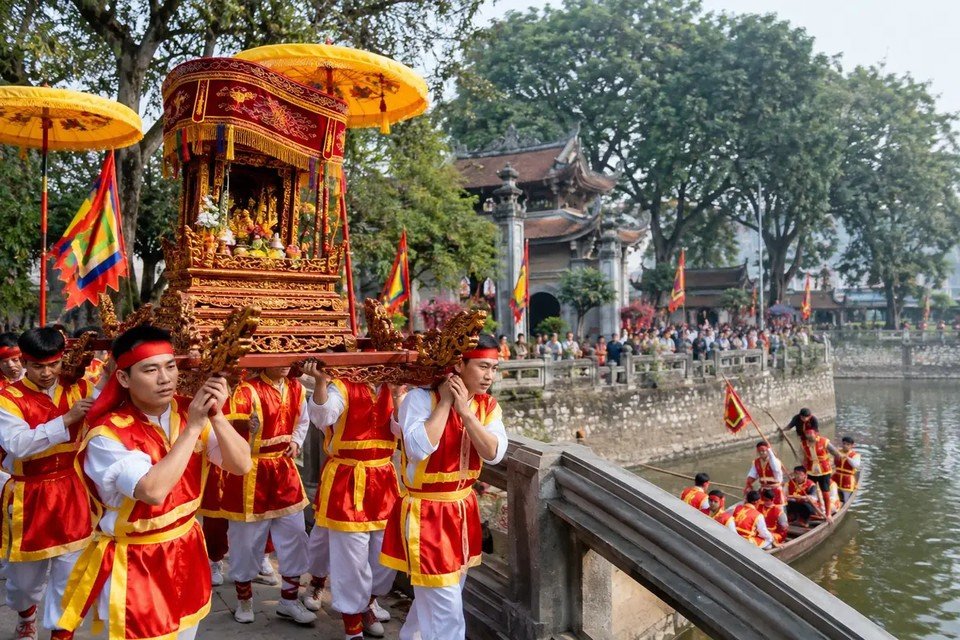
| 7th | In the morning the Saint’s palanquin is carried from the pagoda out to the main road, round a loop and back; incense and rites; in the evening the Dan luc cung ritual | Lang ward portal (23 April 2026): on the morning of 23 April, the 7th, the drum opened the festival, and from early morning residents and visitors streamed into the relic |
| 8th | In the morning delegations perform rites; in the afternoon folk games such as a rice-cooking contest, pot-breaking, cockfighting, poetry and Chinese chess; in the evening the closing rite | Vietnam Pictorial: 24 April closed the festival with a thanksgiving ceremony, religious activities and folk games |
The pages do not match exactly. Hanoi Hoc puts the festival on the 7th of the third month, Tu Dao Hanh’s birthday, with a procession from Lang Pagoda to Hoa Lang pagoda (Dich Vong commune), where it says his father is worshipped. The heritage page instead describes the old grand festival carrying the Saint up to Nen pagoda and down to Tam Huyen pagoda to visit his father, including a stretch where the palanquin bearers waded across the To Lich river and passed Due Tu pagoda before reaching Hoa Lang pagoda, and it names Tam Huyen pagoda as the place where the Saint’s father, Tu Vinh, is worshipped. Hanoimoi’s 2026 article on Nen pagoda has photos of delegations bringing offerings to the places of worship of the Saint’s father, Tu Vinh, and mother, Tang Thi Loan.
On the number of days, Vietnam Pictorial gives the 2026 festival as 22 to 24 April, while the opening at Nen pagoda was already on 21 April. The heritage page adds that people may view the Saint from outside only after the Giai y phuc and Khai quang (consecration) ceremonies, and that the thanksgiving ceremony is not held until the 15th of the third month; Vietnam Pictorial puts thanksgiving rites on 24 April (the 8th), and neither page says whether these are the same ceremony. The schedule in the table comes from pages read on 27 October 2026; festival schedules can change, so confirm with the relic management board or Lang ward People’s Committee before you go (our general suggestion).
The couplet above pairs the Lang festival with the Thay festival; for that pagoda, see our guide to Thay Pagoda by motorbike.
Choosing a day and time to avoid the crowds
For a calm visit, start by avoiding the festival days themselves. All three 2026 news pages describe crowds: Vietnam Pictorial says the festival drew large numbers of residents and visitors, the ward portal describes people streaming to the relic from early morning on the 7th, and Hanoimoi describes large numbers at the opening at Nen pagoda on the 5th.
- Find the dates for your year: check the lunar calendar to see which solar dates the four festival days fall on. For 2026, according to the pages, the 5th of the third lunar month was 21 April and the 7th was 23 April; do not reuse these dates for another year.
- If you want to see the procession: the heritage page describes the palanquin being carried out to the main road on the morning of the 7th. Expect crowds, park a little further away and walk in (our general suggestion).
- Outside the festival, avoid the morning rush hour: Bao Van Hoa (19 January 2026, citing VOV Traffic) reports that on Chua Lang street, on the stretch from Nguyen Chi Thanh past the Foreign Trade University area, 45-seat coaches stopped and parked along both sides, and traffic heading towards Huynh Thuc Khang backed up for long periods in the morning rush hour.
- On Lang road: Hanoimoi (5 February 2026) cites the Hanoi Department of Construction: at peak hours the Nga Tu So – Cau Giay section carries 1,800–3,100 vehicles an hour, 1.2–1.6 times its design capacity. The junctions named are Nga Tu So, Lang – Yen Lang, Lang – Lang Ha and Lang – Nguyen Chi Thanh.
Neither article gives clock times for the rush hour. Before you set off, open a map with a traffic layer to see which stretches are slow (our general suggestion); see our guide to checking a navigation app for riding in Hanoi.
Visits on the first and fifteenth days of lunar months are covered in our guide to lunar day-one and full-moon temple visits; none of the seven pages here mentions those days at Lang Pagoda.
On the address, the heritage page gives Lang Thuong ward, Dong Da district, while the 2026 ward portal places the pagoda on Chua Lang street (Lang ward). As the two differ, type the pagoda’s name together with the street name when you look up the route, so the map does not send you to the wrong place (our general suggestion). If you want to visit another relic the same day, see our page on the Temple of Literature.
What not to do
- Do not stop in the road to watch or photograph the procession. According to the heritage page, on the morning of the 7th the Saint’s palanquin is carried out to the main road before returning to the octagonal house; park first, then walk out to watch (our general suggestion).
- Do not park on the carriageway of Chua Lang street (our general suggestion). Bao Van Hoa reports that coaches stopping and parking for long periods narrowed the road, and that the authorities advised following the rules on stopping and parking.
- Do not try to enter the sanctum during the Giai y phuc ceremony on the night of the 6th; according to the heritage page, only a few people are allowed to be present.
- If you plan to bring anything with a tiger image into the pagoda, ask the keeper first: the heritage page records only the Lang villagers’ tiger taboo and says nothing about visitors (our general suggestion).
- Do not hold your phone to check directions or take calls while moving in heavy traffic; if you need to look, pull over where it is allowed and switch off the engine first (our general suggestion).
- Do not leave the bike somewhere nobody watches it or issues tickets just to be close to the gate (our general suggestion); see our Hanoi motorbike parking checklist.
If you meet the procession or the street is jammed
- You meet the procession on the road: slow down gradually, keep to the right-hand edge and follow the people directing on the spot; do not squeeze between the palanquins, flags and drums (our general suggestion).
- Chua Lang street is jammed by parked vehicles: keep your lane, edge forward behind the vehicle in front and do not make sudden U-turns (our general suggestion). Bao Van Hoa cites advice to choose an alternative route when passing the Chua Lang – Huynh Thuc Khang area.
- You cannot find attended parking near the pagoda: accept parking further away and walking, or move the visit to another time (our general suggestion).
- You arrive on a festival day and it is too crowded: come back on a day outside the festival (our general suggestion).
- You want the gate hours or next year’s festival schedule: the ward article mentions the Lang ward relic management board; ask the keeper at the pagoda or the Lang ward People’s Committee (our general suggestion).
What the sources do not say
- No page gives gate opening hours, closing days or ticket prices.
- All seven pages are silent on motorbike parking near the pagoda and its cost.
- No page links Lang Pagoda with praying for luck before exams, and none says it gets busy in exam season.
- Neither traffic article gives specific rush-hour times for Lang road or Chua Lang street.
- No page gives the solar dates of the festival for years after 2026.
- There are no figures for routes, distances or riding times to the pagoda from elsewhere.
- No page gives dress rules for the pagoda; for what general pages say, see our guide to what to wear to a temple or pagoda in Hanoi.
- None of the seven pages is written for people on rental bikes, and the points in this guide have not been checked on the spot.
Sources checked
All read on 27 October 2026; the dates below are the pages’ own dates.
- Department of Cultural Heritage, the Lang Pagoda festival, from the department’s records (undated): dsvh.gov.vn
- Lang ward portal, the opening of the 2026 Lang Pagoda festival (23 April 2026): lang.hanoi.gov.vn
- Vietnam Pictorial (Vietnam News Agency), the Lang Pagoda festival (22 April 2026): vietnam.vnanet.vn
- Hanoimoi, the opening of the Nen Pagoda festival (21 April 2026): hanoimoi.vn
- Hanoi Hoc, Dr Le Thi Cuc on the Ly-dynasty legacy at Lang Pagoda (undated): hanoihoc.vn
- Hanoimoi, 13 congested routes including Lang road (5 February 2026): hanoimoi.vn
- Bao Van Hoa, morning traffic on Chua Lang street (19 January 2026): baovanhoa.vn
Riding to Lang Pagoda on a rental bike
Lang Pagoda is in the west of the inner city, so from the shop in Long Bien you cross Chuong Duong bridge and ride through the centre; a day’s rental leaves time to combine it with other stops (our general suggestion). For the area, see Dong Da motorbike rental.
Message to send the shop
Hello Nguyen Ha, I would like to visit Lang Pagoda on [date], outside the festival days, and ride back before the evening rush hour. Could I collect the bike at [time] and return it by [time]?
Frequently asked questions
When is the Lang Pagoda festival?
From the 5th to the 8th of the third lunar month, according to the Department of Cultural Heritage; in 2026 that was 21 to 24 April, counting the opening at Nen pagoda. Check the lunar calendar for other years.
Who is worshipped at Lang Pagoda?
The heritage page says the pagoda worships the Buddha and the Saint and is linked to the Zen master Tu Dao Hanh and King Ly Than Tong.
What are the opening hours and ticket prices of Lang Pagoda?
None of the seven pages gives them; ask the keeper at the pagoda or the Lang ward People’s Committee.
Nguyen Ha Motorbike Rental: Ngõ 5 Nguyễn Văn Cừ, Bồ Đề, Long Biên, Hanoi, Vietnam, open 09:00–21:00 daily. Call +84 334 699 969 to arrange a day’s rental for a visit to Lang Pagoda.