
Day Trips from Hanoi
Van Phuc Silk Village by Motorbike: A Half-Day Shopping Route
About 14 minutes to read
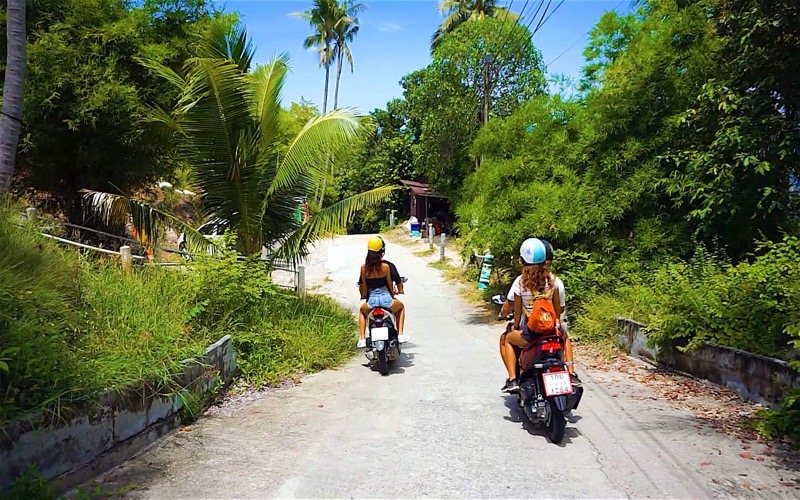
Van Phuc, the thousand-year-old silk village on the Nhue River, is the shortest worthwhile craft-village run you can make from central Hanoi — barely 10 km from the Old Quarter, half an hour by motorbike, free to enter, and packed wall to wall with silk. Where trips like Bat Trang or the incense village eat a whole morning, Van Phuc fits neatly into a half day, which is exactly how it should be done: ride out, walk one long street of shops, learn to spot the real thing, buy what you came for, and be back in the city before the traffic turns ugly. For more craft-village and countryside routes, browse our motorbike day trips from Hanoi guide.
The catch — and it is the reason this guide spends real time on shopping rather than just directions — is that not everything sold in the village is village silk. Imported and blended fabrics sit on the same racks as genuine mulberry silk, and the difference in price is real. So below you will find the ride, a walking route through the village that makes sense, honest price ranges, and the handful of checks that separate authentic Van Phuc silk from everything else.
Why Van Phuc Works as a Half-Day Trip
Van Phuc sits in Ha Dong, on the southwestern edge of the city, beside a quiet stretch of the Nhue River. Silk has been woven here for centuries — the craft is old enough that local tradition credits a village goddess with teaching sericulture, and the weaving tradition has been listed as national intangible cultural heritage. In the 1930s, Van Phuc silk was exhibited at fairs in Marseille and Paris, where the French rated it among the finest woven fabrics in Indochina. That pedigree still shows in the village’s signature weaves, especially Van silk — a lustrous, cloud-patterned fabric that was once reserved for the well-off and remains the connoisseur’s buy here.
Practically, the village is compact. One main street, well under a kilometre long, lined on both sides with silk shops — over a hundred of them by most counts — plus a silk market area, a communal house courtyard with a large mural wall, an old pagoda, and a short stretch of colourful hanging umbrellas that has become the village’s photo spot. You can walk the whole thing at a lazy pace in two hours, or spend half a day if you are getting something tailored or photographing everything. It is open daily, entry is free, and the only fixed costs are your parking and whatever you buy.
Quick Facts for Your Trip
| Item | Details |
|---|---|
| Location | Van Phuc, Ha Dong, southwest of central Hanoi, on the Nhue River |
| Distance from the centre | About 10 km from the Old Quarter |
| Ride time | Roughly 30–50 minutes by motorbike, depending on traffic |
| Entrance fee | None — the village is free to enter |
| Parking | Attended lot just past the village gate; around 5,000–10,000 VND for a motorbike |
| Time needed | 2–3 hours; half a day if you are having clothes tailored |
| Best time | Weekday mornings for shopping; weekends for atmosphere; the annual culture week in late autumn for the full spectacle |
The Ride: Getting There by Motorbike
The Route
There are two standard ways out of the centre, both simple. The classic one follows Nguyen Trai street south-west out of the city toward Ha Dong — you ride to the Ha Dong post office area, then turn onto Van Phuc street, where the village gate makes the destination obvious. The alternative leaves the centre via Le Van Luong and To Huu, which feeds into the same Ha Dong area; on a weekend it can feel marginally less choked. Either way, the moment you leave the Nguyen Trai traffic behind and turn into the village lane, the noise drops and the shops begin.
Set a navigation pin for the village by name before you leave — the last few turns are easy but badly signposted, and phones mounted on the handlebar save you stopping in traffic. Riding time from the Old Quarter is about 30 minutes with clear roads; treat anything up to 50 minutes as normal on a weekday afternoon, because Nguyen Trai carries some of Hanoi’s heaviest commuter flows. Before joining the commuter flow, review our Hanoi riding safety guide.
Where to Park
Do not try to park on the shopping street itself — it is narrow and busy with shoppers and shop owners’ bikes. There is an attended parking lot a short distance past the village gate, charging a few thousand dong for a motorbike. Park there, take your valuables, and do the village on foot; that is how the locals do it, and the walk is the whole point. If the first lot is full on a weekend, attendants will wave you toward the overflow spots nearby — follow their instructions, they know what they are doing.
When to Go
Shops open early and stay open until early evening, virtually every day. The differences are about crowd and light rather than access:
- Weekday mornings are best for actual shopping: shopkeepers have time, you can ask questions, and you can see the looms working without an audience.
- Weekends are livelier — more shops fully open, more photography spots set up, and more day-trippers. Expect to share the umbrella road.
- The village culture week, held in late autumn each year, is the showpiece: extra decorations, the umbrella road lit in the evenings, craft demonstrations and a festive atmosphere that some visitors compare to a miniature Hoi An. If your dates line up, go in the late afternoon and stay into dusk.
- Rain matters less here than at incense or pottery villages — the shops are indoors — but the village is prettiest dry, and the return ride on wet streets in commuter traffic is the part worth avoiding.
The Half-Day Route Through the Village
This is the walking order that works — it front-loads the sightseeing so your shopping decisions come after you have learned something about the craft:
- Start at the village gate and walk up Van Phuc street. Before you reach the shops, you will pass the famous stretch of hanging umbrellas — a hundred metres of colour overhead that photographs beautifully in morning light.
- Pause at the mural wall and the communal house courtyard, roughly the centre of the village. The large mural depicts the village’s weaving past, and the courtyard is one of the few quiet, shaded places to stand still and take it in.
- Find a working loom before you buy anything. Some households in the village keep traditional wooden looms running and let visitors watch — and a few producers have built small workshops right beside their shopfronts so you can see dyeing and weaving and then buy from the same family. Seeing what real hand-woven silk looks and feels like is the best inoculation against the imported fabric you will meet later on the racks.
- Walk the main street and the silk market end to end once without buying. Compare colours, prices and shopkeeper attitudes; the same scarf can vary noticeably in price from shop to shop, and the sellers who explain their fabric patiently are usually the ones worth returning to.
- Circle back and buy. Now that you know the spread of prices and you have handled the real thing, go back to the two or three shops that felt right. If you are having something made, this is the moment to choose fabric and discuss it.
- End at the old pagoda near the village if you have time — a quiet architectural monument that rounds the visit off before the ride home.
What to Buy and What It Costs
The Village’s Signature Silks
Van Phuc’s reputation rests on Van silk, the cloud-patterned weave that made the village’s name: glossy, fine, and traditionally the fabric of choice for an elegant ao dai. Alongside it, shops sell satin silks — soft, cool and popular for dresses, though quicker to fade and crease — and a range of other weaves from crisp tussore to mixed blends. Patterns on genuine Van Phuc weaving tend to be restrained and symmetrical, often woven so the fabric can be used on both sides.
Honest Price Ranges
Use these as a rough guide only — prices vary by shop, season and quality — but the gaps between them are meaningful:
| Product | Rough price range | What it tells you |
|---|---|---|
| Budget ready-made scarves and small items | A few tens of thousands of dong | Almost certainly blended or synthetic; fine as a cheap souvenir, not as silk |
| Blended-silk scarves and garments | Roughly 100,000–200,000 VND | Real silk mixed with other fibres; looks good, wears well, but not pure mulberry silk |
| Genuine mulberry silk fabric | Roughly 300,000–500,000 VND per metre | The authentic article; this is roughly what real tussore costs because raw mulberry silk is expensive |
| Van silk (the signature weave) | Around 460,000 VND per metre as quoted in recent years | The connoisseur’s buy; if a shop quotes far less for “Van silk”, ask questions |
| Custom-made silk clothing (ao dai, dresses) | Commonly from around 500,000 VND upward, fabric depending | Made to measure from your chosen fabric; allow extra time for fitting and finishing |
The single most useful thing to remember from that table: real silk has a floor price. Mulberry yarn costs the weaver serious money before a metre of fabric exists, so a “pure silk” scarf for the price of lunch is not a bargain — it is a different product. Blended fabric is not a scam when sold honestly and can be a perfectly good buy; the problem is only when it is sold as pure silk.
How to Tell Real Van Phuc Silk From the Rest
It is an open secret, reported on by Vietnamese media for years, that a large share of what hangs on the racks here — like in silk districts everywhere in Vietnam — is imported or blended fabric rather than village-woven pure silk. That does not make the village a trap; it makes it a place where an informed buyer does very well. Here are the checks that matter:
1. The Touch and the Sheen
Real mulberry silk is smooth and fine but not slippery-slick; it feels cool against the skin and carries a soft, shifting lustre rather than a plastic shine. Synthetic “silk” is often glossier and harder to the touch. Experienced weavers describe real silk as warm-cool: it never feels cold like polyester.
2. Look at the Pattern, Both Sides
Genuine woven Van Phuc patterns are visible from both sides of the fabric, because the design is in the weave, not printed on top. Much of the imported fabric is printed or has a clear right side and a wrong side. This single check filters out a surprising amount of the stock.
3. Check the Width and the Selvedge
Traditional Van Phuc fabric runs around 90 centimetres wide, and weavers have long woven the words “Ha Dong” into the selvedge — the woven edge of the fabric — as a mark of origin. Wider bolts with plain edges are worth questioning. Not every genuine item carries these marks, but their presence is a strong signal.
4. The Burn Test (Ask, Don’t Do It Yourself)
The definitive test is fire: pure silk burns to a black, crumbly powder and smells like burnt hair, while synthetics melt into a hard bead. Sellers of genuine silk are used to this question and will happily burn a few threads from a hidden corner of the fabric to prove it. A seller who refuses is answering you too.
5. Buy Where the Loom Is
The strongest shortcut of all: buy from the workshop-houses where you can see weaving happening, or from established, labelled producers rather than anonymous racks. You will pay the real price — and get the real thing.
Shopping Etiquette and Bargaining
Bargaining is normal in Van Phuc, but it is gentle — this is a village of craftspeople, not a night market. A few principles serve you well:
- Compare before you negotiate: walk the street once, note prices, then return to buy. Negotiating from an informed position is both more effective and more respectful.
- Bundle to bargain: shopkeepers are far more flexible if you are buying several items or several metres of fabric than over a single scarf.
- Negotiate with a smile or not at all. Sellers here are patient with browsers, and the ones who explain their fabric honestly deserve the asking price.
- Bring cash in small notes. Most shops are small family businesses; large denominations and card expectations both cause friction.
- Ask before photographing inside workshops — looms, dyers and artisans are working, not performing.
- If you are buying significant fabric for tailoring, ask for a receipt or at least keep the shop’s name; good shops stand behind their product.
Timing Your Half Day
The morning version of this trip is better than the afternoon one, for one blunt reason: the ride home. Nguyen Trai street is a commuter artery, and the afternoon version of this trip has you riding back into the city right at the start of evening rush hour.
| Morning plan (recommended) | Afternoon plan (if you must) |
|---|---|
| 08:00 — Leave the centre with a full tank | 13:30 — Leave the centre after lunch |
| 08:40 — Park at the lot by the village gate | 14:15 — Park and start the walk |
| 09:00 — Umbrella road, mural, looms | 14:30 — Sightseeing and workshop visit |
| 10:00 — Walk the street, compare, then buy | 15:30 — Shopping and comparing |
| 11:15 — Tailoring discussion, if any | 16:30 — Finish purchases |
| 11:45 — Ride back | 17:00 — Ride back, ahead of the worst of the peak |
| 12:15 — Back in the centre for lunch | 17:45 — Back in the centre, just before the peak thickens |
If tailoring is the main purpose of your trip, budget more time and expect the fitting conversation to be the longest part of the visit. Some visitors buying fabric here have it tailored in the village; others take their Van Phuc fabric to a trusted tailor in the city — both are normal, and the shops are used to the question. Food in the village itself is limited to simple stalls and snacks, so plan lunch in Ha Dong or back in the centre rather than counting on the village.
Combining Van Phuc With Other Stops
Because the ride is so short, Van Phuc slots into larger days without much strain. The natural pairings:
- Van Phuc plus the Old Quarter’s silk street: the classic shopping double. Buy where the weaving happens in the morning, then compare prices on Hang Gai street in the afternoon — the comparison is educational, and the difference in price for similar-looking items is the best argument for buying at the source.
- Van Phuc plus Quang Phu Cau incense village: for photographers, a colour-soaked double header — silk in the morning, the red incense fields 20-odd kilometres further south in the late morning light, all on the same southwestern corridor.
- Van Phuc plus Thay Pagoda and Tay Phuong Pagoda: a fuller day that trades shopping time for heritage — the pagodas sit a further 20 km west, so treat this as a full-day option rather than a half-day add-on.
FAQ: Van Phuc Silk Village by Motorbike
How far is Van Phuc from central Hanoi, and how long is the ride?
It is about 10 km southwest of the centre, on the Nhue River in Ha Dong. By motorbike, count on 30 minutes with light traffic and up to 50 minutes when Nguyen Trai street is busy. The route is simply Nguyen Trai — or Le Van Luong and To Huu — toward Ha Dong, then onto Van Phuc street.
Is there an entrance fee for the silk village?
No, entry is free — Van Phuc is a living village, not a gated attraction. Your only fixed costs are parking at the attended lot by the gate (a few thousand dong for a motorbike) and whatever you buy.
Is everything sold in Van Phuc real silk?
No, and it is better to know that in advance. The racks hold everything from pure village-woven mulberry silk to imported and blended fabrics. Learn the checks — both-sides woven patterns, the roughly 90 cm width with “Ha Dong” on the selvedge, the burn test on request — and buy from workshop-houses where you can see the looms.
How much should I expect to pay for real silk?
As a rough guide, genuine mulberry silk fabric runs around 300,000–500,000 VND per metre, with the signature Van silk quoted in recent years at around 460,000 VND per metre. Blended-silk scarves sit around 100,000–200,000 VND, and pure silk clothing made to measure starts around 500,000 VND. If a “pure silk” price looks too good to be true, it is.
Can I have an ao dai or dress made during my visit?
Yes — several shops offer made-to-measure clothing from your chosen fabric, and choosing the fabric is the part Van Phuc is uniquely good at. Do not assume same-day finishing; ask the individual shop about their turnaround and whether fittings are needed, and leave more time than a pure shopping visit requires.
When is the best time to visit the village?
Weekday mornings for unhurried shopping; weekends for a livelier atmosphere; and the village’s culture week in late autumn if you want the full spectacle, with the umbrella road decorated and lit in the evenings. Avoid riding home along Nguyen Trai at the start of evening rush hour.
Is bargaining acceptable in Van Phuc?
Yes, modestly. Sellers here are used to negotiation, especially when you buy several items or several metres of fabric. Walk the street and compare first, then return to the shops you liked — bargaining from an informed position gets better results and costs less goodwill.
Where do I park, and can I do the village by car instead?
Motorbikes park at the attended lot just past the village gate for a few thousand dong. Cars are also possible — parking costs more — but a motorbike is the better tool here: the approach streets are narrow, the parking is simpler, and the half-day flexibility is exactly what the village suits.