Manual & Semi-Automatic Motorbikes
Semi-Automatic vs Manual Clutch Motorbike: A Plain Explanation for Riders Who Have Never Used a Clutch

About 5 minutes to read
If you have only ridden automatic scooters, or never squeezed a clutch lever, the semi-automatic vs manual clutch question can look like a choice between two different worlds. When you rent a bike, the difference can decide whether a day of riding feels relaxed or tense. This article explains it for riders who have never used a clutch: where the two types differ, what each asks of your hands and feet, and which signs point to one or the other. It covers general principles, not the specifications of any particular model.
Two types of bike, one kind of gearbox
Both types have a gearbox with several gears, and on both the rider selects a gear with a lever under the left foot. The difference lies in the link between the engine and the gearbox:
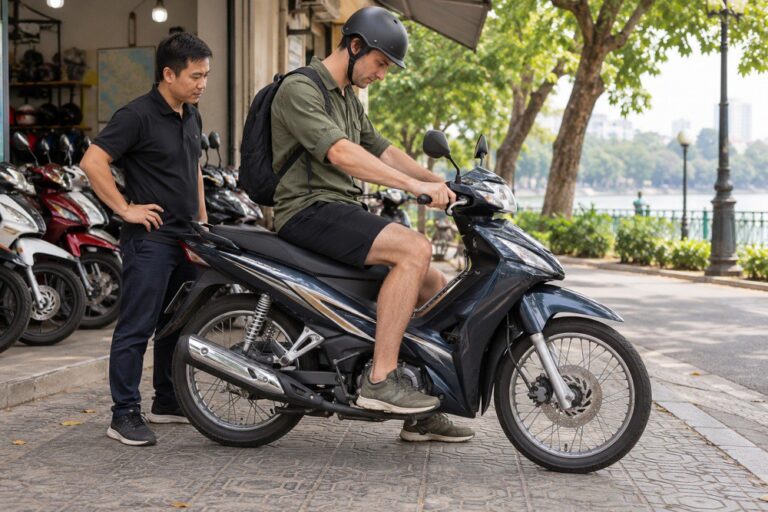
- Semi-automatic (no clutch lever). The clutch works by itself according to engine speed. You never pull a lever: when the engine idles, the clutch disengages and the bike stays still even in gear. You only press the gear lever with your foot when you want to change gear.
- Manual clutch. You control the clutch with your left hand: pull the lever to cut the drive, release it to reconnect. To move off, change gear or stop, you coordinate the clutch hand, the gear foot and the throttle.
A manual clutch therefore gives you more control, but it asks for more actions and stalls more easily while you are still getting used to it.
The two types compared task by task
| Task | Semi-automatic (no clutch lever) | Manual clutch |
|---|---|---|
| Moving off | Select first gear, open the throttle gently, the bike moves | Pull the clutch, select first gear, open the throttle gently, release the clutch slowly |
| Changing gear while riding | Ease off the throttle, press the gear lever | Ease off the throttle, pull the clutch, press the gear lever, release the clutch, open the throttle |
| Stopping at a red light | Hold the brake; the clutch disengages by itself at idle | Pull the clutch while still in gear, or shift to neutral; hold the brake |
| Stalling from a badly released clutch | Rare, since there is no clutch lever | Possible if the clutch is released too fast |
| Left-hand fatigue | Little | Possible in long traffic jams |
If you have never used a clutch, where to start
Only practise on a moving bike when you meet the legal requirements for that vehicle, in a place where it is allowed and away from traffic. A rider who is not yet proficient needs a suitable instructor, and a few smooth attempts do not prove you are ready for city streets. If the bike shows signs of a fault, stop and tell the shop instead of practising around the fault.
- Get used to the gear lever first. If you can, start on a semi-automatic, so your foot learns to shift before your hand also has to manage a clutch.
- Learn where the gears are. The bike you receive may place neutral differently; ask the shop, and check the neutral light on the dashboard if there is one. Reading a semi-automatic shift pattern shows how to find neutral and first gear at a standstill.
- Practise moving off somewhere quiet. For example, repeat it until you can release the clutch smoothly without stalling, and do this before riding into the street. A car-park drill before your first semi-automatic ride sets out a sequence for controls, gears and stopping.
- Do not choose a manual clutch bike just for its looks. If you feel nervous, ask the shop which type will be easier to get used to.
The readiness check for clutch underbones helps you assess yourself before you decide.
Mistakes beginners can make when moving over from a scooter
- Releasing the clutch too fast, so the bike stalls or jerks forward.
- Forgetting to select a gear before opening the throttle, so the engine revs but the bike does not move.
- Opening the throttle a lot while releasing the clutch, so the bike shoots forward unexpectedly.
- Looking down at your foot to find the gear lever instead of watching the road.
- Stopping without pulling the clutch, so the engine stalls right at the red light.
These mistakes can fade with repeated practice in a quiet place. What matters is practising somewhere empty rather than in heavy traffic.
When a semi-automatic or manual clutch bike suits you better than a scooter
- You already ride a semi-automatic and want to keep the feel you know.
- The trip has many slopes or rough roads, where you want to control pulling power through the gears.
On the other hand, if you will mostly ride in busy city traffic with many stops, an automatic scooter may be easier. For riders used to gears who are weighing up a scooter, a geared motorcyclist on an automatic scooter looks at that switch from the rider’s side.
Ask the shop about the bike you will collect
- Does this bike have a clutch lever?
- Where is neutral, and is there a neutral light on the dashboard?
- Where can you practise moving off before reaching a main road?
Not sure which type to rent? Ask Motorbike Nguyen Ha: call +84 334 699 969, or message on Zalo or WhatsApp, 09:00–21:00 every day. The shop is at Alley 5 Nguyen Van Cu, Bo De, Long Bien, near Gia Lam Bus Station (open the shop location in Google Maps). To compare with automatics, see Hanoi scooter rental; daily rates for the semi-automatic Honda Wave and the scooters are on Hanoi motorbike rental prices.