Fuel & Running Costs
Does a Passenger and Luggage Make a Rental Motorbike Use More Fuel? How to Budget for Two
About 7 minutes to read
Short answer: yes, a passenger and luggage usually make a motorbike use more fuel, because the engine has to work harder every time it accelerates or climbs. How much more depends on the bike, the road and how you ride, so there is no single percentage you can apply to every trip. The practical approach is to start from what the bike uses with one rider, add a sensible reserve for the extra load and any hills, refuel earlier than you would alone, and record the real figures so your next estimate is better.
This guide explains why weight affects fuel, gives a simple way to budget a two-person trip, works through an example with clearly assumed numbers, and covers how to carry a passenger and bags without making the bike harder to control.
Why extra weight uses more fuel
| Situation | What happens with more weight |
|---|---|
| Pulling away from a stop | A heavier bike needs more effort to reach the same speed |
| Climbing a slope or bridge ramp | The engine has to lift the extra weight as well, so it works harder |
| Stop-start city traffic | Every acceleration costs a little more, and in Hanoi there are many of them |
| Steady riding on a flat road | The effect of the load is usually smaller than in stop-start traffic |
| Tyres | A heavy load on under-inflated tyres makes the bike feel sluggish and can raise consumption |
The table shows general tendencies only. Each model and each route gives a different result, which is why this guide does not quote a fixed percentage. Manufacturer fuel-economy figures are also measured under test conditions; our article on manufacturer fuel economy figures versus stop-start traffic explains why real riding in Hanoi usually differs from the brochure.
How to budget fuel for a two-person trip
- Start from the solo figure. If you have measured how much the bike uses with just you on it, use that. If not, use a reference figure only as a starting point.
- Add a reserve for the load. Add a margin on top of the solo figure for the passenger and luggage. Treat it as a buffer for planning, not as the bike’s real consumption.
- Add more for hills and unfamiliar roads. Long climbs, mountain passes and headwinds all use more fuel than flat city streets.
- Refuel earlier. With two people and bags, do not wait until the gauge is nearly empty, especially before a stretch with few petrol stations.
- Compare after the trip. Note the distance and the litres you put in, so you have a real figure for next time.
A worked example with assumed numbers
The numbers below are assumptions chosen only to show the arithmetic. They are not the consumption of any particular bike.
- Assume the bike uses 0.8 litres to cover 40 km with one rider.
- For two people and luggage, add a reserve of one fifth: 0.8 × 1.2 = 0.96 litres for the same 40 km.
- For a 150 km trip: 0.96 ÷ 40 × 150 = 3.6 litres.
- Compare 3.6 litres with the bike’s tank capacity to decide how many times to refuel and where.
Replace the assumed numbers with your own bike and route. If the trip includes long climbs, add a larger reserve rather than a smaller one.
Measure your own consumption
The most reliable figure is the one you measure. Fill the tank, note the odometer, ride as normal, then fill the tank again at the same kind of pump and note how many litres it took and how far you went. Litres divided by kilometres gives your real consumption for that kind of riding. Do it once riding alone and once with a passenger, and you will see the difference for your bike and your routes. Our guide on tracking fuel use on a monthly rental shows a simple way to keep the record.
Carry a passenger and luggage safely
- Keep heavy items low and close to the bike. Weight carried high or far from the centre makes the bike harder to steer and balance.
- Do not hang heavy bags from the handlebars. A swinging bag makes the steering heavy and can pull it to one side.
- Secure luggage firmly so it cannot shift when you brake or turn.
- Brief your passenger: sit still, hold on firmly, keep both feet on the footrests and lean with the bike rather than against it.
- Leave more space ahead. A loaded bike needs a longer distance to stop, especially in rain.
- Keep lights and the number plate visible and do not let luggage stick out from the sides of the bike.
- Check the tyres. Ask the shop what pressure suits carrying a passenger; if a tyre looks soft, report it rather than inflating it by guesswork.
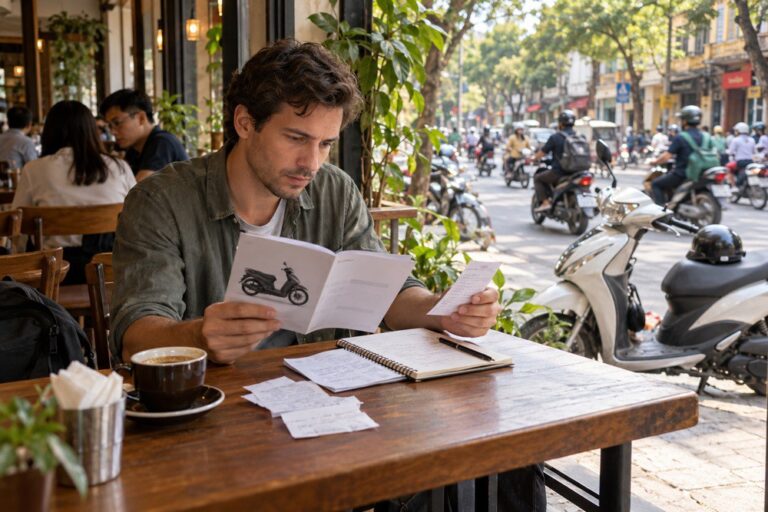
Also check what the bike is designed to carry. Seating, maximum load and where luggage may go are set out in the owner’s manual; our guide to two people on one Hanoi rental bike covers load limits and the decisions to make before riding two-up.
Change how you ride when the bike is loaded
- Open the throttle smoothly and progressively; avoid sudden bursts.
- Slow down early and brake gently rather than braking hard at the last moment.
- Take corners more slowly than you would alone.
- On descents, keep a moderate speed and use both brakes rather than letting the bike run.
Smooth riding helps fuel consumption as well as safety: hard acceleration with a heavy load is where most of the extra fuel goes.
A short practice ride in a quiet place is not proof that you are ready to carry a passenger in city traffic. The rider must meet the legal requirements, know the bike well and be comfortable with the extra weight. If you are not, a passenger transport service is the better choice for that journey.
One bike or two?
For a couple or two friends, the choice between sharing one bike and renting two affects cost, comfort, parking and how tiring the day is for the rider. Two bikes use more fuel in total but carry less weight each; one bike saves rental and parking but works harder. Our guide on renting as a couple: one motorbike or two compares the options.
Questions to ask the rental shop
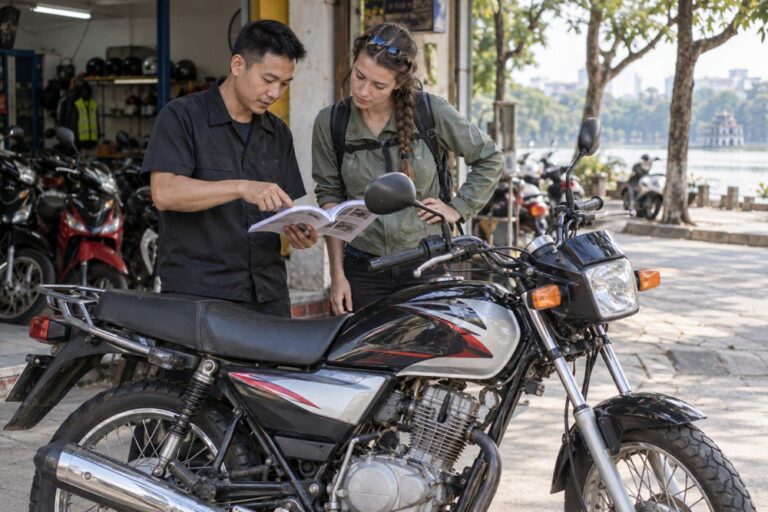
- How much load can this bike carry with two people and luggage, and where should bags go?
- What tyre pressure do you recommend when carrying a passenger?
- How is fuel handled at pickup and return? See agreeing the return fuel level at pickup.
- Is there a model better suited to riding two-up with bags?
Plan fuel stops outside the city
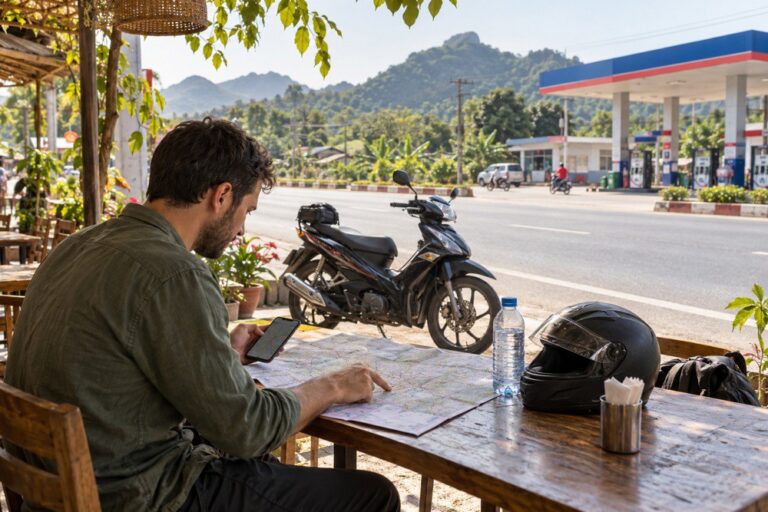
Inside Hanoi you are rarely far from a petrol station, but on day trips the gaps can be longer, and a loaded bike reaches the bottom of the tank sooner than you expect. Before you leave, look at the route on a map and note where the stations are, especially before hill sections. Refuel when the tank still has a comfortable reserve rather than waiting for the warning light. If you are riding with a second bike, agree to refuel together so one rider is not left waiting with an empty tank.
Keep the receipts or note each fill-up with the odometer reading. After two or three stops you will have a real figure for your bike with two people and luggage, which is far more useful than any estimate in a guide.
Frequently asked questions
How much more fuel does a passenger use?
There is no fixed figure. It depends on the bike, the combined weight, the route and your riding. Budget a reserve on top of your solo figure and measure the real result.
Does luggage matter as much as a passenger?
Any extra weight has an effect, and bulky luggage can also add wind resistance. Heavy bags carried high or off-centre also make the bike harder to handle.
Is it cheaper to share one bike than to rent two?
Often the rental and parking are lower with one bike, but the single bike works harder and may be less comfortable on long days. Compare the total cost and how the rider will cope.
Should I inflate the tyres more when carrying a passenger?
Follow the shop’s advice or the pressure in the owner’s manual for the load you are carrying. Do not guess.
Will riding smoothly really save fuel?
Yes. Gentle acceleration and early braking reduce the number of hard accelerations, which is where a heavy load costs the most.
How often should I refuel on a two-up day trip?
Earlier than you would alone. Plan stops so you are never relying on the last few kilometres of the tank, especially outside the city.
Ask the shop
Thuê xe máy Nguyễn Hà is at Ngõ 5 Nguyễn Văn Cừ, Bồ Đề, Long Biên, Hanoi (near Gia Lam bus station), open 09:00–21:00 daily. If you plan to ride two-up with luggage, call or message 0334 699 969 (Zalo/WhatsApp) to ask which bike suits the load.