
Day Trips from Hanoi
Tay Phuong Pagoda from Hanoi by Motorbike: Steps, Parking and Return Timing
About 15 minutes to read
Riding out to Tay Phuong Pagoda is one of the most satisfying half-day trips you can do from Hanoi on two wheels. The pagoda sits on a quiet, wooded hill roughly 30–40 km west of the city, the road out is mostly wide and fast, and the reward at the end — a cluster of ancient tile roofs above the treetops and the most celebrated set of wooden Arhat statues in Vietnam — is well worth the effort. For more destinations with different distances and road conditions, browse our motorbike day trips from Hanoi guide.
What catches most first-time riders out is not the distance. It is the details: motorbikes are not allowed on the main carriageway of Thang Long Boulevard, there are 239 laterite steps between the parking area and the pagoda gate, and there is a real art to timing the ride home so you do not land in the middle of Hanoi’s evening rush hour. This guide covers all of it, in the order you will actually experience it on the day.
Why Tay Phuong Pagoda Is Worth the Ride
Also known by its ancient name Sung Phuc Tu, or Tay Phuong Co Tu, the pagoda is considered one of the oldest Buddhist sites in northern Vietnam. Its origins are traced back many centuries — traditions point to well over a thousand years — but the complex you see today took its current form in 1794, during the Tay Son era, after an earlier major rebuild in the 17th century. That layered history is part of what you feel when you stand under the old gates: nothing here is new, and nothing here was built for tourists.
The pagoda’s fame rests on two things. First, its architecture: three halls arranged along the crest of a low hill, with steep, curving roofs and rounded windows that are rarely seen in other Vietnamese pagodas. Second, its statues. Inside the halls are more than sixty carved wooden figures, most of them from the 18th century, and the highlight is the set of 18 Arhat statues carved from jackfruit wood. Each Arhat has a completely different face and posture — some laugh, some grimace, some sit lost in thought — and they are widely regarded as masterpieces of Vietnamese religious sculpture. A number of the statues have been officially recognised as national treasures, and the pagoda complex itself is listed as a Special National Relic.
Compared with big-name day trips such as Huong Pagoda or Ninh Binh, Tay Phuong is refreshingly manageable. You can ride there, climb up, spend a full hour at the top and still be back in Hanoi for a late lunch. That simplicity is exactly why it works so well by motorbike.
Quick Facts for Your Trip
| Item | Details |
|---|---|
| Location | Thach Xa area, Thach That district, Hanoi — on a low hill above the countryside west of the city |
| Distance from central Hanoi | Roughly 30–40 km depending on your starting point |
| Riding time | About 1 to 1.5 hours each way, traffic permitting |
| The climb | 239 laterite (red sandstone) steps from the foot of the hill up to the pagoda gate |
| Entrance fee | 10,000 VND per visitor in Hanoi’s fee schedule effective from 1 January 2024; check the current ticket board and any concessions before paying |
| Parking | Motorbike and car parking at the foot of the hill, run by local attendants, for a small fee |
| Time needed at the top | About 1 hour for a relaxed visit; longer if you want to sit and enjoy the views |
| Best combined with | Thay Pagoda, a short 15–20 minute ride away — the two pair perfectly in one day |
The Route from Hanoi by Motorbike
The Main Route: Along Thang Long Boulevard
The fastest and easiest way out of the city is to head west on Tran Duy Hung street and continue onto the Thang Long Boulevard corridor, the wide expressway-style avenue that runs from Cau Giay toward Hoa Lac and Son Tay. You will pass familiar landmarks such as FPT University and, further out, the Culture and Tourism Village of Vietnamese Ethnic Groups. From the Big C area at the Tran Duy Hung end, it is roughly 15 km of riding before you reach the turnoff zone for the pagoda.
Here is the part that matters, and the single most important thing to know about this route: motorbikes are banned from the main elevated carriageway of Thang Long Boulevard. Do not ride up onto the expressway lanes. Instead, use the frontage road — the service road that runs parallel alongside the boulevard, which locals simply call the “gom” road. It carries motorbikes, local traffic and buses, and it will take you the entire way west. Riding the main lanes by motorbike is both dangerous and against the rules, and you do not want your day trip to end in a fine.
The Last Few Kilometres
As you approach the far end of the corridor, watch for the big interchange where the boulevard meets the Thach That and Quoc Oai direction. Leave the frontage road here and follow the signs toward Thach That. From there it is only around 5 km more: continue to the Thach Xa intersection, where you will see signboards pointing to Chùa Tây Phương. The moment you turn off, the landscape changes completely — the wide avenue disappears behind you and you are suddenly riding narrow lanes between rice paddies, laterite walls and orchards. Slow down, enjoy it, and expect the odd dog or chicken on the road.
An Alternative Route via National Road 32
If the boulevard corridor does not suit you — for example if you are coming from the southwest of the city — you can ride out on National Road 32 toward Son Tay and turn off toward the Thach That area. This road is older, busier with trucks in places and slower, but it is a perfectly workable option and lets you pass through real market towns rather than alongside an expressway. Whichever route you choose, load the destination into a maps app before you leave and download the offline map for the area — mobile signal in the villages near the pagoda can be patchy.
What the Ride Is Actually Like
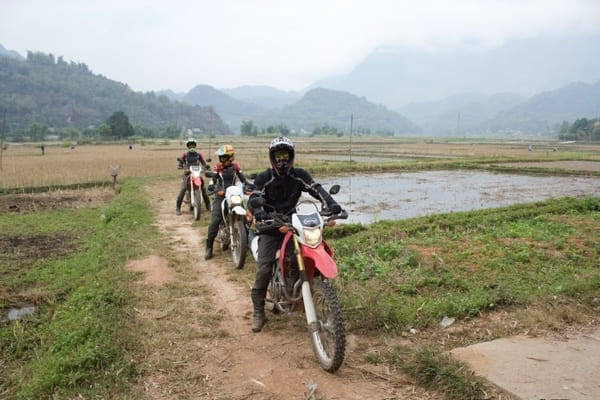
The outbound ride is one of the easiest half-day rides from Hanoi. The frontage road is in good condition, with a handful of intersections and roundabouts where you need to stay alert, and traffic thins out noticeably once you pass Hoa Lac. The final village stretch is narrow but scenic, with patches of rough surface and loose sand here and there, so keep your speed modest. Fill your tank before leaving the city — you will pass petrol stations along the way, but starting full means one less thing to think about. On a clear weekend morning, this ride is genuinely pleasant; on a rainy weekday in the wet season it is doable but demands more care. Before leaving the city, also review our Hanoi riding safety guide.
The Steps: What the Climb to the Pagoda Is Really Like
239 Steps of Old Laterite
Tay Phuong Pagoda was deliberately built on the hilltop, so the visit begins with the climb most people remember as much as the statues. From the foot of the hill, you walk up 239 steps made of red laterite — the same warm, porous stone you see all over this part of the old Doai region. The steps are worn smooth and slightly irregular in height, and many of them carry a layer of moss, which is beautiful to photograph and slippery underfoot when it is damp.
The stairway runs beneath old trees, so even on a warm day most of the climb is shaded. There are flat landings where you can catch your breath, and on a weekday you may have the whole staircase almost to yourself. The reward comes at the top: the old gate frames the first view of the pagoda roofs, and the city feels a very long way away.
How Long the Climb Takes
For a reasonably fit person, the climb takes about 10 minutes non-stop, or 15–20 minutes at a relaxed pace with photo stops. It is not an alpine hike, but it is a real staircase, and in the heat of a summer midday it will get your heart rate up. A few practical notes:
- Wear proper shoes. Slip-on sandals or flip-flops on mossy laterite is asking for a fall.
- If the steps are wet after rain, use the edges of the steps where the moss is thinner, and take the handrail-side of the stairway where you can.
- Older riders or anyone with knee trouble should go slow and use the landings — the descent is actually harder on the knees than the ascent.
- Carry water with you, especially from May to August, and consider mosquito repellent for the shaded stretches.
- In summer, time the climb for before 10:00 or after 15:30; midday on those exposed stones is no joke.
Parking at Tay Phuong Pagoda
Where to Leave Your Bike
Parking is straightforward, which is one of the quiet advantages of this trip over bigger pilgrimage sites. At the foot of the hill, right where the steps begin, there is a dedicated parking area for motorbikes and cars, run by local attendants who will wave you toward a spot. You park, take your helmet and bag, and start climbing — the walk from the parking area to the bottom of the steps is only a couple of minutes.
On ordinary weekdays the yard rarely fills up. On the first sunny weekends of the year, and especially during the pagoda’s festival in the third lunar month, it is a different story: the main yard can reach capacity and bikes start lining the approach road. Arrive early in the morning in that period, or be prepared to park a short walk away and ride back out later in a small stream of departing motorbikes.
Parking Costs and Practical Tips
There is no officially published price board that applies year-round, so treat parking as a small, informal fee — typically a few thousand to around ten thousand dong for a motorbike for the duration of your visit. It is a trivial amount, but it is another reason to carry small notes: handing over a 500,000 note for parking will slow everyone down, including you.
- Lock your bike and take the key, even though the area feels safe — it is a working pilgrimage site, not a guarded garage.
- Take your helmet with you or lock it to the bike; spare helmets left loose on seats have a way of walking off on busy days.
- Do not leave phones, cameras or bags under the seat. Carry a small daypack instead — you will want it for water on the steps anyway.
- Note roughly where you parked, or a landmark near it. In a full yard of identical motorbikes after an hour of climbing, yours will look exactly like two hundred others.
- Keep any parking ticket the attendant gives you, in case it is checked when you exit.
How Much Time You Need at the Top
Once through the gate, the complex unfolds along the hilltop in three descending sections: the lower hall, the middle hall and the upper hall. The layout means the visit is itself a gentle walk — you move from building to building through gates and courtyards rather than around one big structure.
Budget about one hour for a proper visit. The lower halls are atmospheric and quick to walk through, but the upper hall is where you should slow down: this is where the 18 Arhat statues are displayed, and it rewards real attention. Look at their hands, their collarbones, their expressions — one is emaciated from ascetic practice, one beams with joy, others sit grinning, frowning or dozing. Each was carved as a study of a different human temperament, and no two are alike. Alongside the Arhats you will find other celebrated pieces, including the famous statue of the Buddha during his years of austere practice, rib cage visible, lost in meditation.
It is a working religious site, so keep your voice low in the halls, dress modestly, and be considerate if a ceremony or group of worshippers is present. After the halls, give yourself ten minutes at the viewpoints near the gate: on a clear day you look out over a classic northern Vietnamese landscape of orchards, ponds and low hills, and it is the best spot for photos of the rooftops themselves.
Return Timing: When to Head Back to Hanoi
Return timing is where day trips succeed or fail, so here is the honest version. Two clocks are working against you in the afternoon: daylight and Hanoi traffic.
Two Realistic Schedules
| Half-day trip (pagoda only) | Full-day trip (with Thay Pagoda) |
|---|---|
| 08:00 — Leave central Hanoi | 08:00 — Leave central Hanoi |
| 09:15 — Park at the foot of the hill | 09:15 — Park at the foot of the hill |
| 09:30 — Climb the 239 steps | 09:30 — Climb the 239 steps |
| 10:00 — Explore the three halls | 10:00 — Explore the three halls |
| 11:15 — Descend and collect the bike | 11:15 — Descend and ride to Thay Pagoda |
| 11:30 — Ride back toward the city | 12:00 — Lunch in the area, then explore Thay Pagoda |
| 12:45 — Back in Hanoi for a late lunch | 15:30 — Start the ride back |
| — | 17:00 — Back in Hanoi, just ahead of the worst traffic |
The Rush-Hour Problem
If you leave the pagoda by 15:30, you will ride back on a fast, open frontage road and re-enter the city before the evening peak. Every hour after that costs you disproportionately: leave at 17:00 and you will arrive into the thick of Hanoi’s rush hour, when the last stretch back through Cau Giay and the inner districts turns into stop-and-go filtering between buses and cars. It is not dangerous for a confident rider, but it is tiring and slow, and in the wet season you may be doing it in the dark.
A good rule of thumb: be back on the boulevard corridor by 16:00 at the latest. If you do run late, a smarter move is to stop for an early dinner somewhere in the Thach That or Son Tay area and ride back after 19:30, when the city-bound traffic has thinned again. Forcing your way into the city at 18:00 on a Friday rarely ends well.
One more timing note: in the dry, sunny months the light on the return ride through the villages in mid-afternoon is beautiful, and the pagoda grounds are at their quietest between 14:00 and 16:00. If you hate crowds more than you hate heat, a later morning start — leaving the city at 10:00 and arriving as the tour groups leave — can be a great trade.
Combining Tay Phuong with Thay Pagoda
The classic move is to pair Tay Phuong with nearby Thay Pagoda, the great ancient complex at the foot of Sai Son mountain associated with the monk Tu Dao Hanh and the birthplace of Vietnamese water puppetry. It is only a 15–20 minute ride between the two, and they complement each other perfectly: Tay Phuong is compact and hilltop, Thay is sprawling and lakeside, with its famous roofed bridge over the water.
Do Thay Pagoda justice by giving it at least an hour and a half, and note that it has its own parking at a similar small fee (motorbike parking there has recently been around VND 10,000, with cars around VND 30,000). The sensible order is Thay first or Tay Phuong first depending on the season — in summer, climb Tay Phuong’s steps while it is still cool, then enjoy the shaded lakeside grounds of Thay afterward. Both sites are at their busiest during the spring festival season, when the Tay Phuong festival falls in the sixth to tenth days of the third lunar month.
What to Wear and Pack
Nothing exotic is needed, but a few choices make the day noticeably better:
- Clothing: modest and light — covered shoulders and knees are expected in the halls, and you will be climbing 239 steps, so nothing restrictive.
- Footwear: closed, grippy shoes. The laterite steps are mossy and polished; this is the one item not to compromise on.
- Water: at least a litre per person, more in summer. There is no shop at the top of the hill.
- Small notes: for the entrance fee, parking, and an incense offering or cold drink at the bottom.
- Rain gear: a light poncho under the seat saves the whole trip from April to October.
- Offline maps: the pagoda is signposted from the Thach Xa intersection, but the last stretch has several small forks.
- Sun protection: the climb is shaded, but the ride out is exposed; gloves, a mask and sunglasses make a real difference on the boulevard frontage road.
FAQ: Tay Phuong Pagoda by Motorbike
How far is Tay Phuong Pagoda from Hanoi, and how long does the ride take?
It is roughly 30–40 km west of central Hanoi, depending on where you start. By motorbike, plan on 1 to 1.5 hours each way — less early on weekend mornings, noticeably more if you return during evening rush hour.
Can motorbikes ride on Thang Long Boulevard?
No — motorbikes are banned from the main carriageway of the boulevard. Ride the parallel frontage road (the “gom” road) that runs alongside it instead. It adds very little time and is the correct, safe way to make the trip on two wheels.
How many steps does Tay Phuong Pagoda have?
There are 239 laterite steps from the foot of the hill up to the pagoda gate. Most people complete the climb in 10–20 minutes. The steps are shaded, worn smooth and mossy, so wear proper shoes and take care after rain.
Is there an entrance fee?
Hanoi’s published fee schedule effective from 1 January 2024 lists Tay Phuong Pagoda admission at 10,000 VND per visitor. Check the current ticket board for any updated rate, concessions or temporary free-entry arrangements, and bring small notes.
Where do I park, and is my bike safe?
Park in the attended motorbike and car yard at the foot of the hill, next to the bottom of the steps, for a small informal fee (a few thousand to around ten thousand dong). It is generally safe, but still lock your bike, take your key and helmet, and do not leave valuables under the seat.
What is the latest I should leave the pagoda to get back to Hanoi comfortably?
Aim to be back on the boulevard corridor by 16:00. Leaving the pagoda by about 15:30 gives you that with a margin. Leave much later and you will ride into Hanoi’s evening rush hour, or in the wet season, in the dark. If you are running late, eat locally and ride back after 19:30 instead.
Can I visit Tay Phuong and Thay Pagoda in one day by motorbike?
Yes, easily — they are only about 15–20 minutes apart by road. Start by 08:00, spend an hour at Tay Phuong, ride to Thay Pagoda for late morning and lunch, and head back by 15:30. This is one of the best one-day spiritual circuits within easy reach of Hanoi.
When is the worst time to visit?
Midday in the middle of summer, when the steps are at their hottest, and the festival period from the 6th to the 10th day of the third lunar month, when the site is at its most crowded. If you must come during the festival, arrive before 09:00 — the atmosphere is wonderful, but the steps and parking fill up fast.