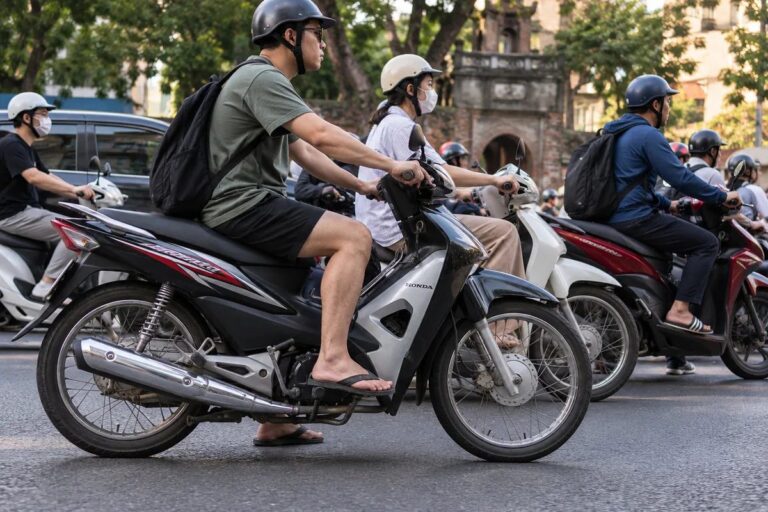
Manual & Semi-Automatic Motorbikes
Checking the Gear Lever and Clutch Before Taking a Rental Motorcycle

On this page
A rider collecting a semi-automatic or manual-clutch motorbike in Hanoi should check more than the fuel gauge and bodywork. The gear lever, clutch lever if fitted, and kick-starter if supplied are controls that can affect whether the motorcycle is usable and safe for the intended rider. Before accepting the vehicle, ask the shop to explain and demonstrate the controls, observe their condition while the motorcycle is parked, and record unusual behaviour. Do not shift a running bike into gear, operate an unfamiliar kick-starter or attempt a road test without the owner’s permission and proper conditions.
This article is about a rental handover check, not teaching an unqualified beginner to ride a manual motorcycle. You can review the Hanoi semi-automatic motorbike rental options to understand the category, but which vehicle and controls are available must be confirmed with the actual provider.
Identify whether the bike is semi-automatic or manual-clutch
A semi-automatic step-through bike commonly lets the rider change gears with a foot lever while using an automatic or centrifugal clutch mechanism. It often lacks the left-hand clutch lever found on a conventional manual-clutch motorcycle. The exact shift pattern, gear indicator and neutral behaviour can vary by model.
A manual-clutch motorcycle has a clutch control that the rider must coordinate with the gear lever. Someone accustomed only to an automatic scooter may not be familiar with this coordination. The rental shop’s willingness to supply a model does not establish that the renter has suitable legal eligibility and skills.
Some vehicles also have a kick-starter; many rely on an electric starter. Do not expect a kick lever on every model or mistake a foldable foot peg for the starter. Ask staff to identify each component before touching it, particularly if the scooter or motorcycle has unfamiliar layout.
The handover goal is to understand the controls provided and notice obvious defects. A rider should not dismantle mechanisms or adjust cables during the initial inspection. Repairs and technical decisions belong to the owner and authorised personnel.
Ask the shop what is permitted at handover
Start with a clear question: “May I check the gear lever and clutch controls while this bike is parked, and would you demonstrate the correct operation?” Some checks can be done visually while the engine is off; others require an employee or a safe practice area. Do not assume an unrestricted test ride comes with every rental.
Ask where it is safe to stand, whether the engine should be off and how to keep the bike secure on its stand. A foot lever can move unexpectedly if handled without understanding the mechanism, and a heavy bike may tip. Follow staff instructions and avoid putting hands near moving components.
If the shop permits a short test of the vehicle, confirm the rider’s legal eligibility, the permitted area, protective equipment and supervision appropriate to experience. Do not test braking, gear selection or clutch release on a busy public road just to find out whether the bike is functioning.
Before accepting the keys, ask how to contact the provider if a control behaves differently after the trip begins. A documented handover and early report help distinguish a pre-existing issue from a later event.
Look at the gear lever before moving anything
First identify the gear pedal and inspect whether it is visibly bent, loose, misaligned or obstructed. Compare its position with the rider’s footrest and other controls. A lever that rubs a body panel or appears to have an insecure mounting should be shown to staff before riding.
Check the shift pattern only with a model-specific demonstration; do not guess from a friend’s bike. Some semi-automatic motorcycles use a different heel-and-toe pedal design from a manual model, and reverse or neutral selection conventions can differ. The gear indicator may help but should not be the sole source for learning the pattern.
If the employee authorises a controlled static check, observe whether movement is smooth and appropriate to the bike. Forcing a hard lever while the machine is in an unsuitable position can harm the mechanism. If selection feels jammed, ask staff to inspect rather than stamping harder.
Record the condition in the handover notes: for example, “lever end visibly bent” or “neutral indicator not consistent during staff check.” These are observable details, not diagnoses of internal gearbox damage. A qualified mechanic must determine the cause and what repair is necessary.
Check the manual clutch if the model has one
On a manual-clutch bike, the clutch lever is generally at the left handlebar. Check whether it is visibly bent, cracked, loose or difficult to reach. Ask the provider to demonstrate normal lever operation on the specific model. A semi-automatic bike without a hand clutch should not be treated as missing a necessary part.
Observe whether the lever returns normally after being released during a permitted stationary check. Excessive slack, binding or unexpected movement can be reported, but the correct free-play specification depends on the manufacturer’s instructions. Avoid adjusting a cable or hydraulic system yourself.
If the engine is running and the clutch does not disengage correctly, the motorcycle can move unexpectedly when a gear is selected. Do not experiment with this in a crowded collection area. Ask staff to demonstrate under safe conditions or have the bike checked before acceptance.
The rider should not interpret a heavy clutch lever as a medical limitation or definite mechanical fault without context. A different model may feel different. What matters is that the person can operate it reliably and that the system conforms to the proper model condition.
What about the kick-starter?
A kick-starter, when fitted, is a lever that helps turn the engine for starting. It is not a normal gear selector, foot peg or brake. Ask staff whether the supplied motorcycle has one, where it is and whether there are specific manufacturer steps and restrictions.
Do not operate a kick-starter on a motorcycle that is not stable, while the rider is off balance, or without understanding ignition, neutral and any required control positions. A sudden kickback or unexpected engine response can injure the rider, and a rushed demonstration can damage components.
Some riders assume a kick-starter will always solve a failed electric start. This is not universally true; ignition and other electrical components may still require battery power, depending on model. If the starter becomes weak, contact the owner instead of repeatedly kicking or trying unrelated tricks.
If a lever appears bent, seized, cracked or does not fold properly, record the observation and ask the shop to assess it. Do not force it through its travel. If the rented model has no kick lever, remove this item from the checklist rather than penalising the bike for missing equipment.
A side-by-side handover checklist
Checks for both types
Both semi-automatic and manual: confirm model, neutral position, gear lever location and physical condition, footrests, brake controls, mirrors, lights and tyres. Check fuel level, odometer and the visible condition that will be documented for return.
Checks for manual-clutch bikes
Manual-clutch only: identify the clutch lever, look for obvious damage, ask about correct free play and request a model-specific demonstration. A clutch that seems to drag or fails to return should be reported without attempting adjustment.
Kick-starter checks
Kick-starter only if fitted: have staff explain location and proper use. Check for obvious damage without force. If you have never used one, do not make the collection yard your first unaided trial.
Document existing condition
Documentation: photograph the plate, gear lever, clutch lever if present, kick lever if present, bodywork and existing marks. Ask the employee to confirm any visible pre-existing damage or concerns in the handover record.
Rider eligibility: verify appropriate licence and other applicable rules for the exact motorcycle class. A driver experienced only with automatic scooters may need more preparation before a geared bike is suitable.
Safe handling while stationary
Choose a stable, permitted surface. Keep unnecessary bystanders and children clear of the vehicle. Ask where the safest standing point is and how to secure the stand. If the bike needs to be moved, let a competent authorised person do so when you are unsure.
Do not grip or press multiple unfamiliar controls at once. A gear lever, rear brake pedal, clutch and kick-starter can be close together. Distinguish them by sight and the employee’s demonstration before operating anything. Do not mistake the throttle for a balance aid.
Never reach near a chain, sprocket, wheel or moving engine mechanism while the bike runs. The purpose of a renter’s check is to notice issues and ask questions, not to inspect internal components. A mechanic can confirm mechanical safety when concern remains.
If an engine is started, keep exhaust ventilation in mind and follow the prescribed starting sequence. Do not leave it running in an enclosed storage area or direct exhaust toward bystanders.
What should be reported before signing?
A bent lever, loose pedal, damaged boot or excessively worn grip can be documented visually. Report an unusual sensation such as the lever failing to return or a persistent problem selecting neutral during staff demonstration. Describe the exact observation rather than labelling the gearbox broken.
If any safety-critical concern remains unresolved, do not accept a vehicle merely to keep to the planned pickup schedule. Ask for inspection, repair or another suitable bike, subject to actual availability and the agreement. A different model may require new eligibility or handling checks.
The general Hanoi motorbike rental requirements guide covers wider booking and document questions. This article concentrates specifically on the three geared-bike controls likely to be unfamiliar at handover.
Keep a record of any promise about repairs or return arrangements. Do not assume the rental provider automatically accepts responsibility for work done by an unauthorised outside workshop. Ask which channel to use if problems develop during the hire.
After the first days of use
Listen for new noises or feel for changing control response without attempting to diagnose the transmission. If gear selection becomes difficult, the clutch feels different or a component becomes loose, stop safely and report the details. Continuing to force a control can create avoidable damage.
A useful note includes the model, date, location, whether the engine was hot, which gear was involved and how the symptom affected use. Do not report a guess such as “the gearbox is destroyed” when what you observed was a hard shift on a particular occasion.
For longer hires, ask about authorised maintenance intervals and how to bring the vehicle to the shop when required. Do not dismantle the clutch cover, adjust the gear linkage or attempt to repair a kick-starter with improvised tools.
Common mistakes at rental pickup
Assuming all geared bikes have a hand clutch: semi-automatics and manual-clutch motorcycles differ. Inspect the exact type rather than asking about a nonexistent lever.
Trying to select every gear while parked without instruction: forcing unfamiliar machinery can damage parts or move the bike unexpectedly. Ask the employee to explain what checks are appropriate.
Testing on a public road without competence: being legally eligible and capable of handling the type are essential. A pickup yard is for a controlled explanation, not a substitute for proper learning.
Failing to record a visible defect: a short dated message and photograph are more useful than trying to remember which lever was bent several weeks later.
Related guide: Renting a Manual-Clutch Bike as a Learner: Ask About Damage and Rules.
Frequently asked questions
Does every semi-automatic motorcycle have a clutch lever? No. Many semi-automatic step-through models lack a hand clutch. Ask about the actual model and its controls.
Should a renter adjust clutch free play? No automatic permission exists. Report concerns and use the owner’s approved service procedure. Exact specifications vary by model.
Does a kick-starter replace all electrical starting requirements? Not on every motorcycle. Whether it works with a weak battery depends on the specific design; ask the provider.
Can I refuse a bike with an unusual control? You should report safety concerns before acceptance and ask the provider to resolve them or discuss another suitable option. The contract determines the booking’s commercial terms.
Discuss a geared-bike handover with Motorbike Nguyen Ha
Motorbike Nguyen Ha is located at Alley 5 Nguyen Van Cu, Bo De, Long Bien, Hanoi, with published opening hours 09:00–21:00. Call +84 334 699 969 or use Zalo/WhatsApp to ask about available semi-automatic and manual models, a controls demonstration, legal documents and actual rental conditions. This guide does not promise a free trial or any particular model.