Automatic Scooters
Parking-Brake Locks on Scooters: Identify and Release Them Safely
On this page
Does your rental scooter have a small catch near the left brake lever? It might be a rear-brake lock, but not every scooter has one and not every lever lock is intended for parking. Before touching an unfamiliar button, ask the rental shop to identify it on the exact model and show you the procedure in the owner’s manual.
The safest habit is simple: know whether a lock exists, understand its intended use, check that it has released fully before moving, and never use the throttle to force a scooter past a dragging brake. This guide explains the questions to ask at pickup without pretending that all automatic scooters work the same way.
What is a scooter brake-lever lock?
Some automatic scooters have a small mechanical catch or lever that holds a brake control after it has been squeezed. The design, position and operation depend on the vehicle. On some models the feature is described as a rear-brake lock; its manual may instruct the rider to use it during starting or warm-up, not as a general parking brake for leaving the scooter unattended on a slope.
A separate parking-brake system on another motorcycle may have a different purpose entirely. Do not confuse either feature with the steering lock, side stand, centre stand or ordinary brake lever. Similar-looking controls can have different functions.
How to identify the control without guessing
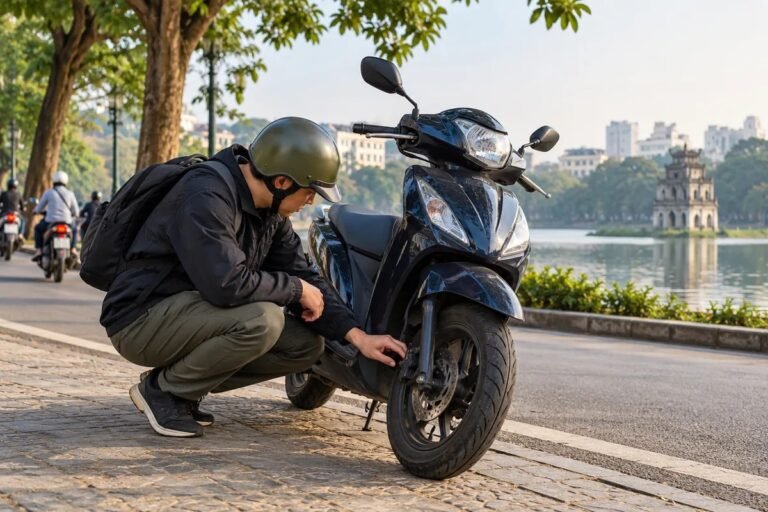
- With the engine off and the scooter secured, look near the left-hand brake lever for a small latch, switch or lever.
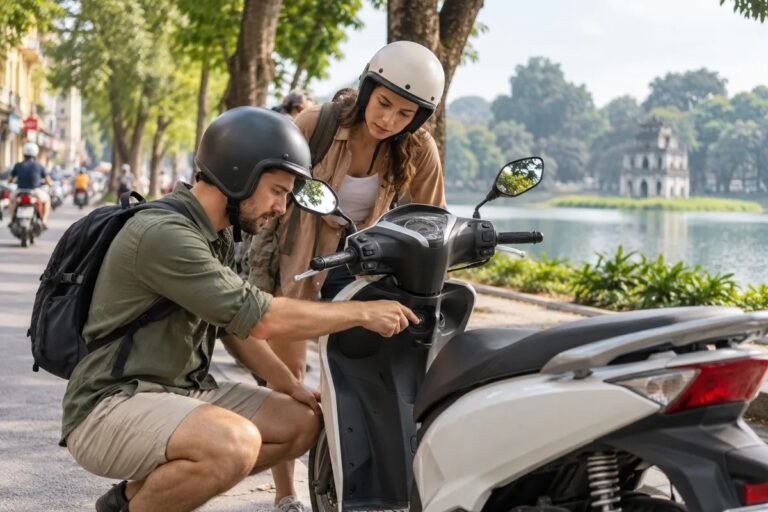
- Ask the shop to name the component, show its location and explain what the manufacturer’s manual calls it.
- Check whether a warning light or marking indicates when the lock is engaged, if that model has one.
- Ask the shop to demonstrate how the control is engaged and fully released while the scooter remains secure.
- Repeat the release check under supervision before the handover ends.
If you cannot identify a control, leave it alone. Do not experiment by pressing random buttons or pulling harder on an unfamiliar catch. A rental handover is the right moment to ask, not a busy junction on your first trip.
When should a brake lock be used?
Follow the instructions for that specific scooter. A manufacturer’s manual may limit the feature to a particular starting procedure or operating condition. It is unsafe to assume that a lock seen beside the brake lever is designed to hold the scooter on a steep slope while you walk away.
| Situation | Safer question or action |
|---|---|
| Starting the engine | Ask whether the manual requires the rear-brake lock or simply a squeezed brake lever. |
| Waiting at a traffic light | Keep the scooter under active control with the brakes and stable footing; do not rely on an unfamiliar latch. |
| Parking for a long period | Use an appropriate stable parking surface and the stand as instructed by the manufacturer. |
| Parking on a steep slope | Seek a safer, flatter parking place rather than trusting a small lock to secure the scooter. |
| Pushing the scooter | Make sure every brake lock is released before trying to roll the bike. |
A centre stand or side stand must also be used according to the manual and the surface conditions. Even a scooter equipped with a brake lock can fall if parked on loose ground or a poor incline. The lock is not a replacement for choosing a stable place.
Why releasing the lock before moving matters
A brake that remains engaged may make a scooter hard to push or slow to move. Trying to overcome it by adding throttle can overheat components, accelerate wear or cause an abrupt response. If the engine revs but the scooter resists moving, stop immediately instead of opening the throttle further.
Some models release a lever lock when the brake is squeezed again; others use a different release action. The correct procedure is whatever the manufacturer specifies for that model. Have the shop demonstrate it and practise only while the bike is secured.
Pre-departure check
- Make sure the scooter is stable and that any indicated brake lock is off.
- Confirm the ordinary brake levers feel normal rather than stuck or unusually loose.
- Where safe and permitted, verify the scooter rolls normally before applying throttle.
- Check for any warning indicator associated with the lock.
- If anything feels wrong, ask the shop to inspect it before departure.
Do not carry out a forceful test on a slope or in traffic. A controlled check at the pickup area is far better than discovering a locked wheel after you set off.
Signs that something is not right
A dragging brake may be accompanied by resistance when pushing, sluggish acceleration, unusual noises or an unfamiliar hot smell. These observations do not prove that a brake lock is the cause. Other faults can produce similar symptoms, so avoid diagnosing or repairing the system yourself.
Stop at a safe location, switch the engine off when appropriate and contact the rental shop. Avoid touching brake parts immediately after riding because components may be hot. Report exactly what happened, when it started and whether the scooter can move normally with the engine off.
If the scooter has no brake lock
Many scooters simply do not include this feature. That is not a defect. Use the brakes, stands and steering lock according to the vehicle’s instructions. For a parked rental, choose firm, level ground where the bike does not obstruct pedestrians or other traffic.
Never improvise a locking device with rubber bands, cord or an object wrapped around the brake lever. It can damage a control, be forgotten during departure or give a false impression of security. If a parking space is too steep or unstable, find a better place.
Why this matters in Hanoi
Narrow alleys, crowded parking rows and sloping entrances can make scooter handling more demanding than expected. A rider may have to push the bike backward or turn it by hand. Before moving a parked scooter, ensure the brake is released, the stand is properly folded and your path is clear.
Read our overnight parking guide for Hanoi for practical questions about parking arrangements. Whatever the neighbourhood, respect local restrictions and ask parking staff before leaving a scooter on a ramp or in a narrow passage.
What if you come from a semi-automatic bike?
A semi-automatic or manual motorcycle may behave differently when switched off in gear. Most conventional automatic scooters do not have a selectable driving gear that a rider can use in the same way. That makes a safe stand and ordinary parking procedure especially important. Do not assume techniques learned on a geared bike transfer directly to an automatic scooter.
If you are new to automatic bikes, explore our scooter rental overview and arrange to have the actual controls demonstrated before pickup. Learning the difference between the brake lock, starter interlock and steering lock is more useful than memorising generic online instructions.
Five questions to ask the rental shop
- Does this exact scooter have a rear-brake or parking-brake lock?
- What does its own manual say the feature is for?
- How can I confirm it is completely released?
- Is there a warning light or indicator associated with it?
- Who should I contact if a brake feels stuck or the scooter will not roll freely?
Nguyen Ha can explain the controls of an available rental scooter at handover. For questions about a specific bike, contact 0334 699 969. Availability and any rental terms should be confirmed directly rather than inferred from this technical guide.