Automatic Scooters
Scooter Handlebar Vibration or Wobble: Stop and Report Safely
On this page
You are riding a rental scooter and notice that the handlebars are vibrating more strongly than before, or the front of the bike begins to shake from side to side. If the behaviour appears at a particular road speed, do not accelerate to find out where it starts or stops. Gradually reduce power, concentrate on remaining stable and reach a safe place to stop when conditions allow. A scooter that has wobbled or felt unstable needs assessment before you continue riding.
This guide is designed to help renters describe an abnormal sensation, not diagnose wheel bearings, tyres or steering parts. What a rider feels at the grips can be caused by different conditions. Even if the wobble disappears when the speed drops, that is not evidence that the scooter is safe to take onto a faster road again.
Vibration, wobble and drifting: three different symptoms
The word “shaking” is ambiguous. Take a moment after stopping to decide what you actually felt. Clearer language makes the first message to the rental shop more useful and reduces guesswork.
| What you noticed | How to describe it | Extra detail worth recording |
|---|---|---|
| Small repeated movement at both grips | Handlebar vibration | Whether the sensation appeared on a smooth or uneven section |
| Handlebars turn or oscillate visibly from side to side | Steering wobble | Whether the front of the scooter felt unstable |
| Whole vehicle sways in a broader pattern | Body weave or lateral movement | Whether a passenger or luggage was present |
| The scooter consistently pulls to one side | Pulling or drifting | Which direction and on what road surface |
| Movement accompanied by a rhythmic sound | Vibration with an unusual noise | Where the sound appeared to come from |
It is possible to experience more than one sensation. Do not create a new test ride to separate them. A careful description of the first incident is enough to start a discussion with the shop.
Immediate priority: stay in control and slow gradually
Motorcycle safety guidance from the Ontario motorcycle handbook advises against accelerating into a wobble or attempting to fight it with sudden steering inputs. It describes reducing the throttle gradually and getting off the road when you can do so safely. The exact response will depend on the surface, traffic and strength of the movement, so avoid treating a short description as a complete riding lesson.
Do not grasp the handlebars so rigidly that you fight every movement, and do not attempt a deliberate acceleration test. Sudden braking during a pronounced wobble can make instability worse, according to rider handbooks. Your task is to reduce danger and stop, not to demonstrate what the vehicle can withstand.
Once stopped, do not take another fast run
Park in a stable place away from moving traffic and switch off the ignition when appropriate. If you are carrying a passenger, make sure they are safely away from the road before you inspect anything. Take a moment to note the event while it is still fresh.
Do not intentionally travel back up to the speed at which the wobble appeared. If the cause remains unknown, the shop should assess whether the scooter needs checking, recovery or an alternative arrangement. Riding slowly until symptoms disappear is not the same as resolving an underlying problem.
What can you observe without repairing anything?
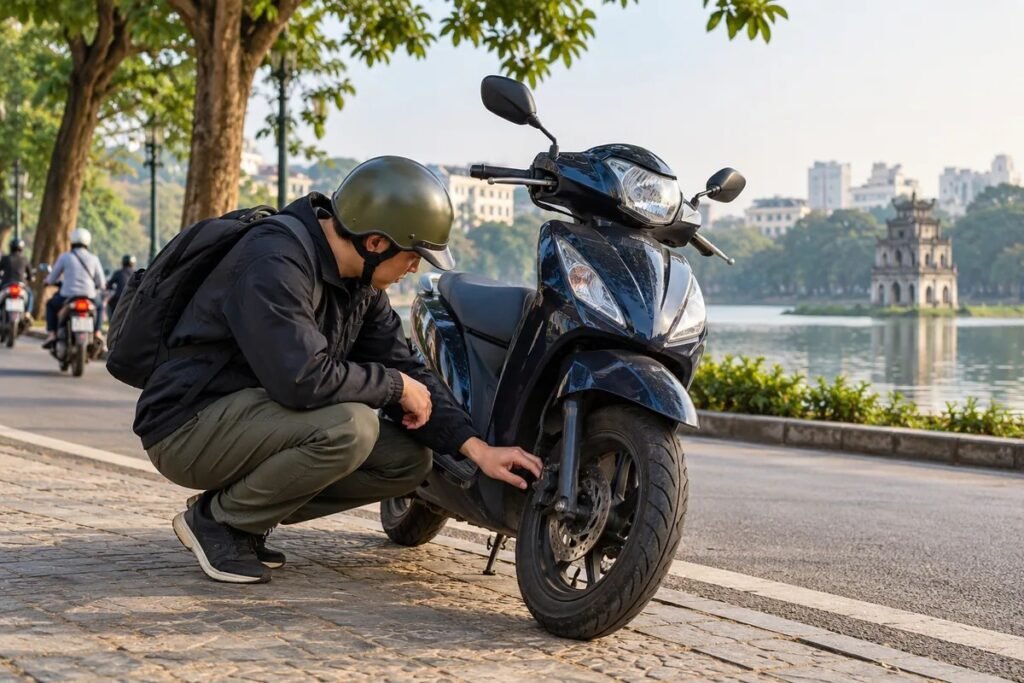
With the motorcycle parked securely, you may be able to see a noticeably flat tyre, damaged rim, hanging object, loose luggage or something caught near a wheel. Use your eyes and photographs rather than touching hot or moving components. Do not lift the bike, disassemble steering parts, adjust suspension or try to balance a wheel yourself.
An observation such as “The front tyre looks flatter than at pickup” is useful; “The wheel bearing has failed” is an unsupported conclusion unless a qualified person has examined the scooter.
Six facts to send to the rental shop
- What moved: only the grips, the front wheel/steering, or the entire bike.
- When: during ordinary travel, over a bump, while braking, or after a change in road surface.
- Road conditions: smooth asphalt, potholes, painted lines, rain or strong crosswind.
- Load: whether a passenger and luggage were present and where the luggage sat.
- Effect of slowing: whether the symptom reduced as you eased off, based on the first incident.
- Current position: where the scooter has been parked safely and how the owner can reach you.
If you recall the approximate speed from a normal glance made before the event, you may include it. Do not look down at instruments during instability or create an exact speed measurement by repeating the ride.
Could luggage or a passenger change the handling?
Additional weight and how it is distributed can influence stability. A loosely secured bag may shift unexpectedly; a heavy load placed far behind the rider may change the vehicle’s balance. Mention these factors when reporting a problem, without concluding that they are the sole cause.
See our guide to securing luggage on a rental motorbike for packing checks. Repositioning an item may remove an obvious hazard, but it does not confirm that a scooter which has wobbled is mechanically safe. Ask the shop to assess the vehicle before returning to the road.
What if the vibration began after hitting a pothole?
Record that sequence. An impact can coincide with changes in a tyre, rim or steering component, but the rider cannot determine the condition from a brief visual check. If the motorcycle was struck hard, request an assessment rather than trying to recreate the symptom on another rough road.
How is this different from ordinary small vibrations?
Engine vibration can be felt through handlebars and footrests during normal riding. However, a new or rapidly increasing vibration, clear side-to-side steering movement, pulling or instability is not something to dismiss as a quirk of the model. Changes compared with the handover condition are especially important.
You should not be asked to decide whether the vibration crosses a certain numerical threshold. A rider who feels the scooter becoming unstable has enough reason to stop and contact the shop.
Why a self-diagnosis is unreliable
Possible contributing factors include tyres, loading, wheels and steering components, but several may produce overlapping sensations. An online description cannot separate them reliably. Do not loosen fasteners, alter tyre pressure by guesswork or try to adjust wheel alignment without approval and proper equipment.
There is a related article on steering play and a motorcycle pulling to one side. The focus here is what to do when vibration or wobble appears during a particular trip, and how to report the event.
A sample message that avoids guessing
“The handlebars started shaking sideways on a relatively smooth road while I was riding alone. I gradually slowed and parked at [location]. It did not happen earlier in the rental. I have not ridden again. Please advise on inspection or collection.” Include the registration plate and clear stationary photos if requested.
A factual timeline makes it easier for the rental business to decide what assistance is appropriate. There is no benefit in naming a defective part before anyone has inspected the scooter.
Questions to ask when collecting a rental scooter
- Does the steering move normally and freely while the bike is stationary?
- Do the tyres look undamaged and correctly maintained?
- Is all existing luggage equipment securely attached?
- Who should I contact if the scooter begins to vibrate or wobble unexpectedly?
For currently available automatic scooters, see Nguyen Ha’s scooter rental information. If a rental vehicle begins wobbling, call 0334 699 969 from a safe location and ask how to proceed. Do not assume that reducing speed has permanently solved the fault.