Riding Skills & Safety Planning
After Leaving a Motorbike in the Sun: Check Seat, Tyres and Controls
On this page
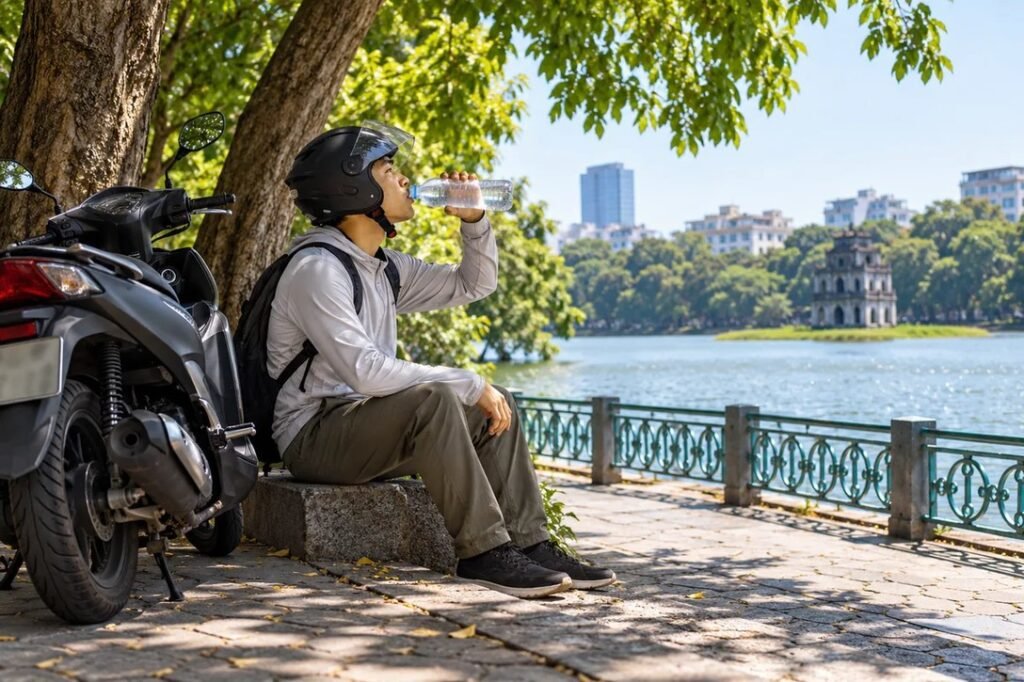
A rental motorbike left outdoors for several hours in Hanoi sunshine can be uncomfortable to touch. The seat, grips, mirrors and exposed metal may become hot, while tyre pressure readings can change with temperature. None of that proves that a parked motorcycle has been damaged by a single afternoon in the sun. But it does mean a returning rider should pause, check the vehicle and avoid making hasty changes to tyres or mechanical parts.
This checklist separates everyday heat-related observations from conditions that deserve inspection. It also explains why a hot tyre should not be deflated to the pressure quoted for a cold tyre. The correct procedure always depends on the actual motorcycle and its manufacturer, not a fixed number borrowed from a different scooter.
Start with the seat and contact surfaces
A dark seat can feel uncomfortably hot after direct sunlight. Handlebars, metal footrests and mirrors may also warm up. Before mounting, approach carefully and check the surfaces you will touch. Do not place bare skin directly against a surface that feels too hot. Moving to shade and allowing time for cooling may be sensible, but there is no reliable universal cooling time.
Do not pour cold water over electrical fittings, a hot exhaust or an unknown component as an improvised fix. If the seat covering has become torn, sticky, distorted or unusually damaged, photograph it and ask the rental company for advice instead of applying chemicals or adhesives.
Tyre pressure: a cold reading is the reference
Sunlight and riding heat can change the air temperature inside a tyre. A warm tyre may therefore show a higher pressure than its cold reading, even when there is no underlying fault. Michelin Vietnam’s motorcycle tyre-pressure guidance recommends checking against the manufacturer-specified cold pressure, and specifically advises against bleeding air from a hot tyre merely to reach that target.
Never use the maximum value printed on a tyre sidewall as the everyday recommended operating pressure. The motorcycle manufacturer specifies the correct setting for the particular model and load. Ask the rental shop or a qualified technician to check it under appropriate conditions rather than guessing.
Why deflating a hot tyre can backfire
Suppose a tyre is above its cold specification because the air inside has warmed. If you release air until that hot reading equals the cold target, the tyre may become underinflated as it cools. Underinflation can affect handling, wear and heat generation. Do not make this adjustment simply because a hot midday reading looks high.
This does not mean you should ignore an obviously damaged or dangerously abnormal tyre. A bulge, cut, deep crack, visible deflation or unexplained handling problem calls for the motorcycle to remain parked and be assessed. The actual pressure and condition need proper checking, not a visual guess alone.
| What you notice | What it may mean | Safer action |
|---|---|---|
| Seat feels too hot | Surface has warmed in the sun | Allow cooling before mounting |
| Hot tyre reads above a cold-pressure value | Temperature may affect the reading | Do not deflate to the cold target while hot |
| Tyre has a bulge, visible cut or is clearly flat | Potential tyre fault | Stop and request inspection |
| Brake lever feels abnormal | Possible control or braking issue | Do not ride until assessed |
| Strong petrol odour near parked bike | Fuel-system or spillage concern | Keep ignition off, move away and report |
| Smoke or unusual burning smell | Potential fire or mechanical hazard | Move away and seek suitable help |
Look at the tyres before touching the controls
From a safe standing position, look for a tyre that is visibly distorted, damaged or too flat, especially if the motorbike has been parked against a kerb or on uneven ground. You cannot determine exact tyre pressure by appearance. A gauge and manufacturer specification are needed for that.
Do not press against the tyre with a sharp object, loosen the valve or inflate it to a number found on an unrelated internet page. Ask the shop what pressure and inspection method apply to the particular rental unit.
What about the brakes after a hot afternoon?
Parking in the sun does not by itself establish that a brake has failed. At the same time, a brake lever that feels unusual, fails to return normally, makes a new scraping sound or has a warning indication should not be dismissed as “just the weather”. Check the controls only as directed at handover, with the motorbike secured and stationary.
Do not touch the brake disc or exhaust to check temperature. Those components may be extremely hot after use and can cause burns. If a bike feels resistant to movement, do not force it or attempt a road test to identify the cause.
What about a petrol smell?
Petrol is volatile and flammable. A strong or new smell, wet patch, apparent dripping or an improperly closed fuel cap requires attention. Keep the motorcycle turned off and away from ignition sources when there is a suspected leak, and contact the rental company. If there is active fuel spillage, smoke or fire, move away and seek suitable emergency help.
Belongings in an underseat compartment
The interior of a closed compartment can become hot during prolonged outdoor parking. Electronics, batteries, chargers, medicines and certain materials may have manufacturer temperature limits. Do not assume every item is safe merely because it fits physically beneath the seat.
Read the storage instructions for your phone, power bank and any product with a battery. If an electronic item is swollen, hot to the touch or emitting an unusual smell, avoid charging or using it and follow its manufacturer’s safety instructions. Do not leave flammable fuel containers in a motorcycle’s storage area.
What to check when returning to the motorcycle
- Approach carefully and look for visible smoke, liquids, damaged parts or an unusual smell.
- Touch the seat cautiously or wait until it is comfortable to use.
- Inspect tyres visually for obvious damage without guessing the pressure.
- Check that mirrors and controls have not been disturbed or broken while parked.
- Confirm that luggage and loose items remain secure.
- Ask for help if anything seems different from the handover condition.
A short stationary observation is not a complete mechanical inspection. A renter can identify a concern and request assistance, but should not attempt to diagnose the engine or brakes.
Can parking in shade prevent every heat problem?
No. Shade may reduce direct solar heating of the seat and bodywork, but ambient conditions can remain hot. Park only where permitted and where the motorcycle is stable. Do not obstruct pedestrian paths or park in an unsafe location merely to find a small area of shade.
If outdoor parking is unavoidable, consider a legal, secure location with appropriate cover, provided it does not trap heat near the exhaust or create a fire hazard. Ask the shop before using a cover that touches the bike’s hot parts or leaving a cover attached to a rental for long periods.
When the motorcycle has been unused for days
A vehicle parked for several days may develop issues unrelated to sunlight, such as a low battery, vandalism, a puncture or a disturbed mirror. These possibilities cannot be inferred from the weather alone. Use the usual handover checks and ask for professional help if starting or braking behaviour is abnormal.
What if the rider has a minor skin burn?
Move away from the hot surface and cool the affected area under cool running water. Avoid putting ice directly on the skin or applying improvised remedies. Seek medical assessment for blistering, significant pain, deep or extensive burns, burns in vulnerable locations or any uncertainty about the injury. Help the injured person before attempting to resume the trip.
Hot surfaces are a good reason to take a moment before climbing onto a bike, particularly for children or people with sensitive skin. Protective clothing can reduce direct contact but is not proof that a hot exhaust or seat is harmless.
Questions worth asking at handover
- What tyre pressure applies to this exact motorcycle and load?
- Where is the seat or fuel cap most likely to become hot in the sun?
- Are there storage items the manufacturer says should not be kept under the seat?
- How should I report a damaged tyre, brake issue or strong fuel smell?
- Is there a safe and permitted parking arrangement near the pickup location?
When to contact Nguyen Ha
Ask the rental provider if the tyres, controls, seat or fuel system look unusual after outdoor parking. For the general fleet categories see Nguyen Ha’s scooter rental information; actual availability and model instructions must be confirmed directly. Call 0334 699 969 if a rented motorcycle needs assessment before use.