Riding Skills & Safety Planning
Hanoi Overpasses, Underpasses and Elevated Roads: Check Motorbike Signs
On this page
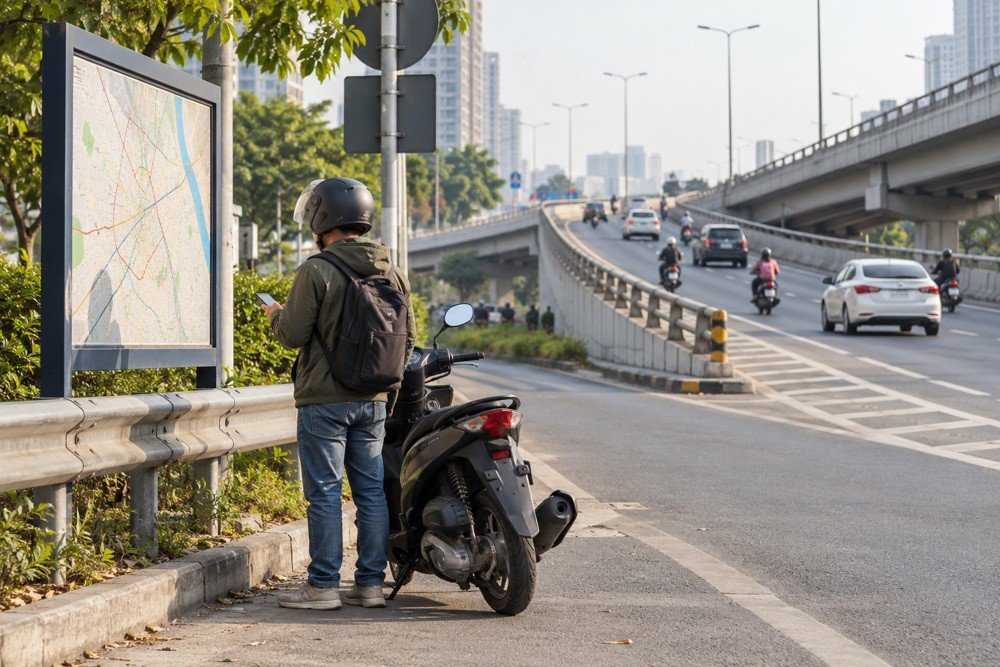
A navigation app tells you to take the ramp ahead in Hanoi. From the road, it is not obvious whether the entrance leads to an elevated road, a flyover or a traffic underpass—and whether a motorbike is permitted there. Do not rely on the appearance of the road or simply follow the car in front. The right decision depends on the signs, lane restrictions and any current traffic instructions at that exact entrance. If you are uncertain, choose a lawful stopping place before the decision point and check your route.
Quick answer: there is no single rule allowing or forbidding motorcycles on every Hanoi flyover or underpass. Some facilities restrict motorbikes entirely; others allow them in designated lanes or have time-dependent controls. Road signs and live instructions take priority over a map shortcut or an old blog post. This guide explains how to read the situation without suggesting that an outdated route description overrides signs on the street.
Three types of access that can look similar
An elevated urban road may be reserved for certain vehicle classes. An underpass may carry more than one vehicle class but separate them into lanes. A short flyover at a junction can have different restrictions from either. Even the same junction may have a surface route and a raised route with different access rules.
| Facility | What to find out | Do not assume |
|---|---|---|
| Elevated urban roadway | Is the ramp restricted to cars or particular vehicle classes? | Motorbikes may enter because a navigation app suggests it |
| Traffic underpass | Which classes and lanes may pass through? | All lanes share the same access rules |
| Flyover at a junction | Are any entry bans or time restrictions posted? | Every flyover in Hanoi applies the same rules |
| Parallel frontage or service road | Is it the legally designated alternative for your vehicle? | It always continues in the direction shown on the main roadway |
This table is a reading guide rather than a list of current permissions. In practice, it is the specific approach and the active traffic signs that answer the question.
Why road signs come before your app’s route
Vietnam’s Law on Road Traffic Order and Safety, No. 36/2024/QH15 as updated in 2026, governs compliance with road traffic signs and signals. Article 11 establishes the order of priority: instructions of the traffic controller, traffic lights, road signs, road markings, then other prescribed signals. It also provides that a temporary sign with a different meaning takes priority over the conflicting fixed sign at that position.
The Vietnamese legal database entry for Law 36/2024/QH15 is a starting point for the actual statutory text. A phone map is a route-planning aid, not a legal source that can override road signs or a police officer directing traffic.
Example: Hanoi’s elevated Ring Road 2
Hanoi Police reported on 7 November 2023 that the elevated Ring Road 2 section from Vinh Tuy toward Nga Tu So restricted motorcycles, mopeds, non-motorised vehicles and pedestrians, and described cases of riders ignoring the posted signs. The report helps explain a real access problem, but it is dated. A journey made in November 2026 still requires checking the current signs and any temporary traffic changes on the approach.
The Hanoi Police report on motorcycles entering the elevated road illustrates why seeing a car use the ramp does not establish permission for a motorbike. If an entry is restricted, do not ride up hoping there will be an easy place to turn around.
Example: lane allocation in Kim Lien underpass
News coverage dated 20–21 October 2026 described motorbike riders using lanes allocated to cars within the Kim Lien underpass, with continuous lane markings and signs near the tunnel entrances. This is a different issue from a complete ban on motorcycle entry. A road facility may admit a particular vehicle while still prohibiting it from certain lanes.
Those reports describe conditions observed at the time of publication. They do not establish the exact current lane allocation in every direction or after subsequent works. Inspect the posted lane markings and signs yourself before entering, and follow any live directions from traffic officers.
Different signs mean different instructions
A prohibition on motorcycles, a restriction for a class of vehicle, a mandatory direction and a lane-allocation sign are not interchangeable. Some signs apply to an entire access road; others indicate an individual lane or a particular manoeuvre. Supplementary plates may add times, distances or exceptions. Read the complete installation rather than memorising only the main symbol.
Do not assume that an image shared online displays the latest configuration. A construction project, incident or temporary diversion may change the permitted route even when an older map still shows the previous road layout.
Look for signs before the ramp separates
An entrance often divides into a raised branch and a surface road before the actual bridge or tunnel. Check the signs while you still have time to choose the appropriate lane, without abrupt weaving. Do not stop in the middle of moving traffic to take a picture of the sign or read a long article.
If you cannot understand an unfamiliar sign, take a lawful alternative route rather than guessing. Park in a permitted, safe place before consulting a route guide. For practical navigation preparation, see our guide to checking expressways in Hanoi route planning.
Temporary signs and traffic police instructions
A construction diversion may use temporary signs that differ from the permanent arrangement. Article 11 explicitly addresses the conflict between fixed and temporary signs. Instructions from an authorised traffic controller rank above signs and signals under the statutory priority rule. This matters if a lane is temporarily closed after a collision, during repairs or for a major event.
Do not interpret a lack of visible cones as permission to ignore a clearly posted restriction. Similarly, do not force a bike through a lane just because a digital map still highlights it in blue.
What if you have already entered the wrong ramp?
Do not abruptly stop in the running lane, reverse through traffic or turn against the flow to correct the route. Such movements can expose you to a far greater risk than the original navigation mistake and may violate legal restrictions. The correct next step depends on the actual roadway, available safe areas and the instructions of the traffic police or route operator.
If possible, follow directions from authorised personnel and seek a safe, lawful way to resolve the mistake. Do not take the phrase “just continue to the next exit” as universal permission to drive on a prohibited road. Do not use a phone while steering through an unfamiliar ramp or tunnel.
What changes inside a road tunnel?
A tunnel may have lighting, lane boundaries, limited sightlines and rules about stopping or turning. Vietnam’s law provides specific traffic requirements for road tunnels, including lighting and restrictions on stopping. The exact structure’s legal classification and local operational signs matter, so do not treat every short underpass as legally identical to a long highway tunnel.
When a particular underpass permits motorbikes, follow the assigned lane and the actual traffic directions. A clear lane for cars is not an invitation for motorcycles to enter it because it looks less congested.
Be cautious with older traffic articles
A news report about a 2020 or 2022 flyover restriction may be useful historical context, but not enough to determine whether that rule still applies today. The same caution applies to screenshots of old road signs, social-media posts and maps that may not reflect a recent change.
Before a planned journey, check current official notices when available, and treat on-site signs as authoritative for the actual approach. Our Hanoi signs, lane and traffic communication guide</a provides related context about interpreting what other road users are doing without blindly following them.
Pre-ride checklist for a rental motorbike
- Identify the type of rental bike and ensure you meet its legal riding requirements.
- Look at the proposed route for expressway or elevated-road segments.
- Allow enough journey time for a legal alternative to a restricted ramp.
- Pay attention to the signs before the road divides into separate lanes.
- Follow temporary signs and authorised traffic instructions.
- Do not stop suddenly, reverse or attempt an unsafe U-turn after a wrong turn.
Questions to ask the rental provider
“My route may cross an elevated roadway or underpass near [junction]. Are there any known motorbike restrictions on the approach? Which official notice or on-site signs should I check? I will follow the current signs rather than relying on a suggested shortcut.”
This question is useful, but a rental employee cannot override restrictions and cannot guarantee that signs will remain unchanged throughout the day. For vehicle-specific booking questions, contact Nguyen Ha at 0334 699 969. This article does not provide a live route-permission certificate, a penalty quote or a claim that every Hanoi underpass admits motorbikes.