Riding Skills & Safety Planning
Turning Right at a Red Light in Vietnam: Signs and Exceptions
On this page
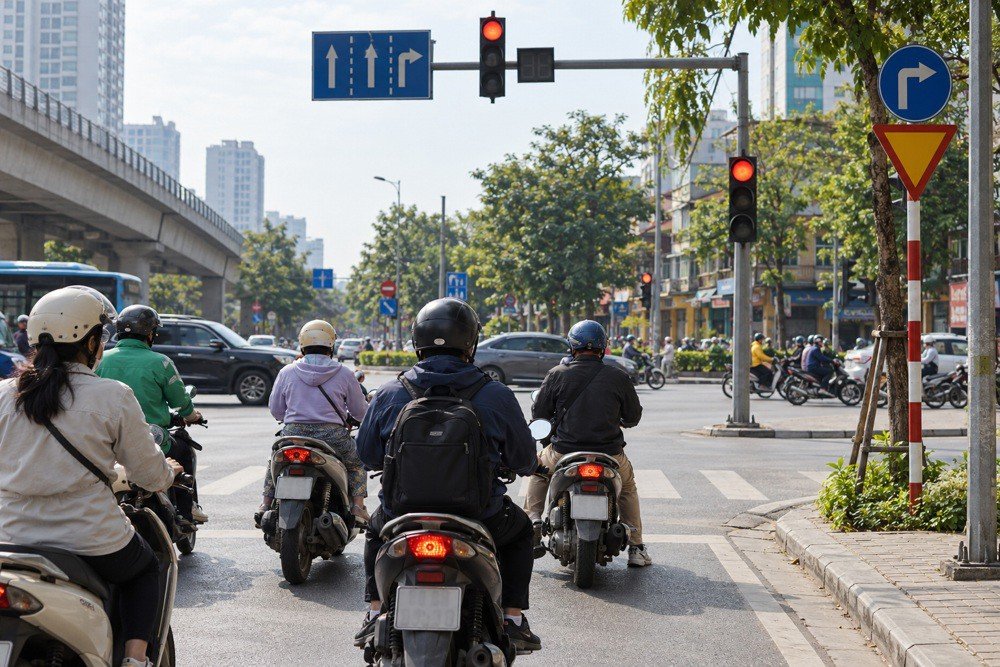
Can you turn right on a red light on a motorbike in Vietnam? Not as a general rule. Vietnam’s 2024 road traffic law states that a red light means no going, and the Traffic Police Department has explained that you may turn right on red only where the junction is organised for it, shown by a green right-turn arrow or a supplementary sign, or when a traffic officer signals that you may go. Even then, you must give way to pedestrians. Seeing other riders turn is not evidence that a junction allows it.
New riders in Hanoi often stop at a red light and watch the bikes to their right carry on around the corner. This guide explains the rule, the exceptions and how to check a junction for yourself.
What the law says about red lights
Article 11(4) of the consolidated Law on Road Traffic Order and Safety describes the three signal colours. Green means you may go, but you must slow down or stop for pedestrians and wheelchair users already crossing. Amber means stop before the stop line, unless you are already on or past it. Red means no going. The law does not contain a general exception for right turns.
Article 11(2) also sets an order of priority: a traffic officer’s instructions come first, then traffic lights, then signs, then road markings. That order matters for the exceptions below.
The exceptions explained by the Traffic Police Department
In January 2025, Tuoi Tre newspaper reported a representative of the Traffic Police Department explaining that, normally, a driver may not go in any direction on a red light. Where a junction is organised to allow right turns, shown by a green arrow signal or a supplementary sign, a right turn on red is permitted and is not a violation. A right turn is also allowed when a traffic officer on duty signals it. In every case, riders should watch for and give way to pedestrians. Read the Tuoi Tre report quoting the Traffic Police Department.
| What you see | May you turn right on red? |
|---|---|
| A green right-turn arrow lit on the signal | Yes, while the arrow shows, giving way to pedestrians |
| A supplementary sign permitting right turns on red | Yes, as the sign indicates, giving way to pedestrians |
| A traffic officer signalling you to turn right | Yes; the officer’s signal takes priority over the light |
| None of the above | No; a red light means stop |
A traffic officer’s signal
Article 11(3) describes the officer’s signals. For example, when an officer extends the right arm forward, road users in front of the officer may turn right, while those behind and to the officer’s right must stop. Because an officer’s signal outranks the lights, you follow the officer even if the light shows red. The guide to traffic officer hand signals at Hanoi junctions explains each signal.
Do not follow the crowd
- Other riders turning is not proof: they may be breaking the rule, or there may be a sign you have not yet seen.
- Do not copy another city’s habits: a sign at one junction in Ho Chi Minh City tells you nothing about a junction in Hanoi.
- Do not rely on old articles: some pages were written under the previous 2008 law; check that guidance refers to the current law.
If traffic is turning and you see no arrow or sign
- Stop before the stop line when the light is red.
- Once stopped, look around the signal pole for a green arrow or a supplementary sign, and check whether an officer is directing traffic.
- If you see none of these, wait for green.
- If you want to know for future trips, note the junction’s name once you are parked safely and ask the shop or check the signs again on your next pass.
Right-turn lanes and road markings
Some junctions have a separate right-turn lane, sometimes separated by painted markings or a small island. A separate lane does not by itself make a right turn on red legal; look for the arrow signal or sign that applies to that lane. The guide on which lane a motorbike should use on wide Hanoi roads explains how lanes and markings work.
What the sources do not settle
- None of the sources we read names specific Hanoi junctions where right turns on red are permitted.
- They do not describe the exact design of every supplementary sign used for this purpose.
- Proposals to allow right turns on red more widely have been discussed, but the Traffic Police Department said they require study; the general rule above remains.
This article is general information, not legal advice. Penalties for running a red light can be significant, so when in doubt, wait for green.
Questions to ask before your first ride
- How do the indicators work on this bike, so I can signal clearly before turning?
- Which route from the shop is easiest for a first ride, with the fewest complex junctions?
Message to send the shop
Hello Nguyen Ha, I am collecting the [model] on [date] and have little experience riding in Hanoi. Could you suggest a simple first route from the shop to [destination], and show me the indicator and horn controls before I set off?
Frequently asked questions
Is turning right on red allowed in Hanoi?
Only where a green right-turn arrow or a supplementary sign permits it, or a traffic officer signals it. Otherwise, red means stop.
Do I still have to give way to pedestrians when a right turn on red is permitted?
Yes. Authorities advise watching for and giving way to pedestrians whenever you turn on red under these exceptions.
What if a traffic officer waves me on while the light is red?
Follow the officer. Under Article 11, an officer’s instructions take priority over traffic lights.
Nguyen Ha Motorbike Rental: Ngõ 5 Nguyễn Văn Cừ, Bồ Đề, Long Biên, Hanoi, Vietnam, open 09:00–21:00 daily. Call +84 334 699 969 for advice on an easy first route from the shop.