Licences & Legal Eligibility
Traffic Officer Hand Signals at Hanoi Junctions: Arm Raised, Arms Out or Pointing at You
About 4 minutes to read
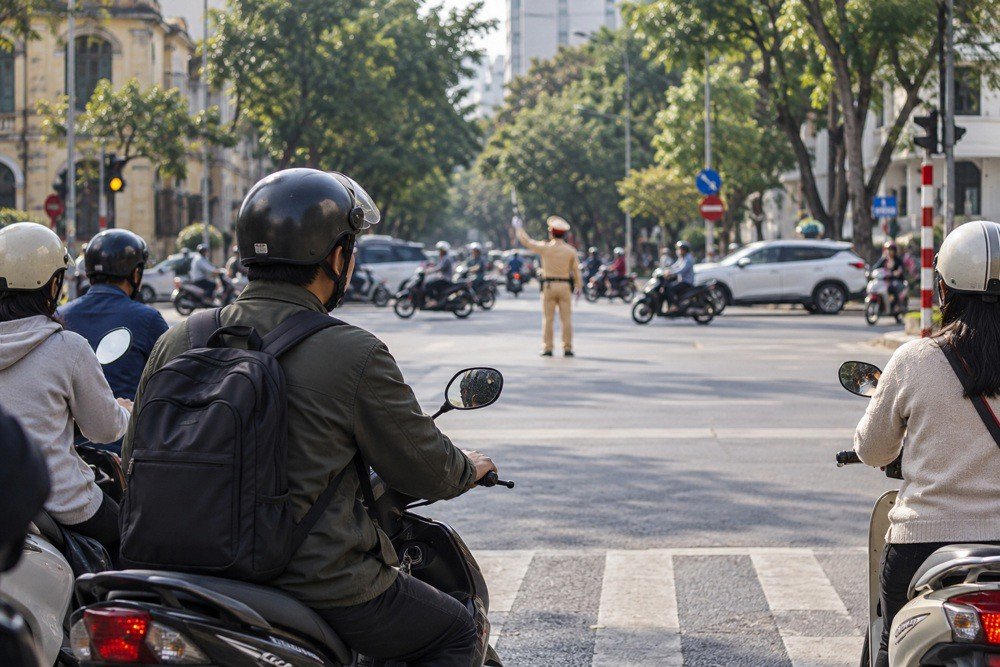
You ride a rental bike into a Hanoi junction. The lights are flashing and someone in the middle of the junction is directing traffic by hand. Which gesture stops you, which lets you go, and does the gesture outrank the light? This guide follows Vietnam’s Law on Road Traffic Order and Safety (Law 36/2024/QH15, in force since 1 January 2025) and Ministry of Public Security pages about Circular 69/2024/TT-BCA.
The hand signal outranks the light
Article 11(2) of the law tells road users to obey road signals in a fixed order of priority: first the commands of the traffic controller, then traffic lights, then road signs. Article 2(10) defines a traffic controller as the Traffic Police or a person assigned to guide traffic on the road. So when a hand signal and a light disagree, the hand signal comes first.
The three gestures written into the law
| Gesture (Article 11(3)) | Who must stop | Who may go |
|---|---|---|
| (a) Right arm raised straight up | Road users from every direction | The text names no direction that may go |
| (b) Both arms, or one arm, held out to the side | Those in front of and behind the controller | Those to the controller’s right and left |
| (c) Right arm held out in front | Those behind and to the right of the controller | Those in front may turn right; those on the left may go in any direction; pedestrians crossing must pass behind the controller |
‘In front’, ‘behind’, ‘right’ and ‘left’ are counted from the controller’s body, not from your bike. One way to picture it (ours, not the law’s): if you are facing the controller, their right is on your left-hand side; if you are behind them, the sides match your own.
Whistle sounds that go with the gestures
A Ministry of Public Security article dated 25 November 2024 describes Circular 69/2024/TT-BCA, effective 1 January 2025. To stop every direction, the officer gives one long, strong whistle blast with the baton raised straight up in the right hand. To let traffic move, the officer gives one short, quick blast with both arms out at shoulder height. When traffic is allowed to flow for a while the officer may lower one arm, which matches the law’s wording of both arms or one arm.
A baton pointed at your bike is a different signal
At a roadside check the signal is aimed at one vehicle. A Ministry article of 29 November 2024 on Circular 73/2024/TT-BCA says the officer raises the baton, points it at the vehicle to be checked and blows a firm whistle; the rider must slow down and stop where directed. Article 72(2)(b) of the law lists obeying a stop command as a duty. If that happens during a rental, read Stopped by Traffic Police in Hanoi: papers and questions.
What not to do
- Do not read right and left from your own bike: the sources count them from the controller’s body.
- Do not follow only the flashing light: Article 11(2) ranks the controller’s signal first.
- Do not simply copy the vehicle ahead; work out which side of the controller you are on (our suggestion).
What the pages leave out
None of the pages explains how to recognise an assigned traffic guide by armband, uniform or badge, or how to tell a team leader from a team member at a distance. None has a separate sentence for the moment when a hand signal and a light say different things; only Article 11(2) gives the order of priority.
Sources checked
- Law 36/2024/QH15 on vbpl.vn (marked in force, updated 29 March 2026)
- Ministry of Public Security, 25 November 2024: whistle sounds and gestures
- Ministry of Public Security, 23 December 2024: duties at junctions
The Vietnamese version of this guide lists every page with its date.
Questions to ask the shop before a busy junction
Ask how the indicators and horn work on the bike you will collect, and where there is a quiet place to test the brakes, because a stop signal can come at short notice. Ask whether, and when, the shop wants to hear from you if you are stopped for a check during the rental. Nguyen Ha’s phone number is 0334 699 969; the listed bikes are on Hanoi motorbike rental prices.