Riding Skills & Safety Planning
Keeping Four or Five Motorbikes Together on a Group Ride
On this page
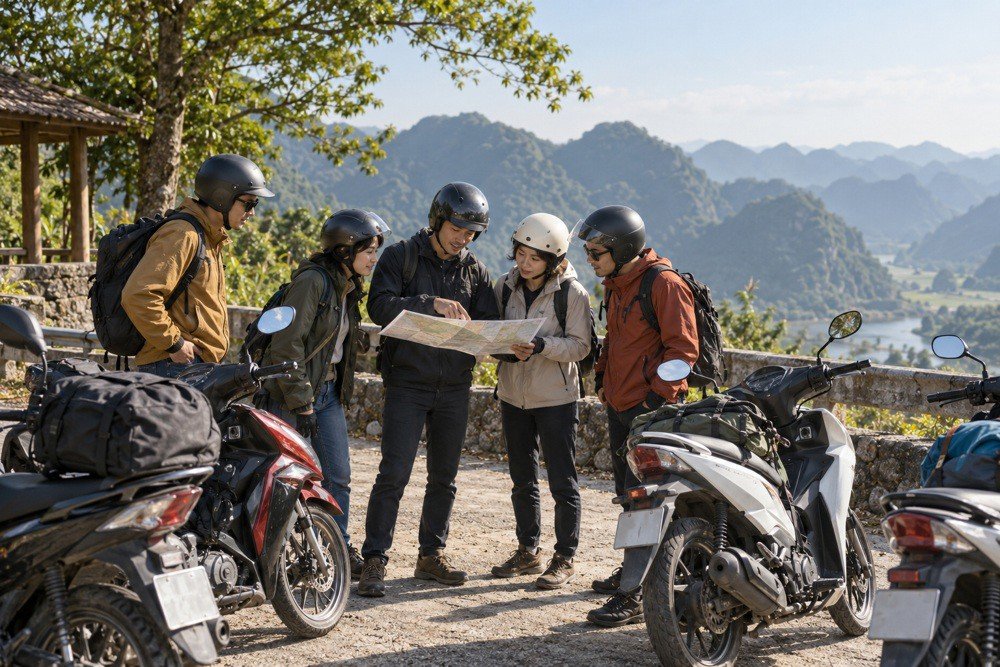
How do four or five friends on separate motorbikes stay together without taking risks? Agree a riding order, keep safe gaps in a line rather than side by side, use simple agreed signals for stopping, and fix regrouping points before every leg so that nobody chases the group through red lights. Vietnam’s 2024 road traffic law prohibits motorbikes from riding abreast and requires proper signals when turning or stopping, so group habits have to fit inside those rules. Each rider must also be legally qualified and confident for the route.
A small group on rental bikes usually mixes people who know the way with people who do not, and riders of different experience. This guide focuses on formation, signals and a plan for getting separated; a companion guide covers meeting points, spacing and a lost rider on city rides.
What the law expects of a group
The consolidated Law on Road Traffic Order and Safety has no special rules for groups, but several general rules shape how a group should ride:
| Article | What it says |
|---|---|
| Article 33(3) | Motorbike and moped riders must not ride abreast, use an umbrella or audio devices (other than hearing aids), or ride with both hands off the handlebars |
| Article 15(2) | Before turning, check behind, keep a safe distance, slow down and signal continuously throughout the turn |
| Article 11(4) | A red light means no going, even if the rest of your group has just gone through on amber or green |
| Article 21(1) | Use the horn only to warn of a potentially unsafe situation or to signal that you are about to overtake |
The law does not define every formation, so this guide does not claim that any particular pattern is officially approved. Riding in a line with safe gaps is the simplest arrangement that clearly respects the rule against riding abreast.
Riding order: leader, middle and sweeper
- Leader: the rider who knows the route best and can set a pace that suits the least experienced rider, not the fastest.
- Middle: less experienced riders, so they are watched from behind and are not left at the back.
- Sweeper: an experienced rider at the back who never overtakes the group, keeps everyone in sight and calls the leader if someone stops.
Agree that nobody overtakes the leader. If someone must pass, for example to take a wrong turn back, they should signal clearly and tell the group at the next stop.
Gaps between bikes
Riding guides commonly suggest leaving at least a two-second gap to the bike in front, counted from when it passes a fixed point. At 30 km/h, a bike covers about 8.3 metres per second, so two seconds is roughly 17 metres. In stop-and-go Hanoi traffic you will be closer at low speed, but keep enough room to stop without touching the bike ahead. In rain, at night or on poor surfaces, increase the gap.
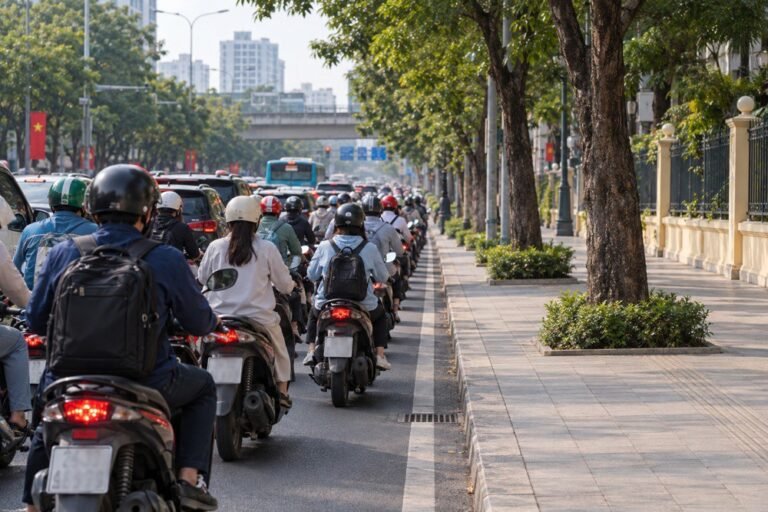
A tight cluster of bikes is not safer than a spread-out line; it leaves less room for everyone to react and blocks other road users.
Signals for stopping and turning
- Turning: everyone uses their own indicator, every time, as Article 15(2) requires. Do not rely on the leader’s signal for the whole group.
- Stopping: agree in advance how the leader will show the group is about to stop, for example indicating early and slowing gradually, and use the agreed stops rather than sudden roadside halts.
- Hand gestures: any group hand signals must be simple, agreed before departure and never require taking a hand off the bars in a moment that affects control.
- Horn: use it for genuine warnings, not as a constant “follow me” signal.
When a red light splits the group
This is the moment most groups get into trouble. The rule is simple: if the light turns red, the riders behind stop, even if the leader and others have gone through. The front riders should then continue to the next agreed regrouping point, or pull in somewhere safe and legal where stopping is permitted, and wait. Nobody should run a red light, speed or weave through traffic to catch up.
Choose regrouping points before each leg: a petrol station, a café or a car park a few kilometres ahead, where bikes can pull off the road completely.
A plan for getting separated
- Before setting off, share the route and the next regrouping point in the group chat.
- Turn on live location sharing; the guide to sharing live location on a group ride explains how.
- If you lose sight of the group, do not chase; ride to the agreed point or stop safely and call.
- Agree how long the group will wait at a regrouping point before calling a missing rider.
- Write down the leader’s number on paper, in case a phone battery dies.
What not to do
- Do not ride side by side across a lane to chat or keep together.
- Do not overtake the leader or race each other.
- Do not follow the bike in front blindly; make your own judgement at every junction.
- Do not tailgate to stay “in formation”.
What the sources do not settle
Riding guides differ on exact gap sizes and on staggered versus single-file formations, and none of the official texts we checked deals specifically with small groups of rental bikes in Hanoi. Choose the simplest arrangement that keeps everyone legal and relaxed.
Questions to ask the rental shop
- Are the indicators, brake lights, mirrors and horns working on every bike in our booking?
- If one bike breaks down or the group is separated, which number should we call, and what information do you need?
For booking several bikes at once, see the shared booking checklist for group rentals.
Message to send the shop
Hello Nguyen Ha, we are [number] riders renting [number] bikes from [date] for a group ride to [destination]. Could you check that the lights, indicators and horns work on every bike, and tell us which number to call if one bike has a problem or we get separated?
Frequently asked questions
Can a group of motorbikes ride two abreast in Vietnam?
No. Article 33(3) prohibits motorbike and moped riders from riding abreast. Ride in a line with safe gaps.
What should we do if a red light splits the group?
The riders behind stop at the red light. The front riders continue to the next agreed regrouping point or stop safely and wait. Nobody runs the light to catch up.
Who should ride at the back of the group?
An experienced rider who stays behind everyone, never overtakes and alerts the leader if someone stops.
Nguyen Ha Motorbike Rental: Ngõ 5 Nguyễn Văn Cừ, Bồ Đề, Long Biên, Hanoi, Vietnam, open 09:00–21:00 daily. Call +84 334 699 969 to prepare several bikes for a group ride.