Automatic Scooters
Moving From an E-Bike to a Petrol Scooter: First-Ride Safety Checks
On this page
Moving from a lightweight electric bicycle to a petrol automatic scooter is not simply a matter of turning a bigger throttle. The new vehicle may be considerably heavier, with different braking controls, seating, acceleration and legal requirements. Before a first ride, verify that you are legally eligible to operate the actual petrol scooter, and assess your ability to handle it while stationary. Arrange suitable instruction in a permitted, safe environment if you need it. A few laps on an electric bicycle do not prove readiness for traffic on a motorcycle.
This guide is for someone whose familiar vehicle is an electric bicycle and who is considering a petrol automatic scooter in Hanoi. It differs from guidance about switching to a manual-clutch bike or managing an unusually sensitive electric throttle. View the automatic scooter rental range for general options, then ask about a specific model’s weight, size and controls before deciding.
Start with legal classification rather than appearance
Under Vietnam’s current road traffic safety framework, an electric bicycle with pedal assistance is a different vehicle class from a petrol motorcycle. A petrol scooter that looks compact may still be a motorcycle requiring the appropriate riding entitlement. Electric bicycle experience does not automatically provide that entitlement.
The relevant vehicle category depends on technical characteristics such as engine capacity. For newer Vietnamese motorcycle licences, A1 and A categories have displacement-based limits. Licences issued before January 2025 may have transitional arrangements. Foreign permits require their own recognition checks. Verify the specific bike and documents with current official information before any road use.
A rental provider can tell you which documents it requests, but the provider’s willingness to hand over a bike does not remove statutory driver requirements. If you are unsure of eligibility, do not attempt a scooter test on public roads merely to decide whether to rent.
The 2026 consolidated Vietnam road traffic safety law sets out vehicle categories and rider requirements. This guide cannot validate any individual’s licence or approve a rider from their electric-bicycle experience alone.
The weight difference can be surprisingly large
Assess real vehicle weight
Some small electric bicycles feel easy to push across a courtyard or balance beside a kerb. Many petrol scooters have a substantially higher vehicle weight, and moving them backwards or putting them on a centre stand can require more effort than riding at a steady speed. Weight also interacts with wheel size, centre of mass and seat height.
Two published model examples
To illustrate why specific models matter, Honda Vietnam publishes a weight of 97 kg for a version of its Vision scooter, while YADEA Vietnam lists a 40 kg mass for its i6 electric bicycle. These are two specific manufacturer figures, not an average for all scooters or e-bikes. Variants, batteries and model years must be checked; a different pair can have very different figures.
You can see the manufacturer’s figures on Honda’s Vision specification page. No claim is made that the rental shop has that version available today; the comparison simply explains why a first-time rider should inspect the actual bike rather than relying on a broad vehicle category.
When assessing your ability, stand beside the stopped scooter with the owner’s permission and see whether you can safely hold, push and park it. If a bike feels too high or heavy, that is a valid reason to choose another model or another form of transport. Do not force a physically uncomfortable vehicle into service.
Braking is not identical across models
Know the actual braking arrangement
An electric bicycle may have bicycle-style brake levers, drum brakes, discs or a particular combination depending on model. A petrol scooter may have combined braking, separate front and rear controls or another design. The presence of two levers does not prove they work in exactly the same way.
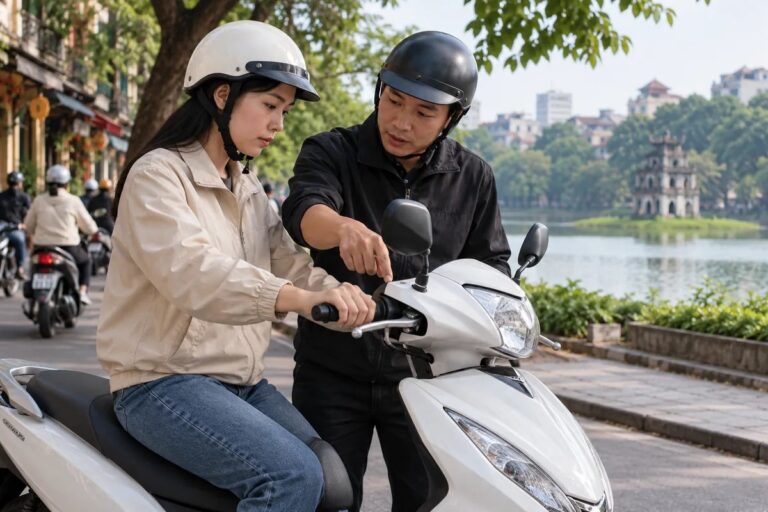
Ask the rental employee to point out each brake, the normal lever feel and any combined or anti-lock braking feature. Do not determine which brake is which by trying a sudden stop on a busy street. Read the exact model’s handbook and follow qualified instruction where needed.
If your hands cannot reach the levers comfortably, the scooter may be unsuitable. Also look for an unfamiliar rear foot-brake or other control arrangement on the actual vehicle. Do not assume that every automatic petrol scooter has precisely the same levers as the electric bicycle you know.
Never respond to an uncertain braking system by increasing speed “to see how it feels.” If a brake seems weak, spongy, sticky or abnormal during permitted stationary checks, report it and ask for inspection before moving off.
Throttle response is different too
New throttle and drive response
A petrol automatic scooter normally uses an engine and transmission that deliver power through a particular engagement process. Its throttle response and acceleration depend on the engine, automatic clutch, transmission and vehicle condition. That can feel different from an electric bicycle where assistance is linked to pedalling or a small electric throttle.
Opening a motorcycle throttle more than intended can produce unwanted acceleration. Proper preparation means learning the controls, keeping wrists and hands positioned as recommended for the specific bike, and avoiding unintended twisting when mounting or repositioning the vehicle.
Do not hold the accelerator against an applied brake to “warm up” or test the power. That can stress components and create a risk of unexpected movement. If the bike surges, stalls unexpectedly or feels mechanically abnormal, stop safely and ask the provider to investigate.
The aim is smooth, predictable control, not reaching a certain speed on your first day. If you have not previously ridden a motorcycle, appropriate instruction in an approved environment is more important than a rented bike’s advertised acceleration.
Plan a controlled familiarisation, if allowed
Before the engine starts: ask for a demonstration of the ignition, key or smart key, stand, brake levers, switches and dashboard. Confirm how to turn the scooter fully off. An unfamiliar key sequence is a poor problem to discover while traffic is waiting behind you.
Stationary fit check: assess seat height, balance, view of mirrors and ability to support and push the bike. Make sure your feet and clothing will not interfere with moving parts. Do not start the engine merely to see whether the vehicle is light enough to handle.
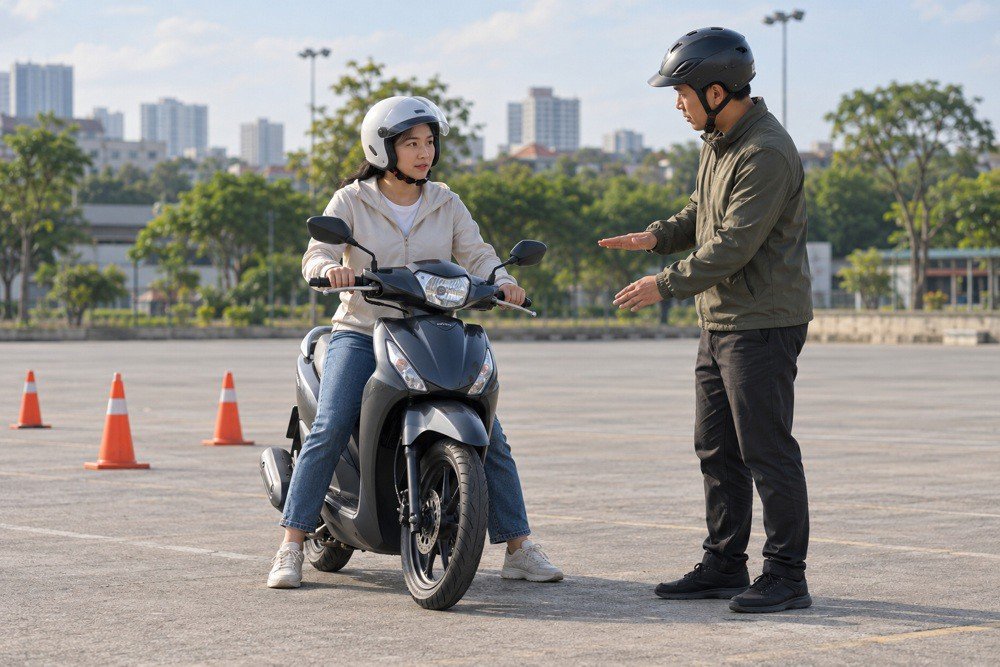
Supervised practice: if you are legally eligible and the shop or instructor agrees, use only a safe permitted area with appropriate protective equipment and guidance. Familiarisation may cover starting, stopping, gentle steering and balancing, but the process must suit your skill and the exact vehicle.
Decision point: if the scooter feels unstable or its controls remain unfamiliar, do not treat a short trial as permission to venture into central Hanoi traffic. Choose more instruction, a more suitable vehicle or another transport option.
A six-item comparison before choosing
Body fit: can you sit comfortably, reach the brakes and hold the scooter stationary? A low seat or small-looking body is not enough without a physical check.
Weight and stand: can you move and park it where you actually live? A steep driveway or narrow alley may matter more than performance on an open road.
Brakes: can you correctly identify and operate the model’s braking system and understand any warning or combined-brake feature? Do not assume a previous vehicle used the same system.
Acceleration: do you understand the throttle and automatic drive well enough to avoid unintended movement under suitable supervised conditions? The precise response is model-specific.
Legality: is the actual rider properly authorised and qualified for this petrol motorcycle? This cannot be settled by the similarity of its controls to an electric bicycle.
Daily use: does the scooter fit the intended route, parking space, luggage and weather? A more powerful vehicle has little value if it is awkward, intimidating or legally unsuitable for you.
Do not generalise from an electric bicycle’s speed
Some electric bicycles cut motor assistance at 25 km/h under the current legal definition, but the vehicle’s actual features must be confirmed. A petrol scooter may travel much faster and place different demands on braking, traffic observation and stability. Do not equate “I have ridden an e-bike in the neighbourhood” with motorcycle experience.
What matters most in dense Hanoi traffic is recognising other road users, stopping safely, scanning intersections and making smooth decisions. Those skills require time and practice and are not fully tested by pressing a throttle for a few seconds in a courtyard.
If a novice rider is still developing basic balance and braking confidence, choose instruction rather than an unplanned public-road trial. This advice is not a claim that all electric-bicycle users lack skills; experienced individuals vary, and the new vehicle has to be assessed on its own merits.
Questions for the rental shop
Can you identify the exact petrol model and variant, and show its owner’s manual? What is its published weight and seat height? Where are the brake controls, and does it have any model-specific features requiring explanation? Are any legally permitted familiarisation arrangements offered?
Ask which licence and other rider documents are required for that vehicle. How are rental charges, deposit, pickup and return handled? If the model proves unsuitable before handover, what options does the actual agreement provide? Do not assume free trials or model swaps are standard.
For an overview of petrol options and current pricing, see the Hanoi motorbike rental price guide, then obtain a written quote for your dates. A product photo or price list cannot confirm a particular bike’s current availability or its exact controls.
Frequently asked questions
Can I drive a petrol scooter using only electric-bicycle experience? Practical experience may help with some balance habits, but legal rider eligibility and correct motorcycle control must be verified separately.
Are all scooters about 97 kg? No. The figure is for a specific published Honda Vision variant. Other petrol scooters can be lighter or heavier, and actual configuration matters.
Will an automatic scooter feel exactly like my e-bike? Not necessarily. Brake layout, weight, throttle response, seating and drive behaviour differ by model. Ask for appropriate instruction.
Should I practise in a quiet public alley? A quiet alley is not automatically a suitable or permitted training area. Practice requires legal eligibility, suitable conditions and proper guidance.
Ask Motorbike Nguyen Ha about suitable models
Motorbike Nguyen Ha is at Alley 5 Nguyen Van Cu, Bo De, Long Bien, Hanoi, published hours 09:00–21:00. Call +84 334 699 969 or message via Zalo/WhatsApp with your riding experience and dates. Ask about actual available scooters and whether any authorised familiarisation is possible; this article makes no promise of a trial or a particular bike.