Food & Cultural Stops
Seafood or Peanut Allergy at a Hanoi Street Stall: How to Tell the Cook Clearly

On this page
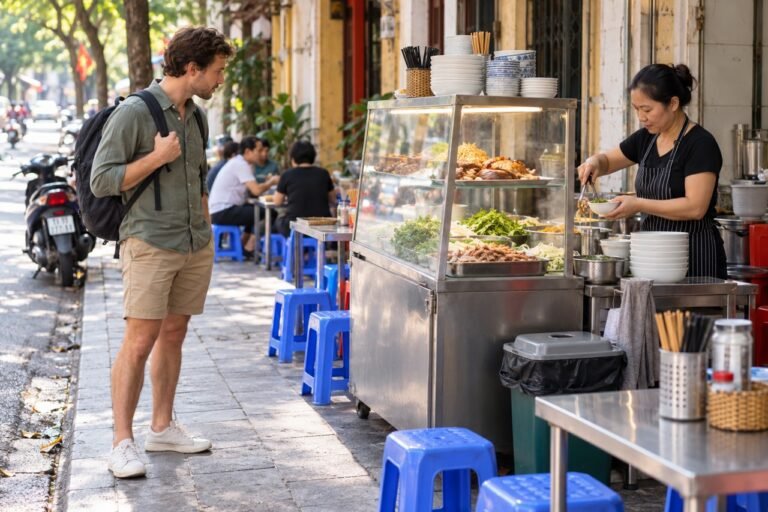
You are allergic to seafood or peanuts and want to eat at Hanoi’s street stalls, where there is rarely a menu listing ingredients and the cook is serving several tables at once. How do you make yourself understood? Say it clearly before you order, ask about the hidden parts of the dish, and walk away if the answer is unclear. Once a bowl reaches the table, you cannot see what is in the broth, the dipping sauce or the oil it was fried in. This guide gives Vietnamese phrases, a short allergy card and a plan for what to do if you react.
It is not medical advice. Your own doctor decides what you must avoid and what to carry.
If you suspect anaphylaxis, use the adrenaline auto-injector you have been prescribed straight away, following the device instructions, and call or have someone call 115, Vietnam’s ambulance number. The NHS advises not to stand or walk, even if you feel better: do not walk to the parking area or ride. Do not use the UK number in NHS material; in Hanoi it is 115.
Before you go out: your doctor and an allergy card
- Ask your doctor in advance exactly what to avoid, how careful to be with shared oil and utensils, and what plan to follow if you react. Carry what you have been told to carry.
- List specific foods rather than a general word: shrimp, crab, squid, fish and so on, as your doctor advises. For peanuts, Vietnamese has two words, đậu phộng and lạc; northern cooks usually say lạc, so write both.
- Make a large handwritten card or keep a screenshot on your phone, with a paper copy in case the phone dies.
- Tell the people you are with about the allergy and what to do if you react. Our page on emergency information to carry suggests a card format for riders.
A three-line card in Vietnamese, with accents:
“Người cầm thẻ bị dị ứng với: (list each food to avoid).”
“Xin cho biết món, nước dùng, nước chấm và dầu nấu có chứa hoặc dùng chung với các thứ này không.”
“Nếu chưa rõ, xin cho biết là chưa rõ. Xin cảm ơn.”
In English: the holder is allergic to the foods listed; please say whether the dish, broth, dipping sauce or cooking oil contains or is shared with them; if you are not sure, please say so; thank you.
Phrases to use before you order
| What you need to say | Vietnamese | Why |
|---|---|---|
| State the allergy | “Em bị dị ứng hải sản và đậu phộng, tức là lạc. Món này có những thứ đó không ạ?” | Say it while ordering, before cooking starts |
| Ask what is in the dish | “Món này nấu với những gì ạ? Có tôm, cua, mực, cá hoặc lạc không ạ?” | Naming each item gets a clearer answer |
| Ask about broth, sauce and seasoning | “Nước dùng hoặc nước chấm có nấu hoặc pha từ hải sản, hoặc có lạc không ạ?” | You cannot see these once the dish arrives |
| Ask about oil, pans and utensils | “Món này nấu chung chảo hoặc chung dầu với món có hải sản hoặc lạc không ạ?” | Shared oil, pans, ladles and tongs can carry food from one dish to another |
| Confirm | “Anh chị nhắc lại giúp em là món này không có hải sản và không có lạc, đúng không ạ?” | Hearing the cook repeat it back is clearer than a nod |
| Hand over the card | “Anh chị đọc giúp em tấm thẻ này ạ.” | Useful when the stall is noisy |
“Em” is a polite way to refer to yourself when speaking to someone older, and “anh chị” addresses them; adjust to suit the person. Change the list of foods to match your own allergy. For first-time stall etiquette, see eating at a Hanoi street stall for the first time.
- Broth and dipping sauce: ask what they are made from and whether they share a bowl or jar with other dishes. Many Vietnamese dipping sauces are based on fish sauce or shrimp paste.
- Frying oil and pans: ask whether they are shared with seafood or peanut dishes. Watching whether the cook changes oil or pans does not replace an answer.
- Boards, knives, ladles and tongs: ask whether they are used for several dishes.
- Toppings added at the end: ask about them separately, because crushed peanuts, fried shallots or dried shrimp are easy to forget when the cook lists ingredients.
- Chopsticks, spoons and dipping bowls: use your own, and do not share a dipping bowl with someone eating seafood or peanuts.
When the cook is unsure or does not understand
- A vague reply is not an answer. Something like “probably not” is not clear enough; ask once more, naming each food.
- If the cook does not know what is in the sauce, seasoning or broth, treat it as unknown and choose another dish or another stall.
- If the stall cannot cook it separately, thank them and move on rather than insisting.
- If it is too busy or noisy to talk, wait until it is quieter or choose somewhere easier.
- If the cook cannot read your card, ask a companion or your accommodation staff to rewrite it in the wording the cook uses.
What not to do
- Do not guess ingredients from smell, colour or appearance.
- Do not taste a little to see, without a clear answer.
- Do not stay silent to avoid a fuss; keep it short but complete.
- Do not assume a stall is safe next time because you had no reaction once.
- Do not take medicine beyond what your doctor has told you.
- Do not ride while you feel unwell.
If you feel unwell after eating
- Stop eating straight away; do not eat more to see what happens.
- Tell your companion and the cook what you just ate so they can help.
- Follow the plan your doctor gave you. This guide does not give dosing advice.
- With serious signs such as difficulty breathing, a swollen tongue or throat, or feeling faint, use your prescribed auto-injector at once and call 115. Say you suspect anaphylaxis and name the food. The NHS lists symptoms including throat or tongue swelling, fast or difficult breathing, wheezing, dizziness or fainting, and says to use a second auto-injector if there is no improvement after five minutes.
- Do not ride or walk to the parking area. If it does not delay care, a companion can keep the key and parking ticket and tell the shop later.
- When there is time, have someone note the stall name, the time and the dishes eaten for the medical staff. Never wait to collect details before calling for help.
Our guide to emergency numbers in Vietnam explains 113, 114 and 115, and what to tell the operator.
What the sources do not say
- No source tells you which Hanoi stalls or dishes are safe for a particular allergy.
- No source gives a list of the ingredients in common Hanoi dipping sauces; recipes vary by stall.
- The NHS page is UK guidance; the emergency number to call in Vietnam is 115, which Hanoi’s Department of Health gave in its 17 February 2026 guidance.
- This guide does not cover medicine choices or doses.
Sources checked
- NHS, Anaphylaxis (last reviewed 21 June 2023); steps re-checked on 18 November 2026: nhs.uk
- Hanoi Department of Health, guidance to call 115 for emergency help, 17 February 2026
Message to send the shop
Hello Nguyen Ha, I have a serious food allergy. If I ever need to leave the bike somewhere because I feel unwell, who should I call and what information would you need from me to collect it?
Frequently asked questions
How do I say “I am allergic to peanuts” in Vietnamese?
“Em bị dị ứng đậu phộng, tức là lạc.” Northern Vietnamese usually says lạc for peanut, so use both words.
Is fish sauce a problem if I am allergic to seafood?
It may be: fish sauce is made from fish and many dipping sauces use it or shrimp paste. Ask your doctor whether you must avoid it, and ask the cook what each sauce contains.
What number do I call for an ambulance in Hanoi?
115. Say you suspect anaphylaxis, give the location and a phone number, and name the food you ate.
Nguyen Ha Motorbike Rental: Ngõ 5 Nguyễn Văn Cừ, Bồ Đề, Long Biên, Hanoi, Vietnam, open 09:00–21:00 daily. Call +84 334 699 969 if you need to leave the bike somewhere because you are unwell.