Riding Skills & Safety Planning
Speed Bumps and Potholes With a Passenger or Luggage
On this page
How should you ride a motorbike over speed bumps and potholes with a passenger or luggage on board? Spot the obstacle early, finish slowing down before you reach it, cross speed bumps square-on with a steady throttle, and warn your passenger so they can hold on. Extra weight lengthens braking distances and makes jolts harsher, so slow down more than you would riding alone, keep luggage low and tied down, and check the tyres and rims after any hard hit.
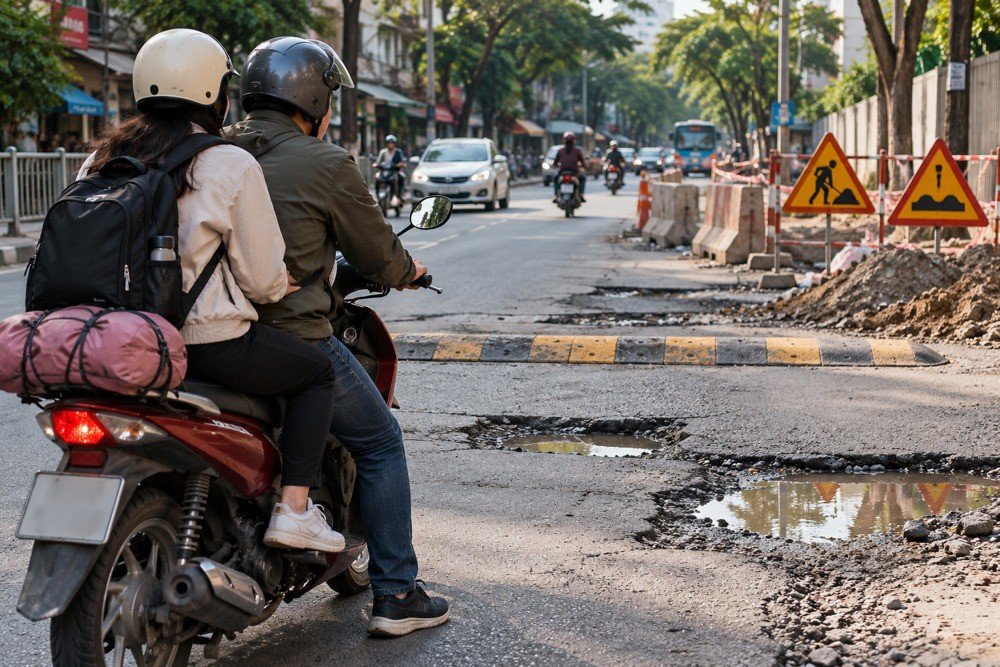
Speed bumps, potholes and patches of half-finished road works appear without warning in Hanoi and on the roads out of the city. On your own, a jolt is uncomfortable; with a passenger or a loaded rack, it can unsettle the bike, shift your bags or throw your passenger against you. This guide explains how to prepare and how to ride through.
Why extra load makes a jolt more dangerous
| Situation | Risk |
|---|---|
| Heavy or high-stacked luggage | When the bike bounces, the load can shift and upset the balance |
| Passenger not ready | They can be lifted off the seat or thrown forward against you when the bike jolts or brakes |
| Heavier bike overall | The suspension works harder and stopping distances get longer |
| Potholes filled with water | You cannot judge the depth, and the wheel may drop further than expected |
| Half-finished road works | Sudden ridges, steps, loose sand and gravel, and changes in surface height |
How serious each risk is depends on the bike, the load and the road, so slow down more whenever you are unsure.
Stay within the legal and design limits first
No riding technique makes up for an overloaded bike. Article 33 of the consolidated Law on Road Traffic Order and Safety allows one passenger on a motorbike, with a second permitted only in specific cases such as carrying a child under 12. It prohibits bulky loads, and luggage must not extend more than 0.3 m beyond each side of the luggage rack or more than 0.5 m behind it, and must not be higher than 2 m above the road.
The manufacturer also sets a maximum load for each model, usually stated in the owner’s manual. The guide to two people on one rental bike explains how to check whether your combined weight and luggage fit.
Crossing a speed bump
- Look well ahead so you see the bump early, and slow down before it rather than braking hard right beside it.
- Cross it square-on, not at an angle.
- Finish your braking before the wheel reaches the bump and avoid sudden inputs. There is no single trick, such as releasing the brakes at the moment of contact, that suits every bike, load and slope.
- Keep the throttle steady and gentle; do not accelerate while the front wheel is climbing the bump.
- Sit upright, hold the handlebars firmly and keep your elbows slightly relaxed to absorb the bump.
- Warn your passenger just before the bump so they can brace and hold on.
Potholes and half-finished road works
- Look ahead and steer around potholes when it is safe, but never swerve suddenly into another lane of traffic.
- Slow down early instead of discovering a pothole at speed.
- Do not assume every pothole can be ridden through with a straight line and released brakes. If you cannot see how deep it is or what lies underneath, stop in a safe place and find another way.
- Treat a water-filled pothole as deeper than it looks: slow right down or go around it if there is a safe gap.
- On road works with sand, gravel or uneven edges, ride even more slowly and leave more space to the vehicle ahead.
- If the surface is very bad, consider walking the bike or choosing another road.
Small wheels and soft suspension feel every hole more. The guide to wheel size and rear suspension for potholes and speed bumps helps you pick a suitable bike before you set off.
Securing luggage and briefing your passenger
- Keep heavy items as low and close to the centre of the bike as possible.
- Tie luggage down firmly so it cannot slide when the bike bounces or brakes.
- Do not hang heavy bags from the handlebars, and do not let luggage cover your lights, number plate or mirrors.
- Ask your passenger to hold on firmly, keep their feet on the footrests and lean with the bike rather than against it.
- Agree on a short word you will call out before a bump or pothole.
- Check the load again after any rough stretch.
For strapping bags to a rack, see rear racks and bungee cords for soft luggage.
At night or in the rain
After dark, faded speed bumps and water-filled potholes are hard to see until they are right under your front wheel. Ride more slowly than in daylight, keep your headlight on and watch the vehicle ahead: if it suddenly slows or bounces, something is on the road. In rain, braking distances grow further, so leave even more room.
What not to do
- Brake hard on top of a speed bump or inside a pothole.
- Cross a speed bump at an angle or steer sharply in the middle of a pothole.
- Open the throttle hard to “jump” a rough patch.
- Carry loose luggage or stack it high enough to block your view.
- Apply one riding position to every bike and every obstacle; what works depends on the bike, the load and the surface.
- Look at your phone while crossing a bad stretch.
After a hard jolt
- Slow down under control and stop in a safe place.
- Check that your passenger is fine and the luggage is still secure.
- Look at the tyres and rims for bulges, dents or loss of air.
- Listen for new noises when the suspension moves or when you ride off slowly.
- If the steering wobbles, the bike pulls to one side or a tyre looks soft, do not ride on; call the rental shop.
- If anything is damaged, take photos and report it promptly.
The checklist after a pothole hit goes through rims, tyres and steering step by step.
Suspension settings for two riders
Some bikes have adjustable rear shock preload that suits heavier loads. Do not adjust it yourself with tools; ask the shop to set it up or confirm it is right. The guide to rear suspension preload for two riders explains why.
Questions to ask the rental shop
- How much passenger and luggage weight can this bike carry, and where should luggage go?
- What tyre pressure suits riding with a passenger and luggage?
- What should I report if the bike feels different after a hard bump?
Message to send the shop
Hello Nguyen Ha, I will ride the [model, plate number] with a passenger and [luggage]. Could you confirm the load limit, the right tyre pressure and whether the rear suspension suits two riders?
Frequently asked questions
How fast should I cross a speed bump with a passenger?
Slowly enough that you finish braking before the bump and cross it square-on with a steady throttle. With extra weight, that usually means slower than you would go alone.
Can I ride through a pothole full of water?
Treat it as deeper than it looks. Slow right down or go around it when there is a safe gap, and avoid it altogether if you cannot judge its depth.
What should I check after hitting a pothole hard?
Your passenger and luggage first, then tyres, rims and steering. If anything feels or looks wrong, stop riding and call the shop.
Nguyen Ha Motorbike Rental: Ngõ 5 Nguyễn Văn Cừ, Bồ Đề, Long Biên, Hanoi, Vietnam, open 09:00–21:00 daily. Call +84 334 699 969 if your rental bike feels different after a hard bump.