Weather & Seasonal Riding
Sudden Thunderstorms on a Motorbike Trip: When to Stop
On this page
What should you do when a sudden thunderstorm hits during a motorbike trip in Vietnam? If you can hear thunder, stop riding and get inside a substantial building as soon as you safely can, because a motorbike gives no protection from lightning. Avoid sheltering under trees, billboards, open-sided roofs or near power lines, and wait at least 30 minutes after the last thunder before setting off. If there is only heavy rain without thunder, the safest choice is still to wait it out; if you must ride, slow down, ride smoothly and never cross deep or fast-flowing water.
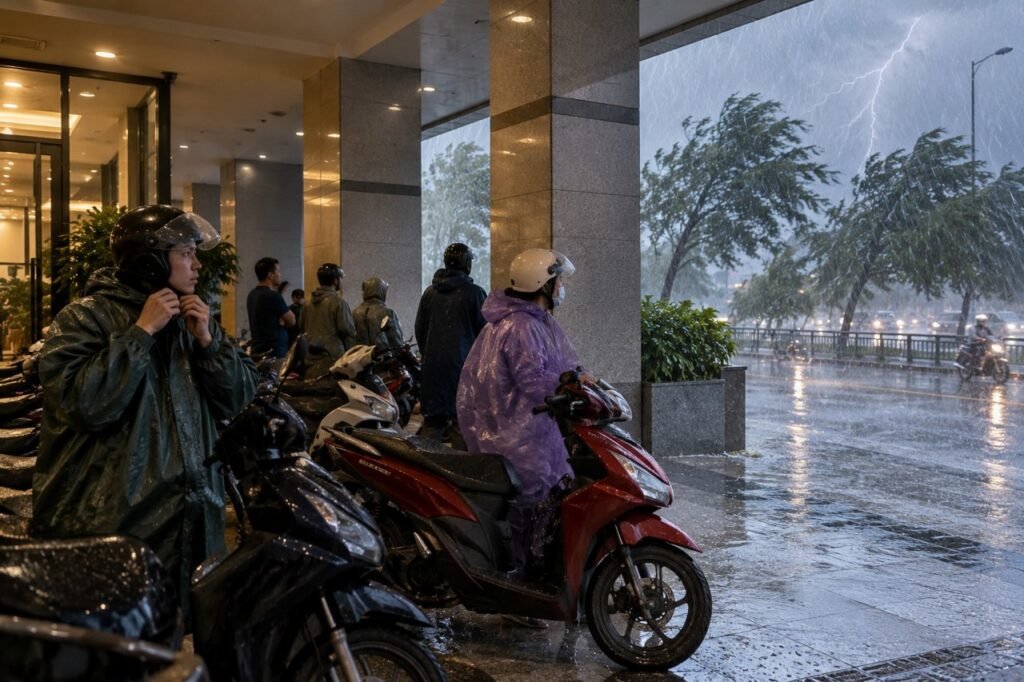
In Vietnam’s warm, wet season, storms can build within an hour on a hot afternoon. Wind picks up, the sky darkens and rain arrives in sheets, sometimes with hail. This guide explains what official safety guidance says about lightning and riding in rain, and what it leaves for you to judge.
What a storm can bring
| Phenomenon | What it brings | Why it matters on a motorbike |
|---|---|---|
| Thunderstorm | Lightning and thunder, often with strong wind and heavy rain, sometimes hail | You are exposed to lightning, wind and poor visibility at once |
| Squall | A sudden surge of strong wind with an abrupt change of direction and a drop in temperature | A gust can push a light bike sideways or bring down branches and signs |
| Whirlwind | Very strong rotating wind over a small area, lasting a short time | Hard to predict and can throw debris across the road |
| Heavy rain | Reduced visibility, water on the road and sometimes flooding | Less grip, longer braking and hidden potholes |
Lightning: why your motorbike is not shelter
The US National Weather Service states plainly that motorcycles and bicycles offer no protection from lightning, that if you can hear thunder you are within striking distance, and that you should not wait for the rain to start before seeking shelter. Its lightning safety guidance also says not to leave shelter just because the rain has ended.
NOAA’s lightning safety page says there is no safe place outside during a thunderstorm. The safest place is a large enclosed building with plumbing and electrical wiring; an enclosed metal vehicle such as a car, van or bus is a reasonable alternative. Open-sided structures such as sheds, picnic shelters and carports are not safe, and neither are porches. Never shelter under an isolated tree.
Both pages give the same rule for leaving shelter: wait at least 30 minutes after the last thunder.
Where to pull in, and what to avoid
- Go inside: a shop, café, restaurant or other enclosed building is the practical choice on a Vietnamese road. A petrol station’s enclosed shop counts; its open canopy does not.
- Avoid trees: do not stop or shelter under trees, which attract lightning and drop branches in strong wind.
- Avoid electrical equipment: keep away from power lines, poles, transformers and anything that has fallen into water.
- Watch for flying and falling objects: signboards, tarpaulins, metal roofing sheets and scaffolding can come loose in gusts.
- Do not stop in the traffic lane: pull well off the road before stopping, with your lights on.
- Do not stop under flyovers or on bridges: Article 18 of the traffic law prohibits stopping or parking under a flyover or on a bridge unless it is specifically permitted, and riders bunching there in a downpour block the road.
- Park the bike sensibly: on firm ground, away from trees and billboards, and out of the way of other traffic.
Bridges, elevated roads and open stretches
Gusts are strongest where nothing breaks the wind: river bridges, elevated roads, open fields and dykes. A light scooter can be pushed across the lane. If a storm is approaching, avoid starting a long bridge crossing, and never try to cross a bridge or causeway where water is rising or flowing fast. The guide to crosswinds on Hanoi’s bridges and elevated roads explains how wind affects a light scooter.
Heavy rain without thunder
Ontario’s official motorcycle handbook warns that in rain you are more likely to be tired and cold, the road is slippery, traction may be poor, visibility is reduced and brakes may be less effective. Its advice is that the best thing to do is sit it out. If you cannot:
- Brake, turn and accelerate smoothly; sudden changes in speed or direction can cause a skid.
- Use both brakes together, which the handbook says is more effective than the rear brake alone, even on a slippery surface.
- Watch for shiny, worn road surfaces, which are very slippery when wet.
- Treat puddles with caution: they can hide a large pothole.
- Remember the road is often most slippery in the first minutes of rain, before oil and dust wash away.
Two Vietnamese rules apply too. Article 20 of the consolidated road traffic law requires lights when rain or bad weather limits visibility, and Article 33 prohibits motorbike riders from holding an umbrella. Wear a rain suit or poncho that stays clear of the wheels; see rain suit or poncho for Hanoi riding.
When to set off again
The 30-minute rule is about lightning only. Reaching it does not mean the road is safe. Before you ride on, check that:
- No thunder has been heard for at least 30 minutes.
- The wind has dropped enough that the bike feels stable.
- Water on your route has drained; do not ride into water whose depth or current you cannot judge.
- No fallen branches, signs or wires block the road. Keep well away from any fallen power line and report it.
- Your visor, mirrors and lights are clean and working.
Check before you go
Thunderstorm alerts are often issued at short notice and can differ from the day’s general forecast. The guide to thunderstorm alerts versus daily rain forecasts explains how to read the issue time and plan around a warning.
If the storm makes you late
Do not ride through a storm to return the bike on time. Message the shop as early as you can with your location and a realistic arrival time. The guide to running late on return day lists what to tell the shop.
What the guidance does not settle
- The lightning and rain guidance above comes from the United States and Canada, written for their own conditions.
- We found no Vietnamese official guidance that names specific places to shelter or how long to wait before riding on.
- No source explains how a rider can see a whirlwind coming; treat a sudden wind change and darkening sky as a reason to stop early.
Questions to ask the rental shop
- If a storm delays my return, when and how should I let you know?
- Does the rental include a raincoat, and where can I store it on the bike?
- What should I check on the bike after riding through heavy rain?
Message to send the shop
Hello Nguyen Ha, I have stopped at [place] because of a thunderstorm. I am safe and the [model, plate number] is parked away from trees. I will set off when the storm has passed and expect to return at about [time].
Frequently asked questions
Is it safe to keep riding a motorbike in a thunderstorm?
No. A motorbike gives no protection from lightning. If you can hear thunder, stop and get inside an enclosed building as soon as you safely can.
Can I shelter under a flyover or a petrol station canopy?
Article 18 of the traffic law prohibits stopping or parking under flyovers and on bridges unless permitted, and open-sided structures are not considered safe from lightning. Head for an enclosed building, and never shelter under a tree.
How long should I wait before riding again?
At least 30 minutes after the last thunder, and then only once the wind has dropped and the road is clear of floodwater and debris.
Nguyen Ha Motorbike Rental: Ngõ 5 Nguyễn Văn Cừ, Bồ Đề, Long Biên, Hanoi, Vietnam, open 09:00–21:00 daily. Call +84 334 699 969 if a storm delays your return.