
Riding Skills & Safety Planning
Your First Motorbike Trip Beyond Hanoi: Safer Route Planning
On this page
Planning a first motorbike trip beyond central Hanoi? Do not start by choosing the most scenic destination or the longest distance. Start with whether you are legally qualified and genuinely comfortable riding, whether the actual rental bike is permitted on the intended roads, and whether you can complete the route without rushing. A manageable first outing usually avoids difficult gradients, unpredictable weather and lengthy exposure to heavy traffic. Plan legal stopping and turning points rather than assuming a map app will always find a safe place for you to turn around.
First confirm permission to use the rental bike outside the city
The fact that a motorbike is offered for hire in Hanoi does not mean every customer may take every bike to any province. The actual agreement can have limits on distance, geographic area, duration, passenger use or procedures when a fault occurs. Ask the rental shop whether your exact intended route and number of days are allowed before making hotel or sightseeing arrangements around the bike.
Be clear about the places you plan to pass through, not simply the destination name. The shop may need to know whether you expect hills, very long stretches or overnight parking. Record its response to avoid guessing about roadside assistance or what maintenance is included away from the shop.
Does a flat route automatically make a trip easy?
No. Roads across the wider Hanoi region include lower-lying and relatively level areas, but an apparently flat route may have significant truck traffic, junctions, roadworks, flooding or sections with poor visibility. A geographical classification of “plain” does not mean every street in that district is suitable for an unfamiliar motorbike or a nervous rider.
The Hanoi municipal natural-conditions overview describes the city’s different landscape types. Use this as general context only; check your specific road on a recent map and through current road authorities rather than predicting gradients from the name of a district.
Choose a route you can comfortably shorten or abandon
Instead of planning a full-day circuit that has no realistic return option, choose a destination and intermediate stop that allow you to evaluate your condition. Know the legal roads back, fuel availability, where you can rest and what you will do if the weather turns. A familiar route of moderate duration may provide a better first experience than a mountain pass or a remote road with difficult access.
If you have never ridden a motorbike before, a trip outside Hanoi is not a suitable first lesson. Get qualified practical training and establish legal eligibility before considering self-riding. Even an experienced rider should take time to understand the particular rental bike’s controls and braking response.
Route checklist before departure
| Planning issue | Question to answer | Why it matters |
|---|---|---|
| Vehicle permission | Does this particular rental allow the planned route? | Different contracts may set different restrictions |
| Rider eligibility | Do I have valid entitlement and enough experience? | A route plan cannot replace legal or practical competence |
| Road type | Are there expressways or prohibited entrances? | Motorbikes must avoid roads where their class is forbidden |
| Traffic mix | Will I share a corridor with many trucks or buses? | Speed differences and blind spots increase demands |
| Weather | Are there rain, flood, heat or storm warnings? | Conditions can make a routine road unsafe |
| Breaks and fuel | Are there lawful places to park and refuel? | Prevents rushed decisions and low-fuel problems |
| Return route | Where can I safely turn back if needed? | A missed turning point is not a reason to stop illegally |
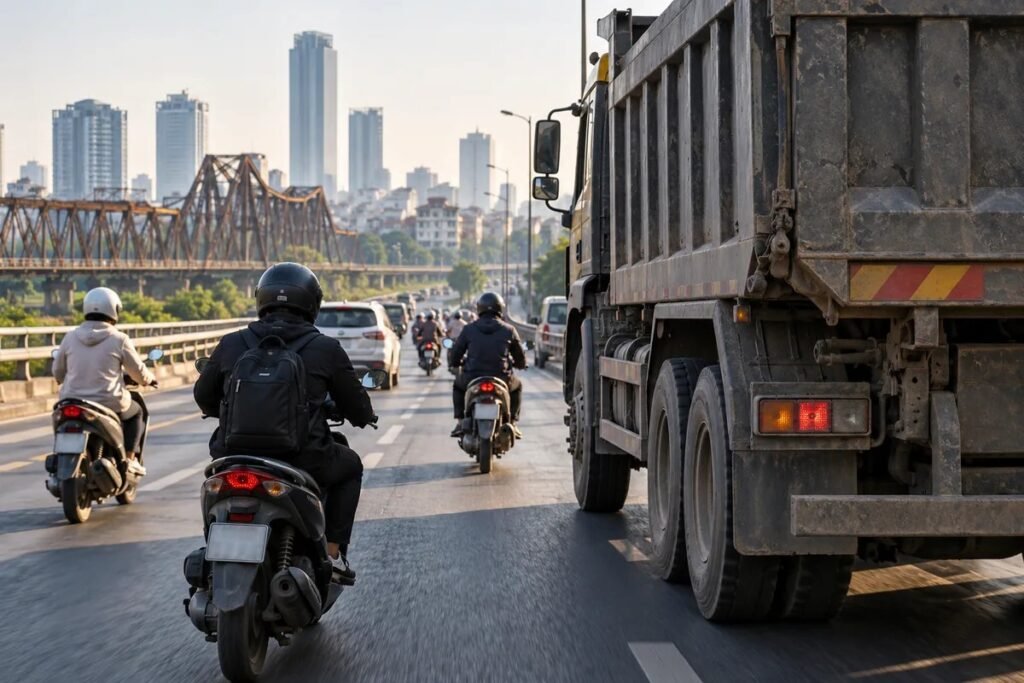
Be particularly careful around heavy vehicles
Trucks and buses have substantial blind spots and need room to turn, brake and change lanes. A rider positioned close to a vehicle’s side or rear may not be visible to the driver. Avoid lingering alongside a turning truck, squeezing into gaps near its wheels or assuming you can be seen because you can see the driver’s window.
Vietnam’s traffic police have published explanations of blind spots around large vehicles. Treat that guidance as a reason to maintain awareness and suitable separation, not as permission to attempt a risky overtake to move ahead of a truck.
What changes outside dense city streets?
Some roads beyond the urban core allow higher speeds for certain vehicle classes, while large vehicles may close gaps more rapidly than a rider expects. Other roads remain narrow, winding or subject to strict local signs. A posted maximum speed is not a target; the correct safe speed may be lower because of visibility, weather, the vehicle or traffic.
On a road shared with much faster vehicles, select a suitable legal lane position and allow enough stopping distance. Do not ride on a prohibited road simply because the navigation app labels it a “fastest route”. Be especially alert at access roads where trucks enter a main road from warehouses or industrial sites.
Plan for turns without illegal U-turns
A first-time route planner may discover that the desired café or viewpoint lies on the other side of a divided highway. That does not make a gap in a median a legal turning point. Look for an allowed junction, roundabout or other designated return route. If you miss a turn, continue to a lawful option rather than stopping in the active carriageway.
Use road signs, lane markings and instructions of traffic officers as the final authority. A location pin is not enough to show that an entrance permits motorcycles or that a U-turn is lawful.
What to do when your first route feels too demanding
Notice fatigue, stress, repeated navigation confusion or difficulty controlling the bike. Stop in an allowed safe place and honestly assess whether continuing is appropriate. You may turn back using an authorised route, take a proper rest, or seek alternative transport. Don’t turn the first outing into a test of endurance simply because you promised friends a photo at a particular location.
If you experience a mechanical concern involving steering, brakes, tyres or the engine, do not push on toward the destination. Contact the provider and arrange a suitable inspection or alternative in accordance with the agreement.
Choosing between a scooter and a semi-automatic bike
The best option is usually a bike you are legally entitled and genuinely competent to control. Some riders are comfortable selecting gears on a semi-automatic; others know an automatic scooter better. Both categories include vehicles with different weight, wheel sizes, braking systems and load limits. A general claim that all semi-automatic bikes climb better or that every scooter is easiest for a beginner is misleading.
If your route has slopes or longer descents, ask the shop whether the specific model and its condition suit that route. The Vietnamese comparison of scooters and geared bikes on hills discusses the underlying considerations but cannot approve an individual journey.
Fuel, luggage and the return time
Ask what fuel the bike requires and record the agreed level at handover. Plan ordinary fuel stops without waiting until the tank is nearly empty in an unfamiliar area. Do not carry luggage that obstructs lighting, steering, braking or your ability to maintain balance. If you need to transport bulky bags, choose a vehicle designed for them.
Calculate the return based on your real start point, allowed roads and realistic rest periods. Leave a buffer for traffic or weather. A day trip that ends far from Hanoi at dusk may not be sensible even if the outbound leg felt easy.
Weather and temporary restrictions can change everything
Rain can reduce visibility and grip; flooding may affect underpasses and low-lying sections; roadworks may require a detour. Do not follow old screenshots that show a route before a temporary closure. Check an up-to-date source near departure and accept that postponing is sometimes the best decision.
The Vietnamese roadworks, restrictions and landslide information guide lists official channels worth checking. An alert from the morning may already be outdated by the afternoon, so follow current on-site directions.
Ask the rental provider about help away from Hanoi
- Describe the planned route and duration and request explicit approval.
- Ask whether the specific model is suitable and available.
- Confirm the contact channel for reporting a breakdown.
- Ask what geographic support is offered and what is not included.
- Understand how repairs or transport must be authorised.
- Record deposit, rental period and final return time.
- Take photos of vehicle condition and any existing damage at pickup.
Do not assume the shop can send a mechanic anywhere or cover the costs of an incident beyond the city. In an emergency affecting people, seek appropriate emergency support first.
Message to send before the first trip
Hello Nguyen Ha, I would like to rent a motorbike for [dates] and travel from [pickup location] to [specific destination] using [planned route]. I have the required driving licence and experience, but this is my first longer trip beyond central Hanoi. Is this journey permitted for the actual available bike, and what distance, maintenance, breakdown and return conditions apply? Please confirm the total rental price and deposit.
Frequently asked questions
Is a flat road always suitable for a first trip?
No. Heavy traffic, trucks, construction, flooding and road restrictions can make it unsuitable regardless of elevation.
Can every Hanoi rental motorbike be taken to another province?
Do not assume so. Obtain the shop’s permission for the specific bike and journey.
Can I use a main expressway if the service road is congested?
Not if motorbikes are prohibited. Follow legal routes and signs, even when that takes longer.
Nguyen Ha Motorbike Rental: Ngõ 5 Nguyễn Văn Cừ, Bồ Đề, Long Biên, Hanoi, Vietnam; 09:00–21:00. Telephone +84 334 699 969.
