Fuel & Running Costs
Does Biofuel Damage Your Motorbike? Check Manufacturer Guidance

On this page
“E10 petrol ruins motorcycle engines” is too broad a claim. A fuel’s suitability depends on the particular bike, its manufacturer, model year, fuel system, condition and the specifications of the fuel supplied. In 2026, Honda Vietnam and Yamaha Motor Vietnam both published information on compatibility with E10, but their statements have different scopes. A renter should read the guidance for the actual bike instead of relying on rumours or assuming every motorcycle is identical.
For a rented motorbike in Hanoi, the practical rule is straightforward: ask the shop which fuel grade is suitable for that exact model and follow the manufacturer’s owner manual. Do not experiment by mixing additives, draining petrol or switching fuel simply to test an internet claim.
What do E5 and E10 mean?
The letter E indicates ethanol blended with conventional petrol. E5 and E10 identify fuel categories with different ethanol proportions; E10 contains up to roughly 10% ethanol under the relevant specifications. The grade and other fuel requirements, including octane, still matter. Reading “E10” on the pump alone is not a substitute for the vehicle’s complete fuel recommendation.
Vietnam’s Ministry of Industry and Trade issued Circular 50/2025/TT-BCT setting a national ethanol-blending rollout from 1 June 2026, and the continued blending of E5 RON92 through 31 December 2030. That is a fuel-policy timetable, not a technical certificate declaring every old motorcycle compatible with every blend.
What Honda Vietnam said in June 2026
In its 19 June 2026 announcement on E10 compatibility, Honda Vietnam said that the motorcycles it officially manufactured, assembled, imported and distributed from 1997 onward were designed to be compatible with E10 under the stated standards. This is a statement within Honda Vietnam’s defined scope, not a claim that any old motorcycle bearing a Honda-looking logo is automatically compatible.
Condition, modifications and fuel quality still matter. If the fuel system has been altered, repaired with inappropriate parts or maintained poorly, ask the provider or an authorised service centre to assess the actual bike. Do not use a manufacturer press release to overrule a warning in the specific owner’s manual.
What Yamaha Vietnam said in July 2026
Yamaha Motor Vietnam’s 7 July 2026 compatibility notice gives a useful example of why engine technology and production year matter. Its preliminary assessment describes fuel-injected (FI) models as compatible with E10. It also states that carburettor-equipped Yamaha models made from 2017 can use E10, while it recommends E5 for carburettor models produced before 2017.
Yamaha provides model codes and years in an appendix. If a rental has an older carburettor engine, read the exact applicable model entry. Do not assume a model with the same marketing name always has the same fuel system or fuel advice across its production history.
Compare the claims before repeating them
| Claim on social media | Better way to assess it |
|---|---|
| “All E10 petrol damages every bike” | Check the manufacturer’s compatibility statement for the actual model |
| “Every motorbike can use E10” | Look for exceptions involving year, design, modifications and fuel-system condition |
| “An E10 sticker proves the engine will be fine” | Read the bike’s handbook and confirm the fuel grade with the owner |
| “Engine hesitation after refuelling proves the petrol caused it” | Report the timeline and symptoms; diagnosis requires inspection |
| “If a brand approves E10, maintenance no longer matters” | Continue to follow manufacturer maintenance and fuel-quality guidance |
A technical statement about one model family is stronger evidence than an anecdote. But even a valid compatibility announcement does not prove the mechanical condition of the specific vehicle being rented today.
Fuel injection versus carburettors
Fuel injection uses electronic control to manage fuel delivery, while a carburettor relies on a different mechanical arrangement. The two systems can appear within bikes sold under similar names. The correct way to identify them is from the actual model information, not merely from the sound made when the ignition is switched on.
Read our fuel-injection and carburettor explainer for broader differences. It is not a compatibility certificate. The manufacturer’s fuel table, manual and condition of the bike take priority.
What about a motorbike that has been modified?
A motorcycle may have replacement fuel lines, carburettor components or other alterations made during its life. A manufacturer notice covering an original design may not account for every modification or unapproved replacement part. This is particularly important for older rental fleets and bikes acquired second-hand.
Ask the owner about the correct fuel for the delivered bike, not just its brand and model name. Do not inspect hoses by dismantling covers or attempt to replace fuel-system parts yourself. Those are tasks for an authorised, qualified person.
Can ethanol fuel change consumption?
Energy content and engine behaviour can vary across fuel blends, but consumption on a particular rental is also influenced by traffic, riding style, load, route and maintenance. Do not attach a precise percentage increase or decrease to every bike simply because a general laboratory or industry figure exists.
If you want a meaningful comparison of fuel costs, record actual refuelling volumes and distances over sufficiently comparable journeys. Avoid treating one short urban trip as proof that a new fuel blend is causing a fault or higher cost.
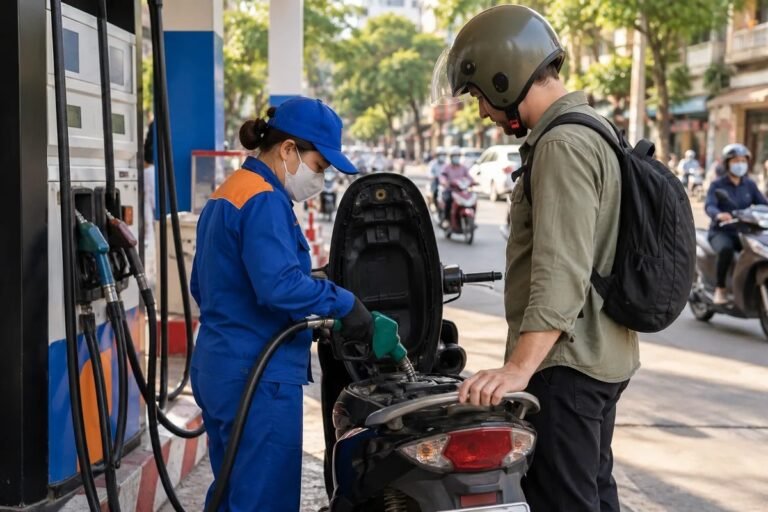
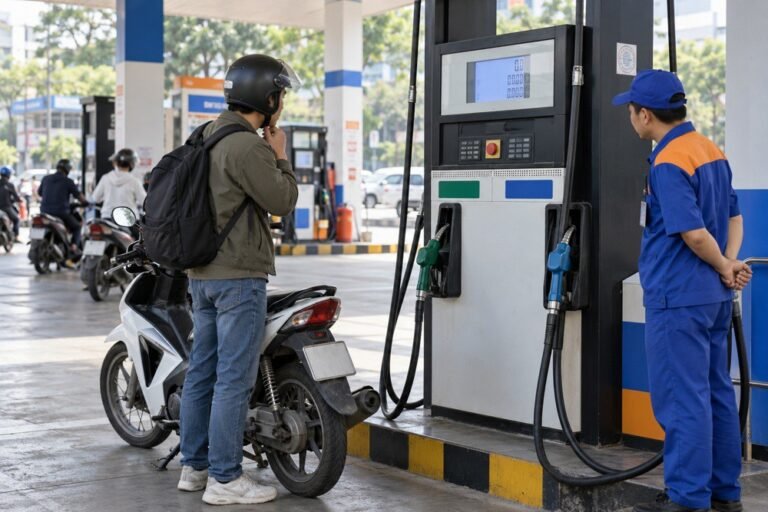
What to do at the petrol station
- Before arriving, confirm the recommended fuel from the rental shop and the vehicle manual.
- Read the dispenser label carefully and check both the ethanol blend and the octane grade.
- If the available fuel does not match the guidance, ask the shop before filling.
- Keep the receipt or note the station, time, fuel grade and volume if useful for the rental record.
- Do not introduce an additive or manually blend fuels unless there is explicit manufacturer and owner guidance.
There is no need to carry out experimental refuelling during a rental. A predictable, documented choice is more useful than proving or disproving a rumour.
What if a bike starts to run badly after a fill-up?
If the engine hesitates, stalls, loses power or develops an unusual smell after refuelling, move to a safe location and contact the rental provider. Do not conclude immediately that the pump fuel was defective or that E10 is incompatible. Explain exactly when symptoms began and what was added to the tank.
How to verify a Yamaha Sirius or Honda Wave rental
These familiar model names are found across different production years and versions. Ask for the specific model year, engine type and fuel guidance for the motorcycle actually available. Do not assume that all bikes with the same name use identical petrol systems.
Read the engine and fuel recommendations shown in the owner’s documentation. If necessary, ask the rental company to confirm with an authorised service provider. This is more reliable than identifying a bike from a casual photograph, an engine noise or a sticker that could have been changed.
Three things the rental company should clarify
- Exactly which fuel grade and blend should be used in this particular motorcycle?
- Are there any known modifications or model-year restrictions relevant to the fuel system?
- What should the renter do if the correct fuel is unavailable or the engine behaves abnormally after filling?
When choosing a motorcycle, compare available semi-automatic rental models and confirm the actual bike, rather than using this fuel article as a stock list. For current advice about a Nguyen Ha rental, call 0334 699 969.
Bottom line
Manufacturer guidance is stronger than a blanket rumour, but compatibility is specific. The Honda and Yamaha announcements show that many appropriately maintained and specified Vietnamese-market motorcycles are compatible with E10, while some older configurations require more care or a different recommendation. Use the model-specific handbook and the rental owner’s instructions as your practical decision point.