Fuel & Running Costs
Petrol vs Electric Rental Cost Per Kilometre: Calculate From Real Bills

On this page
A rental motorbike’s energy cost per kilometre is best calculated from your own fuel and charging receipts divided by the distance actually travelled, not from a headline claiming that one technology is “many times cheaper.” For petrol, compare money spent refilling with kilometres driven over a meaningful period. For electricity, compare the amount you actually pay for charging with the distance covered, accounting for how that charge was measured. Energy cost is not total rental cost: the rental fee, deposit arrangement, any charging plan, and your ability to find fuel or charging all affect the practical choice.
If you are comparing actual vehicles for your dates, review the Hanoi electric rental options and ask for a current quote for the precise electric model. No fixed running-cost number or range can be guaranteed for all bikes.
The two basic formulas
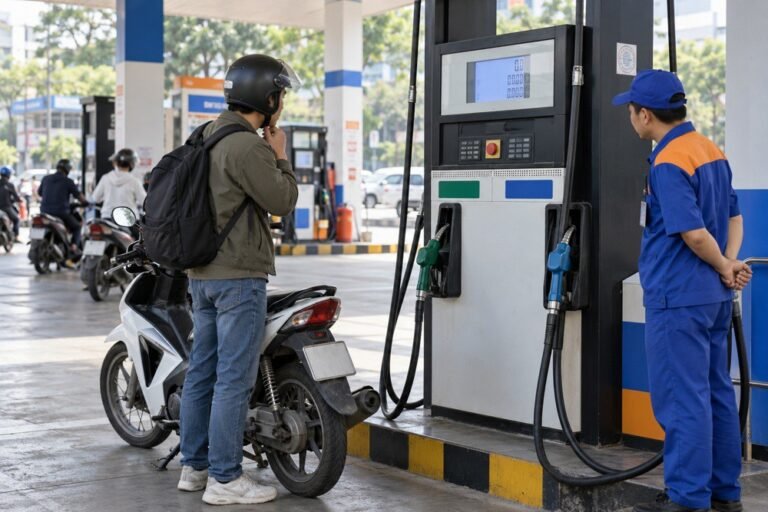
For a petrol rental, use: petrol cost per kilometre = VND actually spent on petrol ÷ kilometres travelled. Record the odometer at the beginning and end of a comparable period. Ideally use a consistent fill level, because paying for fuel left unused in the tank at the end of a test makes a short measurement misleading.
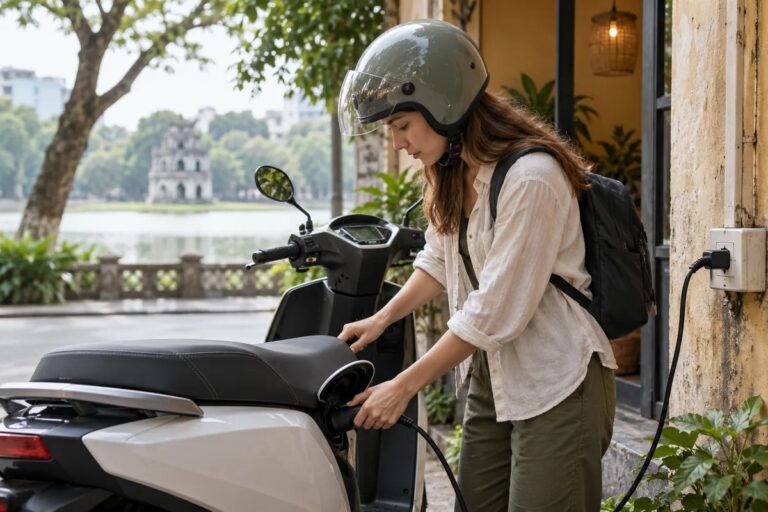
For an electric rental, use: charging cost per kilometre = VND you pay for energy or battery swaps ÷ kilometres travelled. If you are billed per kilowatt-hour, multiply billed kWh by the relevant price and include any applicable tax or charging fee. If you pay by the swap, record the total swap charges. Do not assume that the amount stored in the battery equals the amount taken from the wall.
When you compare models, try to cover similar routes, traffic conditions and loads. Both motorcycles’ energy use can change under frequent stops, hills, underinflated tyres, a heavy passenger or different throttle habits. A single short trip may not represent your normal month.
A petrol-bike worksheet you can actually use
Start and end odometer readings
Step one: photograph or record the initial odometer reading and fuel gauge when you receive the bike. Ask what fuel grade and return fuel level the owner requires. Never guess the correct grade or buy the cheapest available fuel when the manufacturer’s instructions differ.
Keep your real fuel receipts
Step two: after a reasonable amount of ordinary riding, record every petrol purchase: date, amount in VND, litres purchased if visible, and odometer reading. Keep receipts when available. If the tank started almost full and ends nearly empty, an unadjusted sum of purchases can exaggerate consumption; note the start and end fuel conditions.
Calculate VND per kilometre
Step three: divide petrol spending attributable to that period by kilometres travelled. You may also estimate litres per 100 km using 100 × litres consumed ÷ kilometres, but consumption in litres requires a consistent full-to-full method or another defensible fuel estimate. Do not treat an imprecise dashboard gauge as a laboratory measurement.
Suppose, only as invented arithmetic, you spent 72,000 VND over 100 km and the start and end fuel conditions were comparable. The example petrol-energy cost is 720 VND/km. It does not state today’s petrol price, an actual model’s consumption or Motorbike Nguyen Ha’s rental charge.
An electric-bike worksheet with realistic accounting
Record the exact model, battery configuration, starting charge indication, end charge indication and distance. Note whether electricity is included in your accommodation, separately billed by the landlord, measured by a wall meter, or charged through a separate battery-swap or station fee.
Account for charging losses
For a conventional charger: the electricity drawn from the wall may exceed the battery’s nameplate capacity because charging has losses and accessories use some power. Therefore, multiplying nominal battery kWh by the utility tariff can produce an underestimate of actual purchased energy. A reliable meter reading or actual bill is preferable.
If the accommodation charges a fixed amount for each recharge, your real out-of-pocket cost follows that fee even if it exceeds or differs from the public household electricity tariff. Confirm the arrangement before plugging into someone else’s socket. Never assume the landlord permits charging in any room or corridor.
Suppose, again purely as invented arithmetic, a charging episode costs 12,000 VND and supports 80 km of comparable travel. The example is 150 VND/km. It is not a claim about any model’s rated range, a live electricity tariff or the shop’s own pricing. If two recharges cover the period, use both charges and the total distance instead.
Calculate swap charges separately
For a battery-swapping service, use the price charged to this specific rental customer, including plan fees if applicable. A manufacturer’s subscription offered to owners is not automatically included with a hired bike. Do not count a promotional or first-time discount unless the provider confirms it applies to the proposed booking.
A sample comparison with invented numbers
Imagine two vehicles used for similar journeys. Petrol case: 72,000 VND for 100 km, or 720 VND/km. Electric case: 12,000 VND of charging for 80 km, or 150 VND/km. The electric-energy cost is 570 VND/km lower in this hypothetical example only. The numbers are illustrative inputs, not a market survey, manufacturer test or verified cost for a rental.
For 300 km, applying those fictional rates would give 216,000 VND petrol versus 45,000 VND charging, a difference of 171,000 VND. This multiplication is useful for checking how sensitive the result is to distance. It should not be presented as a forecast unless you have measured the actual bikes and payment arrangements.
Now suppose the fictional electric rental fee exceeds the petrol rental fee by 250,000 VND for the same period. The fictional energy saving of 171,000 VND would not cover that fee difference; the petrol option would still have the lower combined rent-plus-energy total by 79,000 VND. No shop rates are being asserted in this calculation.
Avoid confusing an energy rate with an all-in rental rate
A short trip’s total cost includes rent for the agreed booking period, not merely petrol or electricity. For a fair comparison, use the same pickup and return times, real quotes for the exact vehicles and any confirmed delivery or collection charges. Divide the total by planned kilometres only after those items are known.
A refundable security deposit is generally a cash requirement, not an automatic expenditure. Track it in a separate column and use the actual contract to understand deductions and return timing. Similarly, an included charger or helmet cannot be assigned an imaginary extra cost to make one option appear cheaper.
Published motorbike rental prices in Hanoi are a starting point for comparing available types, but you must verify the specific quote, inventory and dates. A listed petrol-scooter rate is not an electric model’s rate, and a historical promotion is not an offer for every month.
What makes comparisons unfair
Comparing one rider’s light electric vehicle with another rider’s heavy, ageing petrol scooter can make powertrain differences appear larger than they are. Model condition, route choice, load and individual riding habits all matter. Try not to label the entire vehicle class more economical based on one unmatched pair of trips.
Charging while an accommodation bill is paid by someone else may appear “free” to the rider, but electricity is still consumed. Decide whether your comparison is the renter’s out-of-pocket cost or the total economic cost, and label the figure. Likewise, petrol bought for someone else’s shared journey should not be included as though all kilometres were yours.
Battery state of charge is rarely a perfectly linear measure of usable energy, and weather and ageing can change the practical range. A manufacturer range test often assumes a particular speed, rider mass and test cycle. Do not calculate an exact kWh/km from the dashboard percentage without accounting for those limitations.
For petrol, a litre purchased at the end of a test may remain in the tank for the next week. Using purchases rather than consumed litres without an opening and closing adjustment causes error. For charging, adding the full nominal battery capacity every time you top up from 70% causes a similar error.
How to collect a trustworthy seven-day log
Create a simple table with these fields: date; bike; initial odometer; final odometer; kilometres; petrol litres and VND or charged electricity kWh and VND; any swap fee; initial and final fuel/charge estimate; and notes on conditions. Avoid storing sensitive contract or identity photos in the same publicly shared sheet.
A week is only a practical starting point, not a guarantee of statistical precision. If one day involves a long intercity journey and the rest involve short city commutes, separate those use cases. Mark days when the bike was not used or when another rider borrowed it; a distance log with missing riders cannot fairly assign energy expenses.
Check the arithmetic after a few days. If your calculated petrol litres per 100 km or electric kWh/km seem implausible, first look for wrong odometer values, unrecorded refills, top-ups, mixed vehicles and incomplete invoices. Do not announce the bike has a defect merely because an estimate changed.
A precise method also helps identify when the bike appears to use more energy than before, but it is not a diagnostic test. If the scooter starts behaving unusually, report it to the rental provider rather than opening the engine or battery housing.
Where published electricity-price research fits
Household tariffs, public charging tariffs, apartment fees and brand-specific battery plans are different products. A rate announced in an official electricity decision may not be the amount a traveller pays for a hotel socket or a public swap. Use the invoice or confirmed plan that actually applies to you.
Our separate electric scooter running-cost research discusses published electricity tariffs and battery plans. This article deliberately asks a narrower question: how a particular renter converts real spending and distance into a fair VND/km figure without claiming a universal charging price.
Simple decision scenarios
Very short stay: The difference in daily or weekly rent may outweigh small energy savings. Convenience of pickup, legal eligibility and parking may matter more than a few VND per kilometre. Ask about exact total charges rather than choosing from energy cost alone.
Longer city commute: Repeated journeys make energy/km more important, but only if charging is reliable and the bike’s actual range suits your route. Include the cost of detours to charge, any swap subscription and the possibility of waiting for a charging point.
Uncertain accommodation: A cheap electric-energy estimate is not helpful if the building prohibits charging or has no safe compatible outlet. Confirm charging permission and the charger specified for the model. Petrol may be more convenient in some circumstances, while an electric option may suit others.
Variable routes or loads: Neither measured rate is guaranteed when the rider, terrain and payload change. Keep a margin, especially when the next charging opportunity is far away.
Frequently asked questions
Should I compare using manufacturer litres/100 km or kWh/100 km figures? Use maker figures as conditional references, not guaranteed real-world results. Your own receipts and comparable distances are better for your actual budget.
Can I use the battery’s kWh label as the exact amount billed? No. Wall charging can include losses, and partial charges complicate measurement. Use the bill or meter whenever possible.
Does a refundable deposit belong in cost per kilometre? Normally track the money tied up separately; only legitimate charges retained under the agreement are an expense, not the entire deposit automatically.
Which vehicle is always cheaper? No universal answer follows from the energy formula alone. Compare the real rental fee, charging/fuelling logistics, eligible rider and actual planned distance.
Get a model-specific quote from Motorbike Nguyen Ha
Motorbike Nguyen Ha operates at Alley 5 Nguyen Van Cu, Bo De, Long Bien, Hanoi, published hours 09:00–21:00. Call +84 334 699 969 or use Zalo/WhatsApp to ask about available petrol or electric models, the rental period and what energy charges are included. No electricity tariff, fuel consumption or stock level is guaranteed here.