Fuel & Running Costs
At the Petrol Pump in Vietnam: Check the Fuel Type and Meter
On this page
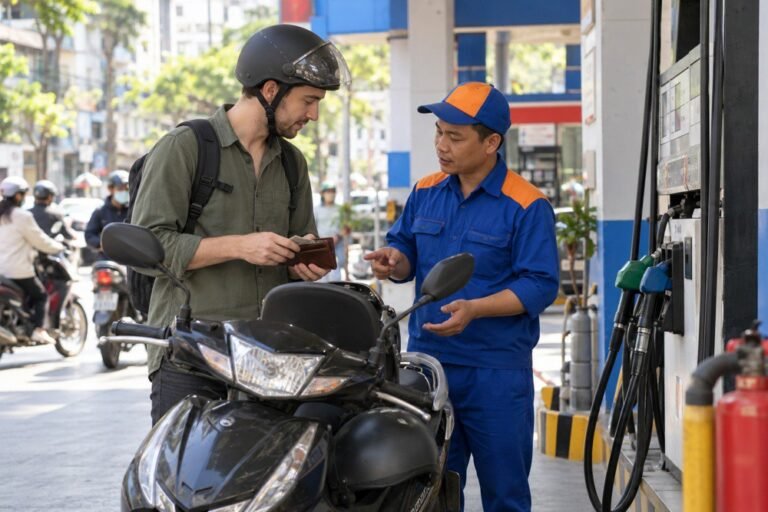
When renting a motorbike in Hanoi, you may need to fill up at an unfamiliar petrol station. Three checks are practical before fuelling: make sure the dispenser display is ready for a new transaction, identify the fuel grade you are about to buy and look for the station’s measurement-verification markings where visible. They can help you ask better questions, but none of these observations by itself proves the fuel’s composition or the dispenser’s measurement accuracy.
The exact bike’s required fuel remains the first question. Ask the rental shop to confirm the specification before the journey. Do not select a product simply because it is the cheapest, because another motorcyclist recommended it or because it has an attractive label.
Quick check before the nozzle enters the tank
| What to check | Why it is useful | What it cannot prove |
|---|---|---|
| Display ready for a new sale | Helps avoid confusion with the previous transaction | That the internal meter measures perfectly |
| Product name and grade | Shows what the pump claims to dispense | That the fuel meets all laboratory specifications |
| Verification mark or seal, if visible | Provides a reason to ask about inspection status | That there is no hidden fault or deliberate interference |
| Quantity and total amount | Creates a useful record of what you paid | That a gauge can confirm exact litres used by the bike |
| Receipt | May record time, station and transaction details | That a particular fuel caused or did not cause a later fault |
Why should the display return to zero?
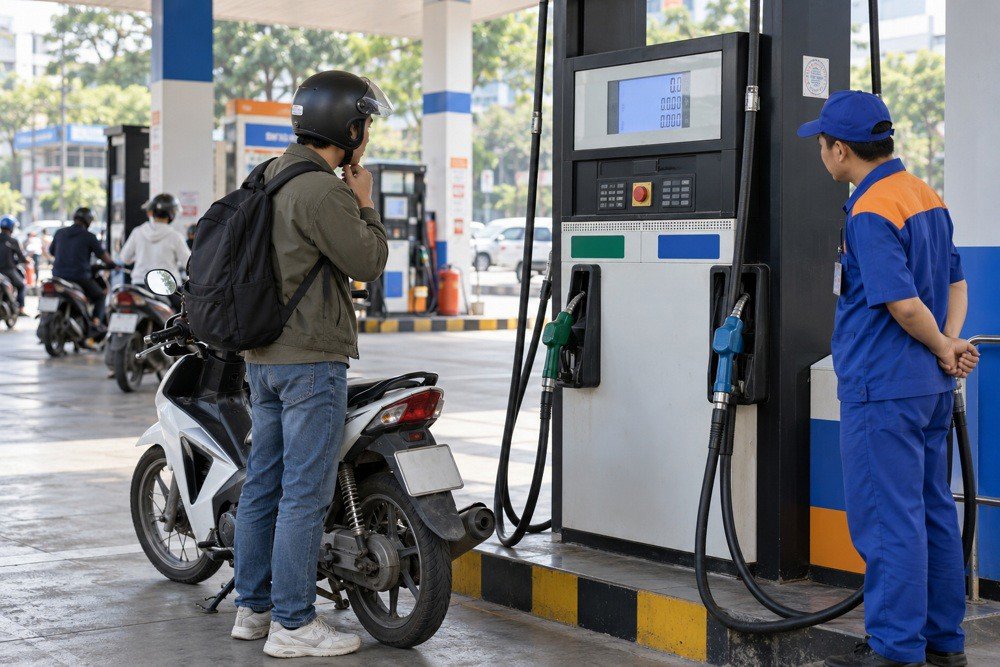
Before a new purchase, you should be able to see that the dispenser has reset for the new transaction. A 2016 article from Vietnam’s Nhân Dân newspaper recommended paying attention to the zero display to reduce the risk of confusion or carryover between sales. That advice is a basic observation, not a claim that every station is attempting fraud.
A display that starts at zero does not certify the internal measurement system. The same article discusses more sophisticated forms of tampering that ordinary customers cannot detect just by looking at the screen. It is unfair to label an entire station dishonest because of a suspicious moment without proper investigation.
How to check the product name
Look at the fuel grade and blend label on the dispenser, and compare it with the motorcycle’s manual or rental instructions. In Vietnam, petrol labels commonly refer to octane categories such as RON and to ethanol blends such as E5 or E10. The correct choice depends on the model, not simply the number printed most prominently.
According to the Vietnamese Government’s report dated 1 June 2026, E10 petrol began nationwide rollout that day, replacing mineral RON95 under the stated policy, while E5 RON92 remained under a published timetable through the end of 2030. That explains why some fuel labels may differ from those visitors remember from earlier trips.
E10 on the pump is not permission for every old motorcycle
Fuel compatibility is model- and condition-specific. Some manufacturers have issued public statements covering particular models, production periods or fuel-system designs. But an old motorcycle may have been modified or fitted with replacement parts. Ask the rental owner for the correct fuel grade, especially for an older model.
Do not assume that every motorcycle in a fleet has the same engine or fuel system. If the available product does not match the shop’s instructions, ask before the nozzle is used rather than taking a gamble.
What are verification marks and seals?
Petrol dispensers are measuring instruments subject to applicable Vietnamese metrology rules and inspection controls. A mark or seal may indicate that an instrument has been verified or protected against unauthorised adjustment. However, its appearance and position can vary by instrument and regulatory requirements. This guide does not provide a universal diagram that would allow a renter to authenticate every seal.
If a visible mark appears broken or missing, ask the station attendant for clarification and consider using another station if uncertain. Do not touch, peel, pry open or photograph restricted equipment closely in a way that creates conflict. Formal checks belong to competent authorities and qualified specialists.
Can a motorbike rider verify the exact litres delivered?
Not from the vehicle’s fuel gauge alone. A motorcycle gauge often uses broad bars, a needle or a warning lamp. Its response to tank shape and parking angle makes it unsuitable for verifying a pump’s precise measurement. If you have a genuine concern about a transaction, keep the receipt and seek the station’s published customer-service or measurement-check procedure.
Do not attempt improvised measuring containers, open-flame tests or draining petrol at the roadside. Those approaches create unnecessary fire and exposure risks.
How to read the amount and price
Before and after fuelling, look at the quantity and total payable displayed by the pump. If the station also provides a receipt, check that the relevant details match. Different pumps may display unit price, litres and total in different positions; do not confuse them. Ask the attendant for an explanation if the display is hard to read.
A discrepancy between a receipt and what you expected deserves a calm question, not an immediate allegation. Record the time and dispenser number if visible, and contact the station or appropriate authority where necessary.
Why a receipt helps during a rental
Keep receipts for your own budget and for any later question about the fuel grade, time or quantity. A mobile-payment record may supply a timestamp even when a paper receipt is unavailable. Save the exact transaction details rather than writing an approximate value several days later.
If the engine jerks or stalls shortly after a refill, our post-refuelling engine-stall checklist</a explains how to describe the incident without automatically blaming the station.
What if the pump does not appear to reset?
Ask the attendant to show that a new transaction has started before refuelling begins. If the answer is not clear, you may choose another dispenser or filling station. Keep the exchange respectful and avoid placing yourself in the path of moving vehicles at a busy station.
It is reasonable to ask for a receipt or clarification about the product. It is not reasonable to interfere with the station’s equipment or claim a technical conclusion that you cannot verify.
What if you see a damaged verification seal?
Report the observation to station staff without touching the seal. If you remain concerned, use a different dispenser and retain any relevant evidence such as a receipt or a photo of the public-facing display taken safely. Inspection and enforcement require the competent authority, not a customer performing an improvised roadside test.
A practical refuelling sequence
- Confirm the correct fuel grade for the actual rental motorbike.
- Park in the station’s designated area and switch off the engine.
- Observe the dispenser’s product label and new-transaction display.
- Ask a question before fuelling if the grade, display or seal appears unclear.
- Stop filling at the limit described in the motorcycle’s manual.
- Close the fuel cap correctly and check for obvious spillage.
- Pay the amount shown and keep a receipt if available.
Do not leave the ignition running during fuelling or smoke near petrol vapours. If fuel is spilled, alert the attendant and follow station safety instructions rather than rinsing it into a drain.
Do not overfill to check the pump
Some riders attempt to use the advertised tank capacity as a test of a station’s meter. That is unreliable: the tank was not necessarily empty, a small amount of unusable fuel may remain, and the safe filling limit may be below the physical rim. Adding extra petrol until the pump reaches a certain number is not a valid measurement check.
What official sources can and cannot answer
Government and provincial guidance can explain petrol policy and measurement-control obligations, but a webpage does not tell you whether one specific dispenser is accurate at the moment you are using it. A current inspection record or competent technical assessment is needed for that conclusion. A retailer’s public label is useful information, not proof of what laboratory testing would find.
Keep distinctions clear: display reset concerns the start of a transaction, fuel label concerns the advertised product, and verification markings relate to measurement controls. None replaces the others.
Questions for the rental provider
- Which petrol grade is correct for the motorbike I will receive?
- Is there a label or handbook page I should check before refuelling?
- Does the shop recommend keeping petrol receipts during a longer rental?
- What should I do if the engine behaves differently immediately after refuelling?
For general vehicle options see Nguyen Ha’s Hanoi rental information. For instructions specific to the rented motorbike, call 0334 699 969 before choosing an uncertain fuel grade.