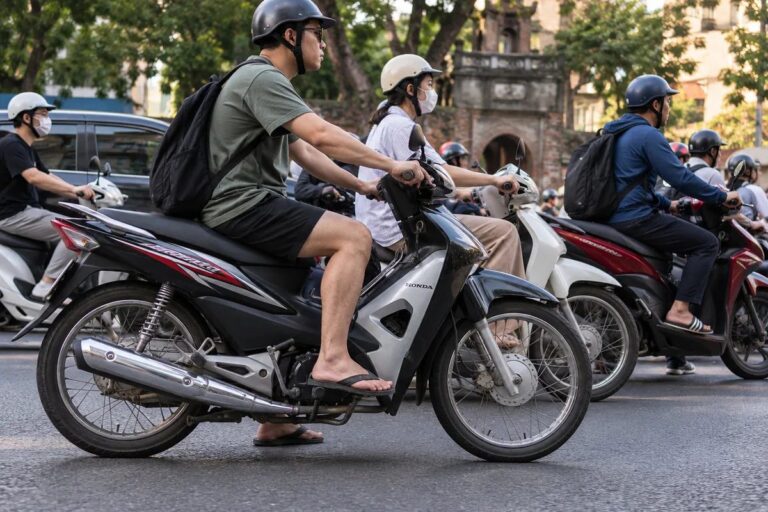
Manual & Semi-Automatic Motorbikes
Rental Semi-Automatic Bike Slips Out of Gear: Stop and Report Safely

On this page
Your semi-automatic rental motorbike is moving normally when the engine suddenly revs without the usual pull from the rear wheel. Perhaps the gear indicator changes to neutral, or a selected gear seems to disengage. Losing drive among other vehicles can be frightening, but accelerating harder or repeatedly stamping on the gear pedal is not the solution. Concentrate on keeping the bike stable, reducing speed and stopping in a safe place. Then tell the rental shop exactly what happened.
This guide is about what a renter should observe and report when a semi-automatic motorcycle appears to jump out of gear. It cannot diagnose worn gearbox components, gear-selector problems or the rider’s earlier shifting technique. A mechanical assessment and the owner’s manual for the exact model are necessary before deciding whether the bike is fit to ride again.
What does “jumping out of gear” actually feel like?
Riders use several descriptions for problems that may or may not share a cause. A short explanation of the sensation is more useful than naming a broken part without inspecting the bike.
| What you notice | How to describe it | Immediate priority |
|---|---|---|
| Engine revs but the bike loses forward drive | “The engine sped up but the bike stopped pulling” | Close the throttle and prepare to stop |
| Neutral lamp appears while moving | “The neutral indicator came on unexpectedly” | Keep steering and slow carefully |
| A gear engages briefly and then disengages | “It would not stay in the selected gear” | Do not keep trying to shift while moving |
| New clunks or grinding noises occur | “There was an unusual metallic sound” | Get clear of traffic and request inspection |
| Burning smell or smoke follows | “There was a strong smell or visible smoke” | Stop, move away and seek help where appropriate |
One event can involve more than one of these signs. A light on the dashboard may not mean exactly what a rider thinks it means on every model. Record the observation and let a trained technician determine the cause.
The first response while the motorbike is moving
Do not open the throttle to try to “make the gear catch”. Keep your eyes on the road and ease off the accelerator. Control the bike with smooth steering and appropriate braking, allowing enough room to react to traffic. Signal and move toward a suitable stopping place when it is safe, not by swerving into a narrow gap.
If you are on a slope or in crowded traffic, the safest stopping sequence depends on the conditions, your training and the specific motorcycle. A gear that no longer transmits drive does not guarantee that the rear wheel will coast freely. Avoid abrupt shifts or unfamiliar control experiments while trying to reach a safe position.
Once you have stopped, secure the bike and switch off the engine as appropriate. Do not conduct another moving test to check whether the gear holds at higher speed. An unexpected loss of drive has already given you enough reason to contact the shop.
How is a semi-automatic different from a manual-clutch bike?
A typical semi-automatic underbone motorcycle has a foot-operated gear selector but no clutch lever operated by the left hand. A manual-clutch motorcycle has a different control arrangement. Do not apply instructions involving a clutch lever to a bike that does not have one. The gear pattern, neutral location and shift method can also vary among models.
Before collection, read the model’s manual or ask the shop to demonstrate the controls. Our semi-automatic versus manual-clutch explanation helps you identify the difference without treating every gearbox as the same.
Could the rider have made an incomplete shift?
Sometimes a gear may not have engaged fully after a shift. However, that possibility does not make an unexplained or repeated disengagement safe to ignore. Do not blame yourself or assume a worn gearbox solely from a brief sensation. Report how the motorbike behaved, whether it had happened before and what was occurring immediately beforehand.
If the shop later confirms that the machine is safe, it can demonstrate the correct shifting method for that particular bike. Until then, trying a new shift technique in traffic is not an appropriate diagnostic test.
What information should you record after stopping?
- The bike: registration plate, model and rental reference if available.
- The place: location pin, nearby landmark and a safe place for the shop to contact you.
- The motion: whether the motorbike was accelerating, cruising, slowing or climbing a hill.
- The gear: the selected gear or indicator you remember, without trying to recreate the event.
- The sound: whether the engine revved, there was a clunk or a grinding noise.
- The conditions: traffic, road surface, rain, passenger or luggage.
- Your response: that you closed the throttle, stopped and have not tried to ride again.
Take photographs of the parked bike and dashboard if doing so is safe. Do not photograph the gear pedal while riding. The recorded facts are enough for the owner to decide whether an inspection or transport arrangement is needed.
Why the bike should not be ridden to test the problem
A symptom that disappears after a restart does not prove the gearbox is sound. If the gear disengages again while turning, merging or climbing, the rider may unexpectedly lose acceleration when other traffic is close. The risk makes repeated tests undesirable even when the distance back to the shop is short.
If a rider reports “it happened only once”, the shop still has useful information. Mechanical faults may be intermittent, and an incomplete shift may not be obvious from outside. Let the responsible provider decide how to inspect the motorcycle.
What if you are carrying a passenger?
Tell your passenger briefly that the bike has lost drive and that you are stopping. Ask them to remain stable without sudden movement while you complete the stop. Once securely parked, both of you should move away from traffic. Do not attempt another trip with the passenger simply to see whether carrying a load changes the symptom.
Take note of any luggage that was carried. This helps provide context but is not proof that weight or passenger position caused the issue.
What if there is a new burning smell?
A strong smell, smoke or increasing mechanical noise makes the need to stop more urgent. Do not lean over hot engine components or remove a cover to look for the fault. If smoke or flames are visible, keep people away from the vehicle and contact suitable emergency assistance. A rental customer should not be expected to disassemble a transmission by the roadside.
What to check during a normal rental handover
Ask the staff to show you the gear pattern and any neutral or gear indicator while the bike is securely stationary. Check that the shift pedal looks intact and that the controls operate normally as demonstrated. If the pedal is unusually loose, stiff or damaged at collection, point it out before accepting the keys.
Our gear-lever inspection guide lists other useful observations. Do not dismantle or adjust a rental motorcycle to complete the checklist.
How should you contact the shop?
A concise message could read: “My semi-automatic bike unexpectedly lost drive while I was in gear. The engine revved but the bike slowed. I stopped safely at [location], switched it off and have not ridden again. Registration [number]. Please advise about checking or collecting it.”
Tell the shop if you are injured, stranded somewhere unsafe or unable to move the bike out of traffic. Request a safe next step instead of assuming roadside repairs or recovery are included in your rental.
What about choosing a different type of rental?
If you are unfamiliar with semi-automatic gears, talk about your experience before booking. You may find an automatic scooter more comfortable for daily city riding, while a semi-automatic suits somebody who knows how to change gears. Read Nguyen Ha’s semi-automatic rental information for general options, then confirm actual available models.
Frequently asked questions
Can I push the bike into gear while it is rolling?
Do not attempt a new or forceful shifting manoeuvre to investigate an unexplained problem. Stop safely and ask the rental provider for model-specific guidance.
Does the neutral light prove a gearbox part is broken?
No. It is one observation. The technical cause requires inspection and the exact manual.
Should I ride back to the shop if the problem stops?
Not without an appropriate safety assessment and the provider’s instructions. A temporary return to normal operation is not proof that the problem has gone away.
Nguyen Ha’s rental contact is 0334 699 969. This educational guide does not claim a particular motorcycle is in stock or that the shop has completed any inspection.