Manual & Semi-Automatic Motorbikes
Turning a Manual-Clutch Motorbike in a Narrow Hanoi Alley Safely
On this page
Narrow Hanoi alleys often contain parked motorbikes, doorways, pedestrians and blind corners. If you need to turn a manual-clutch motorcycle around, the first question should not be “How tightly can I turn?” It should be “Is there enough clear space to do this without putting anyone at risk?” In many lanes, stopping, switching off the engine and repositioning the bike on foot is the better choice.
Low-speed turning on a clutch-equipped motorcycle is a skill that depends on training, bike weight and the available room. This guide explains how to assess the situation and when not to attempt a ridden U-turn. It is not a replacement for supervised rider training, and reading it does not establish that a rider is ready to practise in a crowded residential lane.
Why a narrow alley is different from an open practice area
A quiet-looking alley may still have residents opening gates, children crossing, delivery riders approaching and cars reversing. There may be drainage channels or a sloped entrance under your wheels. If you must make several corrections while balancing a heavy bike, the available space disappears quickly.
Clutch engagement, throttle and braking become more sensitive at walking speed. If the engine stalls at a critical moment, the rider may suddenly have to support the motorcycle’s weight. That risk increases where the surface is wet, uneven or too narrow to put a foot down securely.
First choose whether to ride through, stop or walk
| Conditions | Safer decision |
|---|---|
| Clear, level space with good visibility and adequate turning room | Only a properly trained and legally eligible rider should consider a controlled turn |
| Parked vehicles or pedestrians reduce clearance | Stop and wait or find a different turning point |
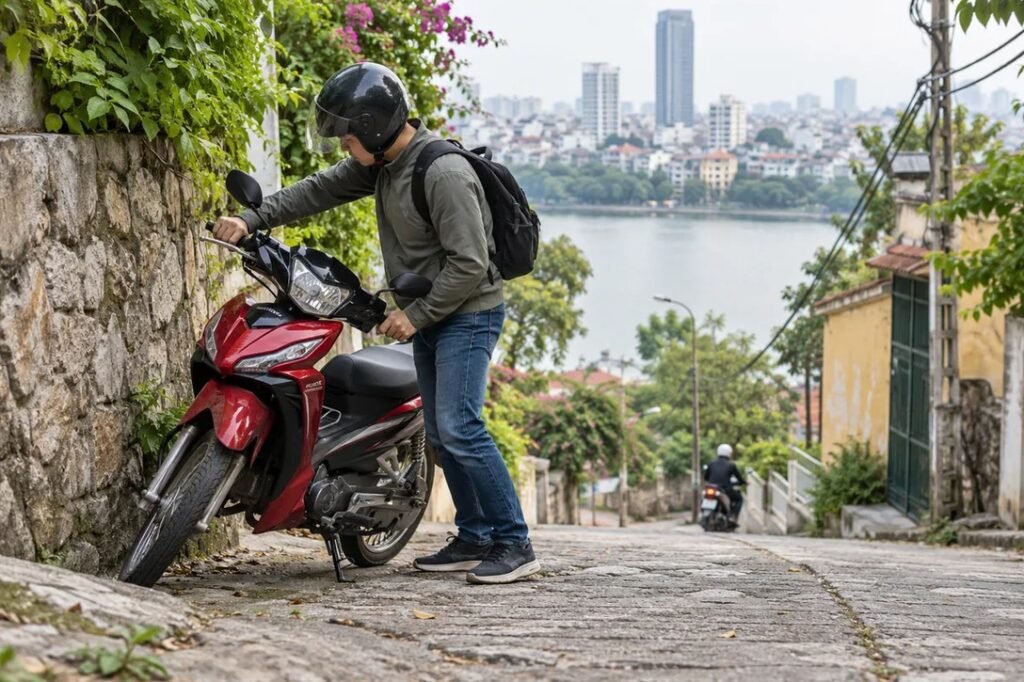
| Sloping, gravelly, mossy or wet surface | Avoid a tight ridden turn; reassess whether walking is safe |
| Passenger or bulky luggage changes balance | Stop, secure the bike and reorganise safely before any repositioning |
| Rider is uncertain or cannot support the bike | Do not attempt a ridden U-turn; seek help or choose another route |
Walking a motorcycle is not automatically safe either. A heavy machine on a steep or slippery slope can become uncontrollable even with the engine off. If you cannot hold it securely, do not push it into a worse position. Ask for assistance or return via a safer route instead.
Look for the widest safe point
Check the path ahead, behind and to each side before making a decision. A wider entrance or courtyard may appear suitable but could be private property, blocked by a gate or used by pedestrians. Seek permission when necessary and never obstruct someone’s access simply because it would make turning easier.
Check mirrors and blind spots before repositioning. A person on foot may move into the space while you are focused on the front wheel. If a friend is helping, agree in advance that they should warn you about pedestrians or traffic rather than stand directly in the motorcycle’s path.
Why wheelbase and handlebar width matter
The width of the handlebars and the bike’s turning circle affect how much space is needed. A motorcycle with taller bars or protruding mirrors can be difficult to swing around between walls even if the front tyre seems to have enough room. Luggage and passengers further reduce flexibility.
Our guide to handlebar width and turning clearance discusses the measurements to compare, especially when choosing a bike for tight Hanoi streets. That article concerns scooters, so apply the same measurement questions cautiously rather than borrowing its turning techniques for a clutch bike.
Clutch control is a skill, not a shortcut
Training courses may teach riders how to balance throttle, clutch engagement and rear braking at very low speeds. On an untrained rider’s first day, however, a tight turn is not the place to experiment. Small control errors can move the motorcycle unexpectedly, especially with a passenger or a wall close by.
Prolonged slipping of the clutch can create unnecessary heat and wear. If the manoeuvre seems to require holding the clutch in a delicate position while inching past an obstacle, ask whether there is a simpler route or a safe opportunity to dismount instead.
What if the engine stalls?
Focus on stopping and supporting the motorcycle safely, not restarting in a hurry. Apply the correct controls for the particular model, keep clear of pedestrians and ensure the bike is stable before attempting a restart. If it tilts beyond your ability to hold, protect yourself and others rather than trying to save the bike at any cost.
Do not repeatedly open the throttle to overcome poor balance or a possible fault. If the engine or clutch behaves unpredictably, move out of danger only when it is safe to do so and report the problem to the owner.
When dismounting may be safer
Getting off and repositioning the bike can reduce the need for a tight ridden turn, but only on manageable, stable ground. Switch off the engine when appropriate, follow the manual’s guidance for neutral or gear selection, and keep the bike under control as you move it. Do not try to push it while perched half-on the seat.
Use a position that lets you balance the weight and see the wheels, while avoiding hot exhaust parts and any pinch points. If a bike begins to move downhill unexpectedly, your priority is safety, not preventing cosmetic damage.
Passengers and loaded motorcycles
Do not try a tight low-speed turn with a passenger unexpectedly shifting their weight. If the situation permits, stop somewhere secure and allow the passenger to dismount before repositioning. This should not happen in an active lane, on a steep slope or where the passenger would be exposed to moving vehicles.
Remove or secure luggage that could swing into the controls or shift abruptly. Do not stack bags higher simply to free floor space. The total load, balance and the motorcycle’s permitted carrying capacity still matter.
Why choosing the right bike helps before you reach the alley
If your regular journeys end inside narrow residential lanes, consider overall motorcycle size, handlebar width, ease of parking and your own handling ability. A smaller bike is not necessarily easier in every circumstance, but trying the actual vehicle before accepting it can reveal whether you can manoeuvre comfortably.
The semi-automatic rental options at Nguyen Ha are different from manual-clutch motorcycles. They do not have the same hand-clutch control, although they still require care in narrow spaces. This guide is educational and does not confirm the shop stocks manual-clutch bikes.
Never practise an unfamiliar turn among pedestrians
If you want to develop low-speed manual-clutch skills, use an authorised training environment with a qualified instructor and the correct licence or permission for the vehicle. Start with sufficient open space and appropriate protection. A successful practice turn does not mean you should immediately repeat it near walls, parked cars or residents.
Riding skill develops through supervised experience, not a list of steps copied from a screen. If you are not ready for the situation in front of you, stopping is a good decision.
What to do if the alley is blocked
Do not force the motorcycle past a parked car, a roadworks barrier or a group of pedestrians. Find a stable place to wait, check alternative access on a map only while stopped and ask a local resident or parking attendant for a safe exit when appropriate.
Never assume a narrow lane is legally open to vehicles just because another rider has entered it. Watch for one-way controls, temporary restrictions and private access signs.
Seven questions before a tight manoeuvre
- Is there room for the entire bike, including handlebars, mirrors and any luggage?
- Can I see both directions and any doorways along the turn?
- Is the ground dry, level and stable enough?
- Can I stop and put a secure foot down if I need to?
- Is a passenger changing the bike’s balance?
- Am I legally eligible, trained and confident on this exact type of bike?
- Would another route or a safer place to dismount be easier?
Ask the rental provider before heading into tight lanes
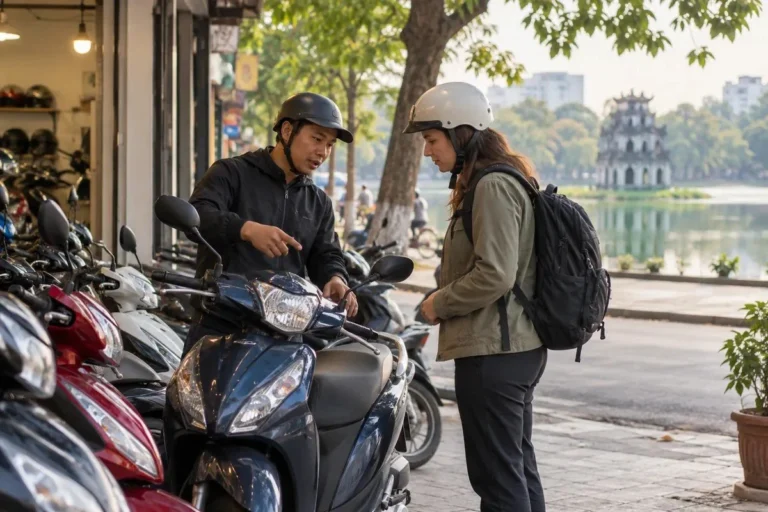
At pickup, ask the shop about the model’s size and basic controls, how to park it securely and whom to call if it becomes difficult to manoeuvre. If you are unfamiliar with manual-clutch operation, do not assume a semi-automatic underbone uses the same technique.
Nguyen Ha can confirm the bikes actually offered for rental in Hanoi at 0334 699 969. Choose a motorbike you can manage safely rather than one that requires advanced low-speed manoeuvres every time you return home.