Manual & Semi-Automatic Motorbikes
Rental Motorbike Chain Comes Off or Breaks: What to Do Next
On this page
A sudden clatter near the rear wheel, an engine that revs without driving the motorcycle, or a length of chain lying in the road may mean that the final-drive chain has come off or broken. A chain failure can also interfere with the rear wheel, so the danger is not limited to losing acceleration. Do not try to catch the chain, force the rear wheel to turn or keep riding until you reach the shop. Reduce power, regain a safe stopping position and ask the rental provider for assistance.
This article covers ordinary chain-driven semi-automatic and geared motorcycles; many automatic scooters use a different enclosed belt transmission. The actual machine’s design matters. A renter does not need to determine whether the chain, sprockets or adjusters failed before contacting the owner.
What might you notice if a chain fails?
| Observation | Possible explanation | Safer immediate action |
|---|---|---|
| Engine revs but the rear wheel does not drive normally | The final drive may no longer transmit power | Ease off the throttle and prepare to stop |
| Sudden rattling or metallic clatter | A loose part may be moving near the wheel | Stay focused on direction and traffic |
| Rear wheel resists turning or skids | A broken chain or other component may have jammed | Use your training to maintain balance and stop safely |
| A metal chain appears on the road | Some of the drive chain may have detached | Do not walk into moving traffic to recover it |
| New damage around the chain guard | Another part may have been struck | Leave the bike parked for inspection |
These signs cannot prove chain failure from a distance. A wheel problem, gearbox issue or other mechanical fault can feel similar. Treat an unexpected loss of drive or wheel movement as a reason to stop, whatever the cause.
How to respond while moving
Keep looking ahead and close the throttle. Maintain control of steering and braking as the situation allows. Signal and move to a suitable stopping place when it is safe, without swerving toward pedestrians or a narrow shoulder. The New Zealand Transport Agency’s motorcycle road-code guidance on chain breakage warns that a failed chain can cause loss of drive or a locked rear wheel.
A manual-clutch rider may have a clutch-control procedure described in that country’s guidance, but a typical semi-automatic bike does not have a hand clutch lever. More importantly, disengaging the engine does not necessarily free a rear wheel jammed by broken chain parts. Do not assume a universal sequence works for every motorcycle.
Do not restart or try to refit the chain
A detached chain can be oily, sharp and heavy. Placing fingers near a sprocket or between the chain and wheel can cause serious injury if anything moves. Even with the engine off, shifting the bike’s weight may unexpectedly turn parts of the drivetrain. Do not place your hands in that area or ask somebody to spin the rear wheel.
Do not wrap the broken chain around a sprocket, tug it into position, start the engine to see what happens, or use makeshift wire to connect the ends. Correct inspection and repair involve checking the entire drive assembly for damage and proper adjustment, not just putting something back where it looks as though it belongs.
Can you push the motorcycle out of the way?
Only if the bike can be moved safely and the rear wheel is not obstructed. A chain may be trapped near the wheel, so forcing the motorcycle to roll can cause more damage or loss of balance. If it will not move freely, leave it in the safest position available and request assistance. Do not push a heavy bike into flowing traffic or down a slope you cannot control.
Warn any passenger to remain in a safe position until the bike has stopped securely, then dismount away from traffic. If a police officer or road authority directs traffic around the bike, follow local instructions.
What photographs are useful after stopping?
- A wide photograph showing the bike’s position and surrounding safe area.
- The registration plate and any number needed to identify the rental.
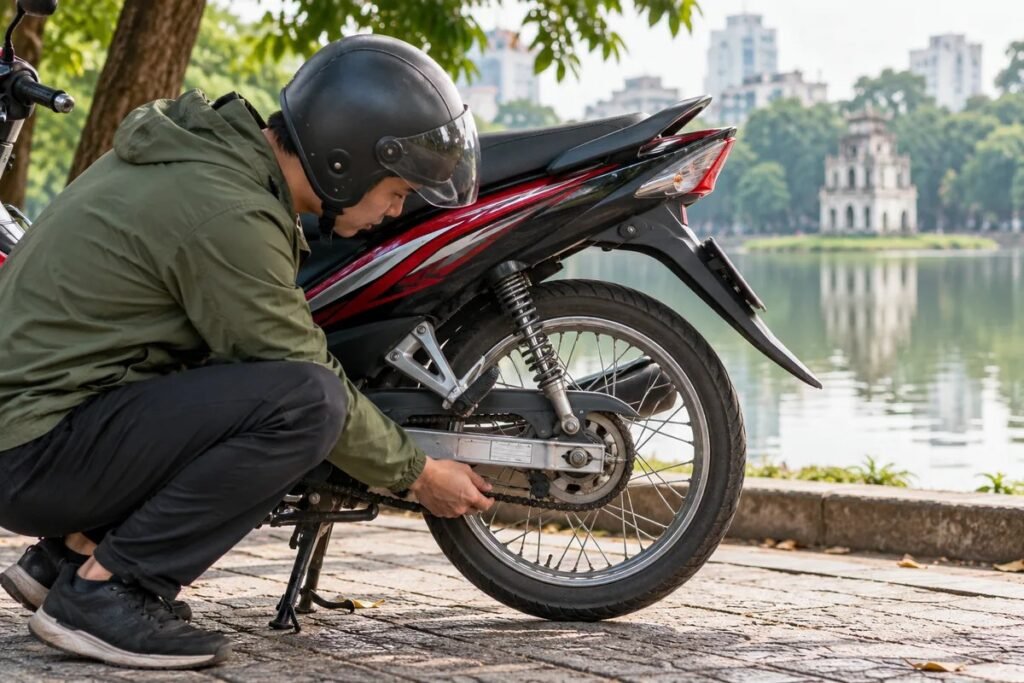
- A photo of the rear-drive area from outside the normal wheel and chain space, without touching parts.
- Any visible loose chain lying safely off the road.
- Any damaged chain guard or nearby component that can be seen without dismantling.
Do not kneel beside live traffic, lean into a trapped wheel or cross lanes to get a better photograph. The safety of the people present matters more than collecting a perfect image of the broken part.
What information should go in your first message?
Include the location pin, vehicle registration, time and what you heard or felt. State whether the bike lost acceleration, whether the rear wheel rolled normally and whether it is now parked and switched off. Mention any passenger or injury. Tell the provider what you have not attempted, such as a restart or a repair.
A useful message is: “The bike made a loud noise near the rear wheel and no longer moved when I opened the throttle. I stopped safely at [location]. The chain appears displaced. I have not restarted or tried to move the chain. Please advise whether the bike needs collection.”
Why chain slack and maintenance matter
Final-drive chains require correct tension and lubrication according to the vehicle’s manufacturer. Wear, damage, alignment and sprocket condition also matter, so a successful-looking quick adjustment is not proof that the drive is sound. A rental rider should ask for checks at handover and follow the owner’s maintenance arrangement instead of tightening the chain without authorisation.
Our chain-care and slack overview explains what riders can observe and which work should be left to the shop. It complements this emergency-response guide rather than replacing an inspection.
How is this different from an automatic scooter belt?
Many twist-and-go scooters use an enclosed continuously variable transmission, not an exposed final-drive chain like a common semi-automatic underbone. A scooter with a belt problem may show different symptoms and requires different inspection. Do not attempt to apply a chain repair tutorial to a belt-drive scooter, or assume that every motorcycle with a gearbox has the same rear-drive arrangement.
Should you let somebody nearby repair it?
Ask the rental provider before authorising work. You may be dealing with more than a detached chain; damaged guards, sprockets or wheel components may need a workshop. Replacing parts without agreement can also make it hard to establish what happened or which condition the bike was in at the time of failure.
If the location is unsafe, explain that urgently so the provider can discuss an appropriate response. Do not promise that the shop offers recovery at no cost or from every location unless that is part of the confirmed rental terms.
What if you suspect damage after hitting a pothole?
Record the impact and resulting noise without trying to reproduce it. If there is damage around the rear wheel, the bike may need a wider inspection. Never ride on simply because the engine still starts.
A pre-ride visual check can help notice unusual chain sag or obvious damage. It does not substitute for periodic workshop maintenance. The bike should remain parked if the chain is missing, trapped or broken.
How to reduce the risk before collection
Ask staff to demonstrate the normal appearance of the chain and chain guard on the actual bike, and to explain what to do if the rear wheel feels unusual. Look for obviously loose or damaged components without opening covers. If the chain guard is broken or the chain appears to touch other parts, raise the issue before accepting the motorbike.
Read the Nguyen Ha semi-automatic rental information when choosing a model. Confirm the specific vehicle and current availability rather than assuming a guide describes an in-stock motorcycle.
Frequently asked questions
Can I carry the chain to the shop and ride the bike without it?
No. A chain-driven motorcycle cannot operate normally without its drive chain. Arrange an appropriate inspection or transport plan with the owner.
What if the chain has only slipped off?
Do not attempt a roadside refit. There may be an underlying alignment, tension or component problem that needs proper assessment.
What if the rear wheel is stuck?
Do not force it to turn or push the bike downhill. Keep people clear of traffic and request help.
Call Nguyen Ha at 0334 699 969 to report the vehicle and location. The shop needs to confirm how assistance will be arranged for the particular rental.