Riding Skills & Safety Planning
Wet Brakes After Riding Through Water: A Rental Motorbike Checklist
On this page
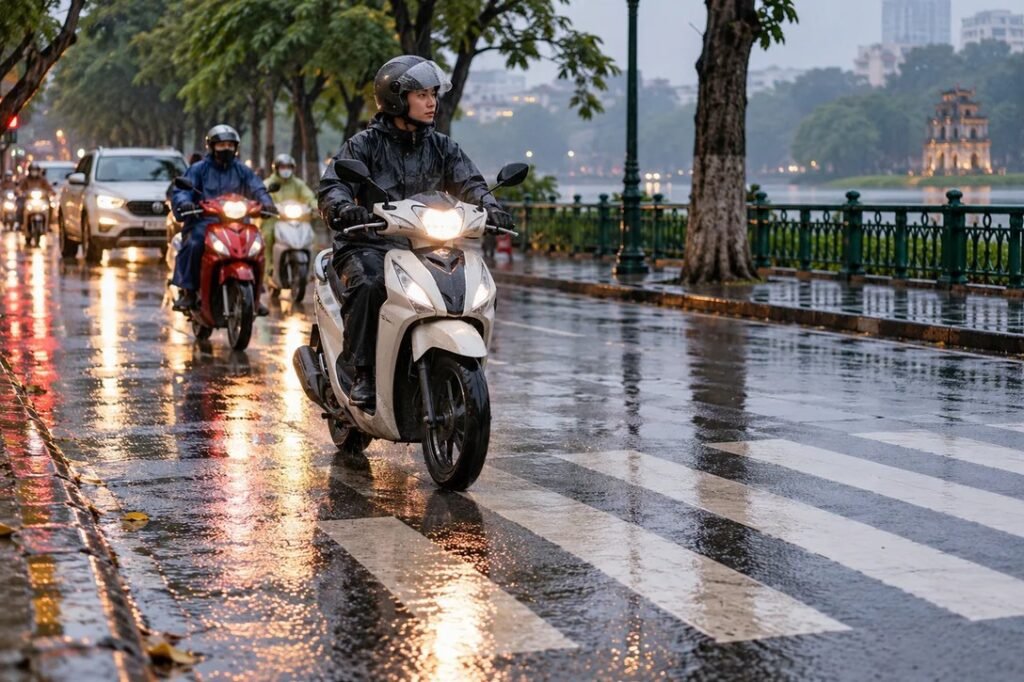
You have just ridden a rental motorcycle through a shallow puddle in Hanoi and the brakes no longer feel as responsive as before. Water can temporarily affect braking friction, while the wet road itself can reduce tyre grip. Those are two separate concerns, and a rider should not assume that every weak brake will automatically recover after a few squeezes. If braking feels abnormal or unreliable, find a safe place to stop, leave the bike parked and contact the rental provider for assessment.
This checklist is for shallow water already encountered during an ordinary journey—not a recommendation to cross flooded streets. Deep, fast-moving or unknown-depth water can hide holes and threaten the engine and rider. When the road ahead is uncertain, finding another route is safer than testing the depth with a rented motorbike.
Why wet brakes can respond differently
Many motorcycles use a disc brake, a drum brake or one of each. Water between friction surfaces can change the initial feel and delay the braking response. The extent and duration depend on the system, the water and the condition of the brake components. A wet road also has different traction from dry asphalt, so an apparently normal brake may still be unable to stop as quickly.
| Observation | What it may indicate | Safer response |
|---|---|---|
| Brake lever feels normal, but stopping seems weaker | Moisture or reduced road grip may contribute | Reduce speed and stop for assessment if performance is abnormal |
| Lever suddenly feels unusually soft or travels farther | Potential braking fault requiring inspection | Do not continue or perform further tests |
| Motorbike slides on a painted line | Road traction may be poor | Avoid sudden steering or braking inputs and stop safely |
| Grinding noise or pulling to one side | A mechanical concern may be present | Park and report the symptoms to the shop |
| Engine stops after water crossing | Water-related engine or electrical trouble is possible | Do not repeatedly restart; contact the owner |
These are observations, not a diagnostic chart. A mechanic must assess suspected brake faults. The passenger or rider cannot establish mechanical safety just because a lever still moves.
What Honda’s manuals say about moisture
A Honda motorcycle owner’s manual explains that damp brakes can reduce braking efficiency and describes a controlled, low-speed use of the brakes to help them dry. Another manual discusses this after washing the bike. Such instructions apply in the conditions defined for the actual model and must not be treated as a universal permission to ride a vehicle with an unexplained, persistent brake problem.
If the bike’s brakes already feel dangerously ineffective, do not ride into traffic to reproduce the symptom or force a drying procedure. Stop as safely as possible, then have the shop advise what inspection or assistance is required. The correct response depends on the bike and road.
Before reaching a puddle, decide whether to avoid it
Look ahead for standing water, potholes, roadworks and traffic. If the depth is not clear, do not use the bike as a depth gauge. A puddle can conceal an uneven surface, open drain or debris. It may also be deeper near the kerb. The fact that another motorbike has crossed does not establish that your particular vehicle can do so safely.
Slow down early, leave space and seek another route if conditions warrant. Do not enter deep water or floodwater moving across the road. If the street becomes hazardous, a delayed journey is preferable to damage or injury.
What to do after you notice weak braking
- Keep your attention on the road and gradually reduce speed with the control available.
- Move toward an appropriate stopping location only when traffic conditions permit.
- Do not accelerate again to “check whether the brakes have dried”.
- Secure the motorcycle and let your passenger move away from traffic.
- Record which brake or control felt unusual and when the change began.
- Contact the rental provider and ask whether the bike needs inspection or collection.
Do not assume that repeated squeezing will solve every issue. If the brake does not respond reliably, the bike should remain out of use until its condition has been assessed. A renter should not remove pads, loosen cables or apply chemicals to a wet brake.
Why following distance matters even after the puddle
Water left on the road can lengthen stopping distance by reducing available grip. A driver who follows another vehicle too closely may have little room for a sudden stop. Even with functioning brakes, allow more space and anticipate junctions, pedestrians and vehicles pulling out of side streets.
Do not use a fixed numerical following gap as proof of safety. Rain intensity, tyres, braking systems, slope and visibility vary. If you cannot maintain an adequate margin, wait for better conditions or use another mode of transport.
Can you test the brakes in a parking area?
For a known, normally functioning motorcycle, the manufacturer’s manual may describe a specific low-speed check after washing or moisture exposure. However, a bike with an actual brake fault or pronounced reduction in performance needs inspection, not an informal test ride. Do not carry out emergency stops, high-speed trials or repeated road experiments.
Ask the shop which procedure is applicable to the exact motorcycle. A different model might have disc, drum, CBS or ABS arrangements. The way the controls feel can vary, making generic internet instructions unreliable.
Disc versus drum brakes in rain
Disc brakes expose the friction surfaces differently from enclosed drum brakes. Both may be affected by moisture, but their response and inspection needs differ. It is not correct to say one design always becomes immediately safe after water exposure. Condition and maintenance matter as much as the type.
At handover, identify the front and rear controls and ask about any manufacturer-specific precautions. Related guidance in our CBS and ABS explanation</a helps separate different braking features without assuming every rental has them.
What if the engine stops after crossing water?
Do not repeatedly press the starter. Water entering the intake or other systems can create damage that is made worse by restart attempts. Leave the ignition off when safe, record the depth and location as accurately as possible and contact the owner. Do not open engine covers or try to drain fluids at the roadside.
An engine that restarts once does not necessarily indicate that everything is safe, and a brake system affected by water may still need inspection. Treat the two concerns separately when reporting.
Which facts help the rental shop?
- Motorcycle registration plate and model, if known.
- Time, street and approximate water depth from the original crossing.
- Which brake felt different and how the lever or pedal responded.
- Whether there was a new sound, warning indicator or pulling sensation.
- Whether the motorbike is already parked and safe.
- Any photograph of the stationary bike or dashboard that does not put you in traffic.
A simple report might say: “After crossing shallow standing water near [location], the front brake felt weaker than earlier. I reduced speed and parked. I have not ridden again. Please advise whether it needs an inspection.” Avoid claiming that water definitely caused the problem before a professional has checked.
What not to do
- Ride faster to make moisture disappear.
- Carry out a hard stop to see whether ABS works.
- Spray oil, lubricant or cleaning fluid onto brake discs or pads.
- Ride home with brakes you cannot trust.
- Repeatedly start the engine after a suspected water-ingestion event.
- Ask a passenger to film the test while you operate the motorcycle.
Planning a safer rainy-day rental
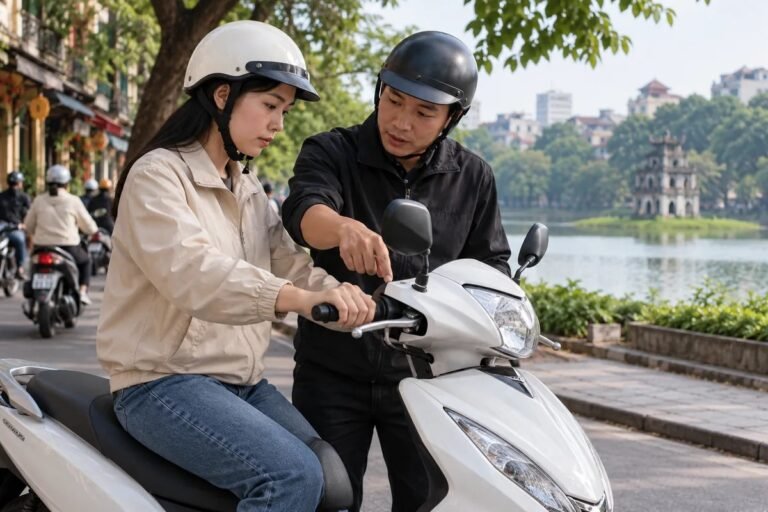
Check the weather and route before leaving, and give yourself enough time to avoid rushing. Ask the rental shop to show the normal brake feel at collection. If you are unfamiliar with the controls, consider an appropriate supervised familiarisation away from traffic before a rainy-day journey.
Confirm the actual model’s instructions
Different makes and model years have different braking arrangements. Look at the Nguyen Ha scooter rental overview for general vehicle types, then ask about a specific available bike. If you suspect wet-brake weakness or another fault, call 0334 699 969 from a safe place rather than testing the issue on the road.