Riding Skills & Safety Planning
Motorbike Throttle Stuck While Riding: Safety and Rental-Shop Reporting
On this page
A motorbike throttle that does not spring back when you release your hand is an emergency. The engine may continue delivering power even though you intend to slow down. Concentrate on controlling the vehicle and ending the powered motion safely, rather than looking down at the grip or repeatedly twisting it to diagnose a fault. The correct way to interrupt engine power depends on the motorcycle: a manual-clutch bike has controls that a typical automatic scooter does not.
Essential rule for a renter: know the actual motorcycle’s engine cut-off and stopping controls before riding. If a throttle becomes stuck, use the emergency procedure appropriate to the model and your training, brake with control and stop somewhere safe. Once the motorbike is stopped, do not start it again to see whether the problem has disappeared. Contact the rental provider for assessment or suitable recovery.
How can a stuck throttle feel?
You release the accelerator, but the motorcycle keeps pulling, the engine continues to rev or the grip feels unusually stiff. Some riders notice the problem as an unexpectedly slow return rather than a complete jam. In any of those situations, continuing to ride to “see if it settles down” can be dangerous.
An unfamiliar throttle response can also be confused with normal engine behaviour, a glove snagging the grip, clothing touching the controls or the rider unintentionally opening the throttle while trying to brake. The cause is not something to establish during the emergency.
| Observation | Why it matters | Priority |
|---|---|---|
| Grip does not return when released | Engine power may not reduce as expected | Use the model-specific emergency stop procedure |
| Motorcycle keeps accelerating | Distance to obstacles can close quickly | Keep steering control and interrupt propulsion safely |
| Grip returns slowly at a stop | May signal interference or a mechanical problem | Do not depart; request inspection |
| Motorcycle continues to move after engine power is cut | It still has momentum | Brake progressively to a suitable safe stop |
| New smoke, burning smell or loss of braking | Another serious hazard may exist | Protect people and seek urgent assistance |
Manual-clutch motorcycles have a specific emergency method
The Motorcycle Safety Foundation (MSF) discusses a stuck throttle in its You and Your Motorcycle riding guide. For a motorcycle equipped with a manual clutch and an engine cut-off switch, it describes using the switch while pulling in the clutch to interrupt engine power, then controlling the motorcycle and coming to a safe stop.
That guidance applies to a control arrangement with both the clutch lever and the cut-off switch. It must not be applied word for word to every scooter, electric motorbike or semi-automatic underbone. Motorcycles differ in their ignition, brakes, transmission and possible electronic functions.
Why you cannot tell every scooter rider to pull the clutch
A typical automatic scooter has no hand-operated clutch lever. A common semi-automatic underbone has a foot gear selector but no conventional manual clutch lever either. Therefore “pull in the clutch and hit the kill switch” is not a complete instruction for the whole range of rental motorbikes.
The proper way to remove engine power on a scooter depends on its model and controls. Some vehicles have a dedicated engine stop switch; others may require a specific ignition procedure. The rider must know which control is correct before departure, not try to find it by touch for the first time in busy traffic.
Keep the steering under control
Do not stare down at the right grip, reach into moving parts, or release the handlebars to investigate the cable while the motorcycle is still moving. Look ahead, anticipate where other road users are going and keep the bike stable. The aim is to interrupt propulsion without creating an immediate steering or traffic hazard.
Once engine power is safely interrupted according to the vehicle’s design, the motorcycle still has forward momentum. Appropriate braking is needed to slow it and stop. Use the braking method you have been trained to use for the specific motorcycle; a sharp, uncontrolled input can create another loss-of-grip risk.
Never turn the key to steering lock while moving
The ignition system and steering lock can be located near each other. Do not rotate a moving motorcycle’s key toward a steering-lock position or try to remove the key while rolling. The way OFF and LOCK are arranged differs across models. Do not assume instructions for one scooter describe the lock sequence on another one.
Ask the rental provider to identify the normal shutdown and emergency engine cut-off procedure during handover. The correct action must not disable your ability to steer or unnecessarily create an electrical hazard at the critical moment.
What if the throttle suddenly returns to normal?
Do not regard a temporary recovery as proof that the underlying issue is gone. A grip that stuck once may stick again during a turn, junction or hill. Once you are able to reach a safe stopping place, keep the bike parked and have the provider determine whether inspection, repair or transport is needed.
A short roadside test—revving the engine, twisting the throttle repeatedly or riding another block—does not establish safe operation. A rental customer should not attempt to dismantle the handlebar housing to find a cause.
Check the actual controls during the rental handover
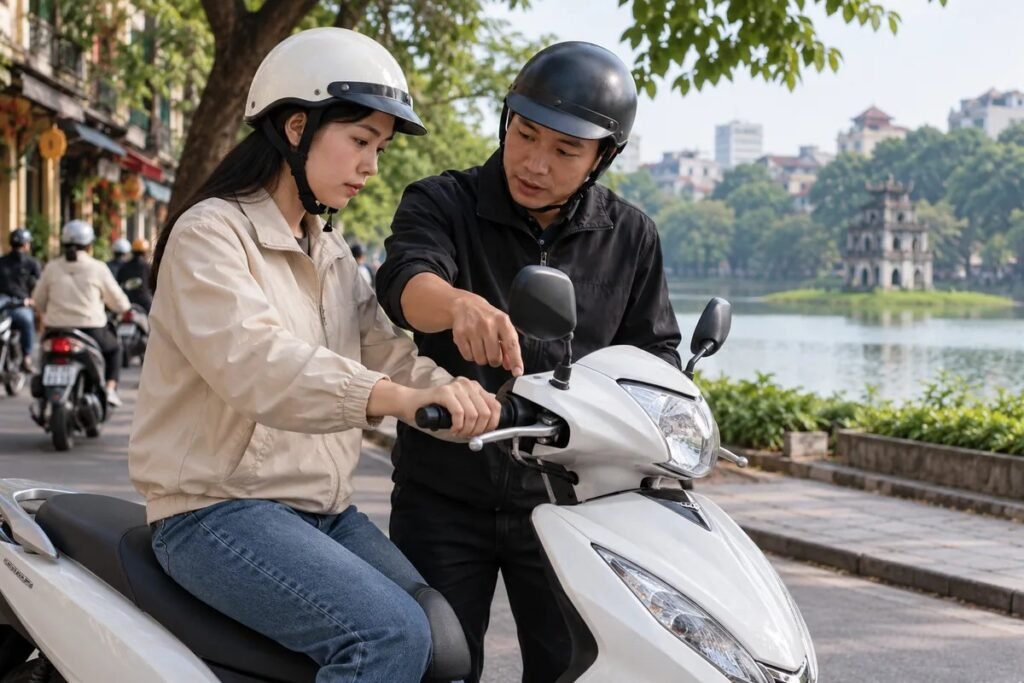
Before the engine starts, ask staff to demonstrate the throttle’s normal return movement and the engine cut-off method. With the motorcycle securely stationary and powered off, a qualified person can show that the grip returns freely and does not snag at different handlebar positions. If it feels sticky or does not return as intended, do not accept the bike until the concern is resolved.
Gloves, rain sleeves, phone mounts and luggage straps should not crowd the right-hand control. A bag handle hanging from the bar can obstruct the throttle or brake. Check the rider’s actual clothing and accessories rather than assuming everything that fits next to the grip is safe.
Why a brake is not a substitute for cutting power
If the engine is continuing to drive the motorcycle, braking alone may be fighting that drive, increasing risk and strain. For manual-clutch models with the appropriate controls, the MSF’s approach emphasises isolating the engine’s drive while maintaining the ability to slow and steer. On other designs, use the manufacturer-specified emergency procedure.
Never assume the front and rear brake controls are in the same places on a scooter, semi-automatic or manual motorcycle. Ask staff to identify them clearly. Brakes that themselves feel abnormal need a separate qualified assessment.
What if you are carrying a passenger?
The passenger may be frightened by the sudden acceleration or change in engine noise. The rider should concentrate on stopping safely instead of turning around to explain the incident. Once the motorbike is fully stopped and stable, help the passenger dismount away from passing traffic.
Do not take the same passenger on another “test ride” to see whether the throttle fault repeats. A second person adds load and can affect balance, making experimentation especially inappropriate.
What should you document once safely stopped?
- Registration plate, model and rental reference.
- Location, time and road conditions.
- Whether the throttle remained open, returned slowly or felt physically obstructed.
- Whether the motorcycle accelerated, revved unusually or behaved differently when braking.
- How you brought the bike to a stop, including any cut-off control used if known.
- Whether a glove, handlebar accessory or bag strap was near the grip.
- Any smoke, smell, warning icon, near miss or damage.
Photograph the stationary grip and surrounding accessories if it is safe. Do not manipulate the throttle to produce a photograph or video, and do not restart the engine for the purpose of showing a fault.
A message you can send the shop
“The throttle on my rental bike did not return normally near [location]. The engine continued to pull after I released it. I followed the stopping procedure I had been shown and parked the motorbike safely. It is switched off and I have not tried to start it again. Plate [number]. Please advise on a qualified inspection or safe collection.”
This message communicates what happened without claiming that a cable, spring, electronic control or grip component is definitely defective. The shop can then decide what assessment is needed.
Do not improvise repairs
Do not spray lubricant into the grip assembly, pull a cable, remove the throttle housing or adjust any hidden stop screw on a rented motorcycle without qualified authorisation. The fault could involve a mechanical or electronic condition that a quick adjustment will not resolve.
What if smoke, injury or a crash occurs?
Protect people first. If the motorcycle is smoking, leaking petrol or near fire, move clear of the danger and obtain suitable emergency assistance. If someone has been injured, seek medical help and avoid moving them unnecessarily when a serious injury is suspected. Only deal with rental paperwork or damage photographs after urgent safety needs have been addressed.
Frequently asked questions
Is a stiff throttle always a broken cable?
No. The symptom may have several possible causes. It needs proper examination, and a renter should not guess from a single observation.
Can I ride back if the throttle works normally again?
Do not resume riding without an appropriate assessment and instructions from the responsible provider. A temporary return to normal is not evidence that the problem is solved.
Does an electric scooter use the same emergency controls?
Not necessarily. Electronic throttle controls, propulsion shutoff and interlocks depend on the model. Ask for the actual manufacturer-approved emergency instructions.
Confirm the safe procedure before your next rental
When collecting a rental motorbike, ask which controls interrupt the engine’s power and how the throttle should return when released. For current Nguyen Ha vehicle information and a report about the motorcycle you are using, call 0334 699 969. This educational guide does not replace the vehicle’s manual, supervised training or emergency assistance.