Riding Skills & Safety Planning
Apartment Garage Ramps in Hanoi: Scooter Grip, Corners and Thresholds
On this page
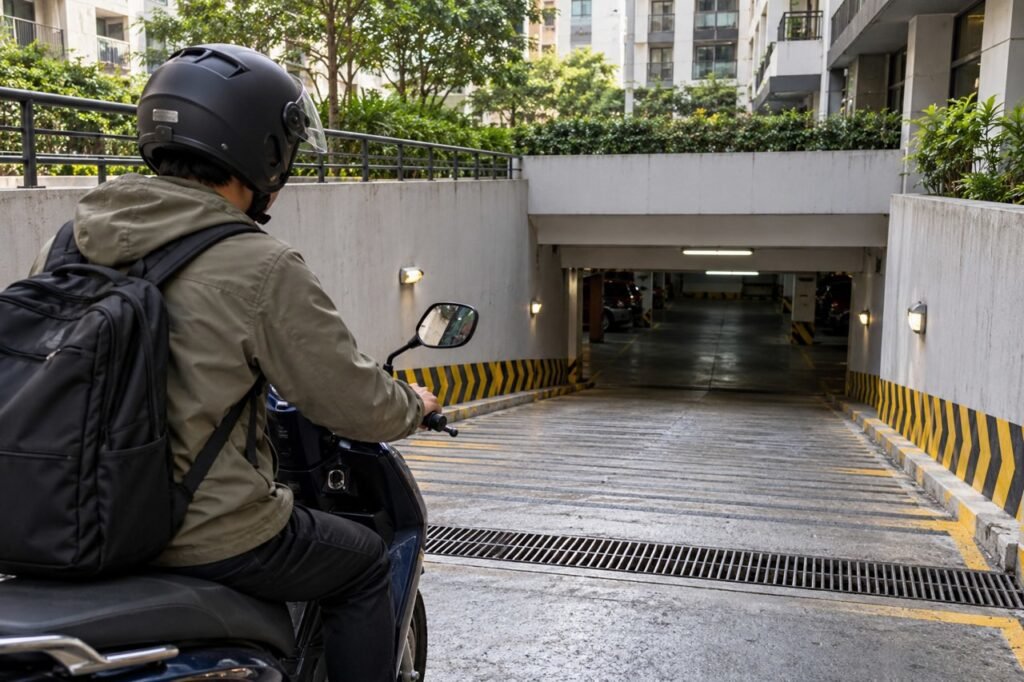
A steep ramp into a Hanoi apartment garage may look short, but it can combine several hazards in just a few metres: a sharp change in slope, polished concrete, a narrow bend, a raised threshold and traffic emerging from a blind corner. The safest approach is to assess the access point before committing the motorcycle. If the surface is too slippery, the bike too heavy or the layout beyond your ability, choose another permitted entrance or request suitable assistance rather than attempting to prove that you can ride or push it through.
This article addresses the distinctive layout and surface hazards of apartment parking garages, including lips, drains, pedestrians, barrier arms and tight turns. For a broader discussion of automatic scooter hill starts and engine braking on flyovers, see our existing scooter hill-start and ramp guide. The two topics overlap geographically but have different practical purposes.
Look at the entire ramp, not just the slope angle
From the top of an entrance, the bottom of the ramp may be hidden. A vehicle could be waiting at the exit, and the surface may change suddenly from rough concrete to polished tiles. Assess whether the route has separate entrances and exits, a mirror, a stop line or a staff member directing traffic. A straight, dry ramp with good sightlines is different from a narrow spiral with water running across it.
Do not enter just because the barrier arm has opened. Check that there is a clear, usable space on the other side and that a pedestrian or car is not about to approach. If the line of sight is blocked, wait in a lawful, safe position and seek guidance from the parking staff.
Five garage features to check before riding in
| Feature | What may go wrong | Safer decision |
|---|---|---|
| Polished or wet concrete | Tyres have less reliable traction | Do not enter a surface you cannot control safely |
| Raised lip or drainage channel | A wheel can strike or deflect at the transition | Check height, angle and suitable access route |
| Blind corner at the bottom | Oncoming traffic becomes visible late | Seek clear passage before beginning the slope |
| Barrier arm halfway up | You may have to wait on a steep incline | Ask staff about a safe staging area |
| Pedestrian crossing or doorway | People may step directly into the ramp | Yield and avoid committing with poor visibility |
The table is a decision checklist, not a method to certify a ramp as safe. The garage’s own rules, staff instructions and the rider’s skill are important.
Why wet tiles and green growth are warning signs
Some ramps have smooth paint, glossy tiles or areas with algae and moisture. A surface that looks merely damp may have little grip for tyres or shoes. This matters whether you intend to ride down or dismount and walk the motorcycle. Pushing a heavy scooter on a steep slippery surface can be just as difficult to control as riding it.
Do not deliberately brake hard or accelerate to test traction. If you cannot stand or keep the scooter secure, do not enter. Ask the parking manager for an alternative route or properly trained assistance.
A lip or step is not the same as a gentle ramp
A raised concrete edge at the garage entrance can abruptly change the wheel’s direction, especially when approached at an angle. Painted metal drainage covers and expansion joints can also be slippery. Check the access geometry and the model’s ground clearance before attempting to cross; a general article cannot tell you a safe maximum step height for every rental scooter.
If the threshold is too high, sharply angled or obstructed, do not force the bike across it. Avoid scraping the underside or striking a wheel to see whether there is enough clearance. A different authorised entrance is preferable to damaging the motorcycle or losing balance.
Downhill: plan the stop at the bottom in advance
Before entering a descent, look for space where you would stop if a car or pedestrian appears. Begin at a controlled, appropriately low speed and avoid sudden inputs. Proper braking techniques depend on the actual motorcycle and its braking system. Do not assume a generic command to hold just one lever applies to every model.
On some automatic scooters the transmission’s behaviour changes at low speed, so engine braking may be limited or inconsistent. The model manual and competent instruction matter. Do not switch off the engine and coast downhill to save petrol.
Uphill: avoid waiting where the motorcycle can roll back
If the barrier or ticket machine is located partway up the slope, find out where motorcycles are expected to wait. A small automatic scooter may roll back when propulsion is not applied, and parking-brake features are not universal. Do not rely on the throttle to hold a bike motionless on a slope or assume it can be supported safely with one foot.
Ask the parking staff about the approved stopping area, and learn the actual scooter’s hill-start procedure before using a demanding garage. If the bike is loaded heavily or you cannot support it, request help rather than attempting an unfamiliar manoeuvre in live traffic.
What if cars are moving in both directions?
Some garages have a single narrow ramp carrying traffic both ways. Signs, mirrors, lights and staff may organise priority, but you cannot assume they are present or working. Wait for a clear instruction where sightlines are poor, leave a suitable separation and avoid accelerating to “beat” an approaching car.
If somebody is reversing, keep out of their blind spot and do not squeeze between a wall and a turning vehicle. It is often safer to allow the larger vehicle to complete its movement before taking a narrow route.
Footwear and passenger movement
A rider who needs to support the bike at low speed should wear suitable secure footwear. Slippery sandals or a wet floor can make it difficult to maintain balance. A passenger adds weight and may suddenly shift position while the bike is navigating a sharp turn or slope.
Where the access is difficult, consider having the passenger dismount in a safe, level place before entering, if permitted and practical. Do not ask them to step off halfway down a steep ramp or onto a narrow ledge near traffic.
What to do if the scooter starts rolling back
Maintain control using the braking procedure you have been trained to use for that actual vehicle. Do not improvise a new throttle-and-brake technique under pressure. If the bike cannot be held securely, protecting people takes priority over saving the motorcycle from damage.
Once safe, stop and ask garage staff for assistance. If the motorcycle has struck a step, fallen or developed an abnormal control feel, photograph the stationary condition and notify the rental owner before continuing.
Can you just push the motorbike down?
Not automatically. A heavy vehicle can gain momentum while being pushed downhill, and a person may have poor grip on a wet surface. Do not assume pushing is the safer fallback when the ramp is too steep to ride. If you cannot securely manage the load and position of the motorcycle, use a different entrance or qualified assistance.
Check the garage’s permission and opening rules
Apartment buildings may have separate resident and visitor procedures, restrictions on electric vehicles or different access points for motorcycles and cars. Ask the building staff rather than assuming that every vehicle can enter the same ramp. This article does not establish the policy of any particular Hanoi building.
Keep payment or parking tickets accessible without searching pockets while moving. Stop in an approved area before checking a phone, retrieving a ticket or adjusting luggage.
How this differs from parking a geared motorcycle on a hill
A semi-automatic or manual-clutch bike has a different gearbox and sometimes different parking practices. If you are evaluating a geared rental, read our geared-bike parking on slopes guide. Never assume that a twist-and-go scooter has a gear you can select to hold it parked.
Before accepting a rental: six useful questions
- Is this exact model manageable for me at low speed and when stopped?
- Where are the front and rear brake controls?
- Does this particular scooter have a parking-brake feature?
- What should I do if the bike tips or contacts a high threshold?
- Are there any components underneath that may be vulnerable to a raised lip?
- Can the shop explain the model’s basic safe controls before I enter a steep garage?
A photo of the parking entrance may help staff understand your question, but it does not let anyone remotely certify safe clearance or grip. If the garage is clearly too difficult, choose another permitted place to park.
When the surface or controls feel wrong
Do not continue into a blind, slippery descent if you cannot maintain control. If you observe brake weakness, repeated wheel slip or unusual grinding, stop in a safe location and report it. Never repeat a failed attempt at higher speed simply because other riders appear to manage the ramp.
Confirm with the parking operator and rental shop
Ask the garage about its entry rules and safer access options. For the motorcycle’s controls or damage-reporting process, contact Nguyen Ha at 0334 699 969. Neither this article nor the shop’s general rental categories can guarantee that a particular steep garage is suitable for your bike and experience.