Manual & Semi-Automatic Motorbikes
Neutral or First Gear at a Long Red Light on a Manual Bike?
On this page
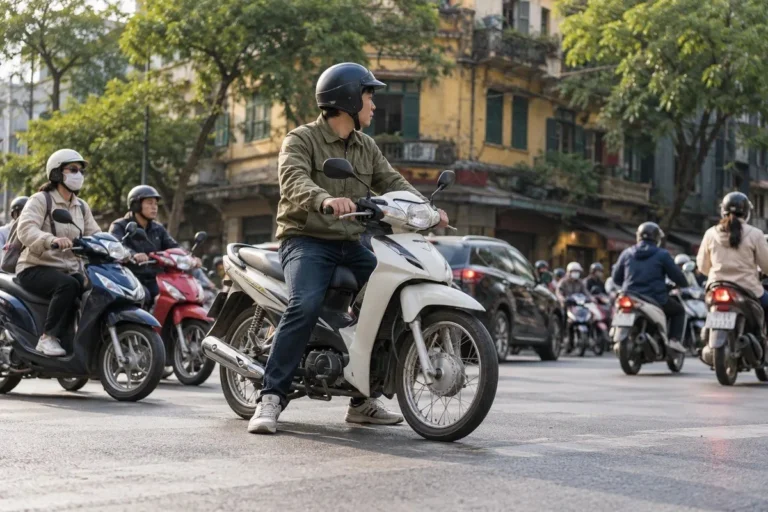
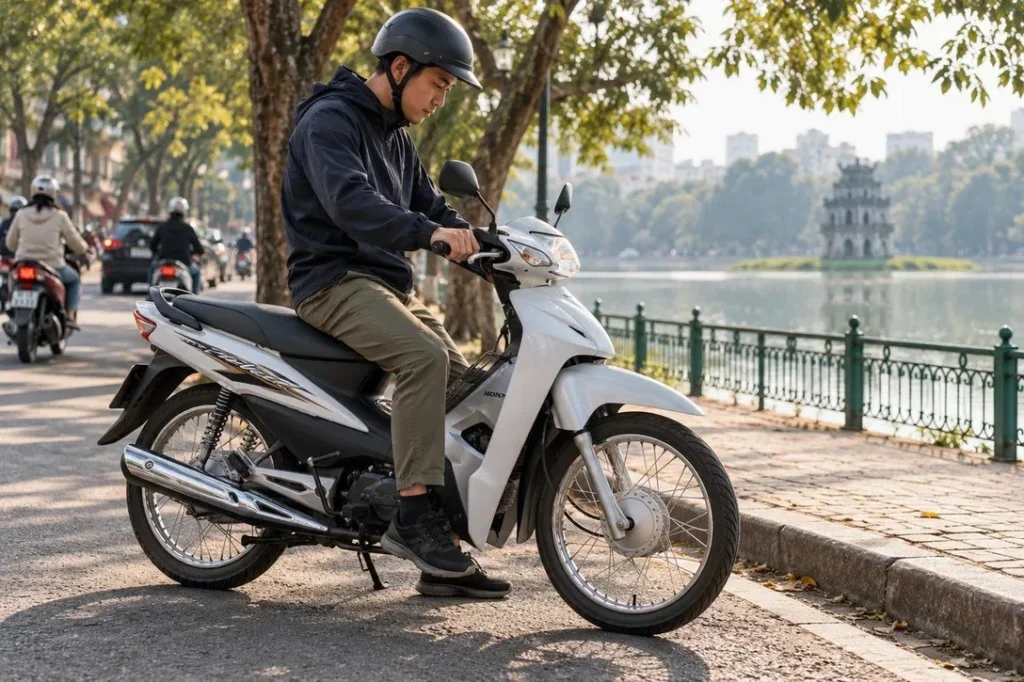
A Hanoi traffic light turns red and the countdown appears to be long. You are stopped on a motorcycle with a hand-operated clutch, squeezing the left lever in first gear. Your hand starts to tire. Would selecting neutral be more comfortable, or should you remain in first gear so you can move if another vehicle approaches from behind?
There is no safe answer based on the countdown alone. Being ready to move can matter when traffic is approaching from behind. Neutral may relieve clutch-hand effort during a genuinely long, secure stop after traffic is fully settled, but it delays the ability to move. The road surface, visibility, nearby vehicles, the model’s controls and the rider’s experience all affect the decision. The motorcycle must be held with its brakes while stopped, whatever gear is chosen.
What changes between neutral and first gear?
| Situation | First gear, clutch fully disengaged | Neutral |
|---|---|---|
| Ready to move | Usually quicker once a safe path exists | Requires a deliberate shift into gear first |
| Clutch hand | Continues holding the lever on a conventional manual bike | Can normally release the lever when safely in neutral |
| Unexpected throttle input | Must also control clutch engagement | Power is not transmitted through the transmission |
| Stopped on a slope | Brakes still required to prevent rolling | Brakes still required to prevent rolling |
| Approaching vehicle from behind | Can offer faster response if you are capable and a safe escape path exists | Requires more steps before moving |
The table assumes an ordinary hand-clutch motorcycle that is functioning correctly. Semi-automatic underbones may use different clutch behaviour and shift patterns, so do not transfer the same hand positions to another bike without reading its instructions.
Safety guidance places emphasis on rear traffic
The Motorcycle Safety Foundation’s riding-tips guidance recommends remaining in first gear with the clutch disengaged when stopped in traffic so that a rider can respond if necessary. Scanning behind you, keeping control of the brakes and identifying a safe escape option are more important than an impatient launch when the light changes.
Being in first gear is not permission to suddenly accelerate through a red light, a pedestrian crossing or other vehicles. An escape is only appropriate when lawful and genuinely safer than remaining stationary.
Why some experienced riders use neutral during a long stop
The American Motorcyclist Association’s MSF Q&A acknowledges that neutral may reduce fatigue at a long, settled stop on level ground. It also notes the trade-off: shifting back into first takes time if a threat approaches. The rider should remain alert, keep a brake applied and be ready to change gear before moving.
This is a situational choice rather than an instruction to place the bike into neutral every time a light shows a long countdown. In active, unpredictable traffic, staying in first can preserve readiness.
The countdown is not a safety guarantee
A display showing ninety seconds does not mean conditions will remain fixed for those ninety seconds. Vehicles can creep forward, another motorcycle can approach from behind, a pedestrian may cross unexpectedly or the signal can change. Keep looking around rather than watching only the timer.
When traffic ahead is creeping, repeated neutral–first shifts can become distracting. The safest response is to follow appropriate training and remain prepared for changing traffic rather than treating the countdown as the sole factor.
What changes on a slope?
On a hill, the motorcycle can roll regardless of whether the gearbox is in neutral or first gear with the clutch fully disengaged. Hold it securely using appropriate brakes, with footing that suits the surface and slope. Do not attempt to keep it stationary by partially engaging the clutch against engine power.
If you have experienced a burning smell after holding a bike on a hill, see the clutch heat and burning-smell checklist. Do not treat an unresolved smell or brake concern as an opportunity to practise a new technique.
Which foot should support the motorcycle?
The answer can change with the road’s camber, your height, a passenger and the actual brake arrangement. On many conventional manual bikes, the left foot can provide support while the right foot remains at the rear brake pedal. A different position may be necessary on uneven or slippery ground.
The MSF Q&A notes that putting down one foot or both feet depends on the situation and experience. The goal is stable balance, a controlled brake and continued awareness—not an inflexible rule that overrides a visible hazard under one foot.
Do not copy a different bike’s neutral position
On many manual motorcycles, neutral sits between first and second gear. Other transmission layouts exist, and some semi-automatic underbones use a rotary pattern. A neutral indicator helps confirm selection but should not be confused with an assumption that every gear lever has the same movement.
Before riding, ask the shop to demonstrate the exact motorcycle’s pattern while stationary. Our gear engagement and neutral-light guide covers the relevant checks at rental handover.
What if you accidentally select the wrong gear?
Keep the brakes applied and throttle closed while safely stationary. Do not rev the engine and abruptly engage a gear to compensate for confusion. When uncertain, stop trying to move until you have identified the correct controls or obtained suitable assistance.
A sudden lurch can endanger a pedestrian or the motorcycle immediately in front of you. Protecting control is more important than responding instantly to a horn behind you.
How to prepare before the light changes
Keep monitoring cross traffic, pedestrians, mirrors and your available space. Whether you chose neutral or first, do not look down at the shift lever for a prolonged time as the signal changes. Move only after verifying that the route ahead is clear and legal.
For riders learning coordinated take-off, our guide to manual-clutch stalling at take-off explains why unfamiliar control inputs should be practised in a supervised, lawful area instead of a busy junction.
A practical decision checklist
- Is the motorcycle safely stopped with its brakes applied?
- Is traffic still approaching from behind, or has a protective queue formed?
- Is the road level, sloping or unusually slippery?
- Do you have a genuine safe option if a vehicle approaches too quickly?
- Are you fully familiar with this bike’s first-gear and neutral controls?
- Can you remain attentive to the signal, pedestrians and surrounding vehicles?
- Is there any mechanical issue that should prevent continued riding?
Never answer the questions by reading your phone while in active traffic. Consider conditions before moving and use judgement consistent with your training.
What about a semi-automatic underbone?
Many semi-automatic motorcycles have no hand-operated clutch lever, so the specific complaint of squeezing the left hand for a full minute does not apply. Gear choice still matters: the vehicle can move if the throttle is opened while in gear, and you must hold it securely with brakes.
Ask where neutral is on the actual bike and whether its gearbox can change gear in the same way as a conventional manual-clutch motorcycle. Do not assume one model’s shift pattern or indicator applies to another.
Frequently asked questions
Should I always shift to neutral when a countdown shows over one minute?
No. Time remaining does not remove the need to watch approaching traffic or be ready to move if necessary.
Does leaving the bike in first gear stop it rolling on a hill?
Not reliably when the clutch is disengaged. Use the appropriate brakes to hold the motorcycle stationary.
Is it always wrong to select neutral at a long stop?
Not necessarily in a settled, suitable situation, but it adds a step before moving and needs careful situational awareness.
Nguyen Ha’s manual-clutch fleet has not been verified as available. For exact models and handover questions, call 0334 699 969 before travelling to the shop.