Manual & Semi-Automatic Motorbikes
Manual-Clutch Bike Stalls on Take-Off: What to Know
On this page
A motorcycle with a hand-operated clutch stops running just as you try to move away. The lights may change to green, traffic begins moving and you feel pressure from people behind you. This can happen to an inexperienced rider who releases the clutch too quickly, uses too little throttle or selects an unsuitable gear. It can also reflect a mechanical fault; the way it stalls and any additional warning signs matter.
Start with safety: if the motorcycle stalls in traffic, prevent it from rolling, stay alert to other vehicles and avoid frantic restarting or uncontrolled acceleration. If it cannot restart normally or you do not have enough space to move safely, obtain appropriate help. Someone who is not yet competent with clutch control should train under suitable supervision in a lawful area away from public traffic.
Why a manual motorcycle may stall during take-off
| Possible reason | What may happen | What to check with the trainer or shop |
|---|---|---|
| Clutch released too abruptly | Engine load rises before sufficient torque is available | Friction-zone familiarity and model behaviour |
| Insufficient throttle | Engine cannot maintain rotation as drive engages | Appropriate take-off control taught for that bike |
| Wrong starting gear | Engine struggles or the bike lurches | Correct shift pattern and first-gear confirmation |
| Steep uphill start or heavy load | More torque is needed as the bike moves | Whether the route and load suit the rider’s training |
| Clutch, fuel or ignition issue | Stalling repeats despite normal control inputs | Qualified inspection rather than continued practice |
The table is a list of possibilities, not a claim that every stall is rider error. Tell the owner if unusual noises, warning lights, a burning smell or poor clutch engagement accompany the event.
Understand the friction zone before riding in traffic
The friction zone is the part of the clutch-lever movement where engine drive starts transferring to the rear wheel. Riders use it briefly and smoothly to move away. Its precise position and feel differ across motorcycles and can change with maintenance or wear.
The Motorcycle Safety Foundation’s riding-tips manual describes coordinating clutch, throttle and first gear, and warns against stalling or over-revving. Read the model's official instructions and learn with a competent instructor; a web article is not a substitute for controlled practice.
Practice only in a suitable location
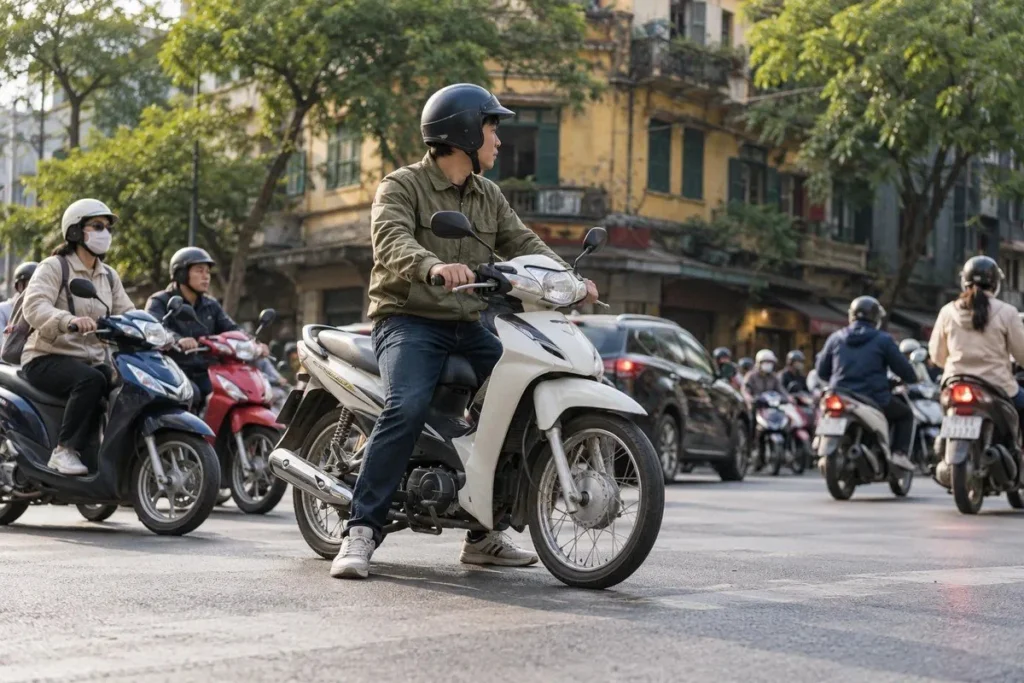
Inexperienced riders should not use a crowded Hanoi junction or steep parking ramp as a training area. Only practise when legally eligible for the motorcycle and at an authorised location separated from traffic, with suitable instruction and safety equipment. Learning how to control a particular motorcycle is different from being ready for an unfamiliar public road.
A good early goal is smooth, predictable starts and stops without looking down at the controls. If the instructor or shop observes an abnormal response, stop training on that bike until the issue is assessed.
Use the right first gear, not a guess
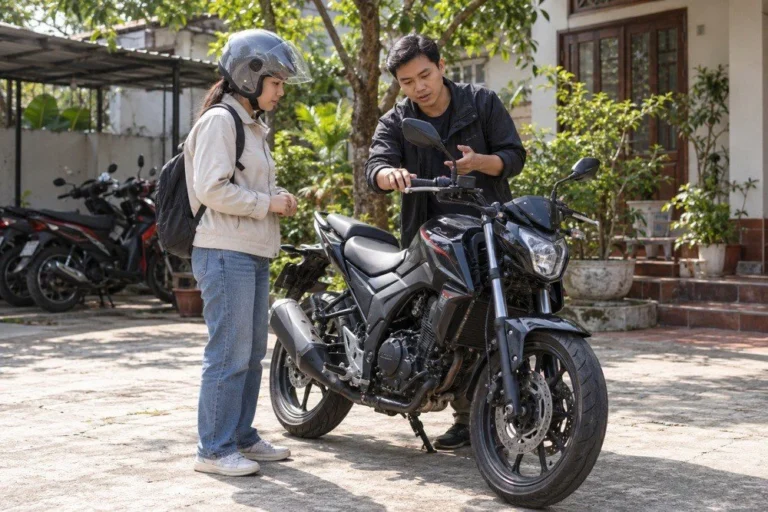
Motorcycles can have different gear patterns and neutral-indicator layouts. Ask staff to show the actual bike’s shift sequence and the meaning of its dashboard display. A semi-automatic underbone with a rotary gearbox may not behave like a conventional manual-clutch machine.
Our manual-bike gear engagement and neutral-light guide explains the questions to ask before rental. Do not force the gear lever or assume the gear positions are identical on all machines.
A controlled take-off has several coordinated parts
In formal rider training, the learner checks the surroundings, selects the appropriate gear, controls the motorcycle’s brakes and uses gentle, coordinated clutch and throttle movement to begin moving. It is not a contest to release the clutch as quickly as possible, and excessive revving can cause a lurch rather than solving an underlying problem.
Training should establish how the specific bike behaves during a safe, level-ground start before introducing hill starts or other higher-demand situations. Beginners should not independently practise those techniques with passing vehicles nearby.
If the engine stalls at an intersection
Keep the motorcycle controlled and avoid sudden attempts to launch forward. Check for approaching vehicles and whether you have a safe path. The method for restarting depends on the model’s starter interlocks, clutch and gear indicators. Follow the owner’s manual and any instructions already provided for the exact motorcycle.
If you are uncertain about the controls, or the bike will not restart normally, prioritise securing the scene and requesting assistance. Do not remain exposed in a traffic lane to repeatedly press the starter, and do not attempt to push a motorcycle through moving traffic when it would be unsafe.
A repeated stall may be a mechanical warning
If the bike runs roughly at idle, stalls every time the clutch starts engaging, or develops a strong fuel smell, smoke, unusual noise or electrical warning, stop and report it. A clutch that feels inconsistent, unusually stiff or unexpectedly slips also needs a proper assessment.
Do not diagnose a fuel-system, clutch-adjustment or ignition fault from a general list of symptoms. The vehicle’s exact model, maintenance condition and observed behaviour determine what a qualified mechanic needs to inspect.
Hill starts deserve additional training
On an incline, using only a partially engaged clutch to keep the motorcycle stationary can generate heat and wear. Hold the bike with the proper brakes while stopped, and use the model’s trained hill-start technique when it is safe and you are qualified to do so.
For signs to report after repeated slipping on a slope, see the burning smell after a hill stop guide. A persistent odour is a reason to stop and seek assessment rather than keep practising.
A useful symptom record
| Detail | What to write |
|---|---|
| Starting conditions | Flat road, incline, passenger or luggage |
| Gear selected | The gear indicated on the actual bike |
| Clutch response | Sudden engagement, slipping or normal movement |
| Engine behaviour | Stalled immediately, hesitated or ran roughly |
| Extra warning signs | Smell, leak, unusual sound, warning indicator |
| Actions taken | Safely stopped, turned off or contacted the shop |
The record helps the shop understand the problem without asking the renter to repeat a risky demonstration in traffic. Share observations honestly even if you think an incorrect clutch movement contributed.
Would a different motorcycle be more suitable?
Someone who has only recently started learning manual-clutch control may be better off delaying the rental and obtaining training, or considering another type of motorcycle they are already legally qualified and competent to ride. A semi-automatic does not have the conventional hand clutch, and an automatic scooter generally removes the foot-shifting task as well.
Manual-clutch models are quoted per model on request, so ask Nguyen Ha whether one is available before booking. Do not assume that a training motorcycle, spare bike or free model switch is always available.
Questions to ask at handover
- Is this a true manual-clutch bike and is it suitable for my legal licence category?
- Where are first gear and neutral on this specific machine?
- What are the normal clutch controls and starter interlocks?
- Can a qualified staff member explain any unfamiliar operation while the motorcycle is stationary?
- What should I do if it stalls repeatedly or has an abnormal smell?
- How do I contact the shop and record a mechanical concern?
Related guide: Emergency Braking on a Manual Motorcycle: Brakes, Clutch and Control.
Frequently asked questions
Does every stall mean a clutch needs replacing?
No. Control inputs and gear selection can cause stalling, but repeated or abnormal symptoms require a competent assessment.
Should I add lots of throttle to prevent stalling?
Not as a general solution. Excessive revving and abrupt clutch release can lead to an unexpected lurch or loss of control.
Can I learn the friction zone for the first time at a red light?
That is not appropriate training. Seek qualified instruction in a safe, lawful setting away from active traffic.
To enquire about an actual Nguyen Ha rental model or report a repeated stall, call 0334 699 969. The shop must confirm which vehicles and support arrangements are available.