Manual & Semi-Automatic Motorbikes
Descending a Long Hill on a Semi-Automatic: Brakes and Gears
On this page
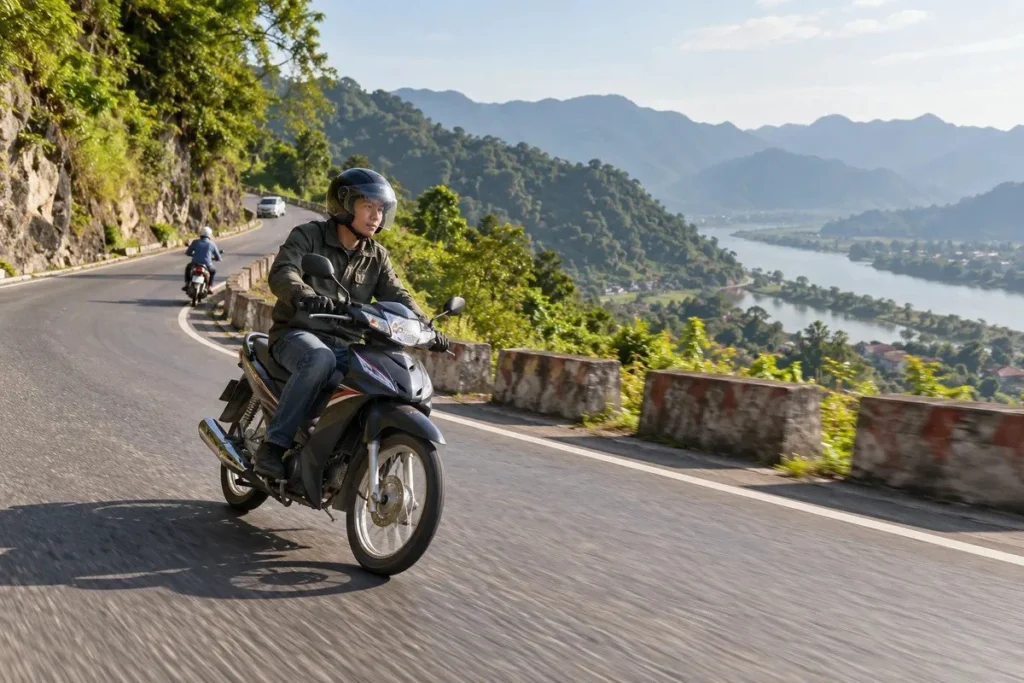
On a long downhill road, a motorbike can gain speed even with the throttle fully closed. If you rely on constant brake pressure alone, the brakes may become dangerously hot and less effective. With a semi-automatic motorcycle, appropriate engine braking can help share the task of controlling speed—but only when the motorcycle is in a suitable gear and the engine remains connected through its clutch system.
Before a descent: choose a speed and gear appropriate to the specific bike, load and road conditions, while following the manufacturer’s instructions. Avoid shifting abruptly to a very low gear at high speed. Use both brakes as trained and never coast downhill in neutral. If braking performance becomes abnormal or a burning smell appears, aim to stop safely as conditions allow and seek an inspection rather than continuing into a long descent.
Why long downhill braking creates heat
Going downhill converts gravitational potential energy into motion and heat. Brake pads and discs or drums dissipate some of that energy as they slow the bike. Applying the brakes continuously on a long, steep descent can raise their temperature enough to reduce braking effectiveness.
Honda’s CBF125 owner’s manual recommends combining engine braking with intermittent use of the brakes on long steep slopes. That manual describes its own model, so it is supporting general safety context, not a gear chart or operating manual for every semi-automatic rental motorcycle.
What engine braking means
With the throttle closed and the engine engaged through the drivetrain, the rear wheel drives the engine against internal resistance. That can help slow the motorcycle. A lower appropriate gear may create more engine braking at a given road speed, but selecting an excessively low gear or downshifting abruptly can disturb the rear tyre or over-rev the engine.
On some semi-automatic designs, a centrifugal clutch can change how much engine braking is available at very low speed. The exact behaviour depends on the model and its clutch and gearbox design. Do not assume the same response on every underbone.
Plan before the road tips steeply downward
Look ahead, reduce speed appropriately before the descent, and follow the correct shift procedure for the motorcycle you are actually riding. An unfamiliar rider should not use a long hill to experiment with transmission limits. The goal is stable speed and control, not maximising engine revs for the strongest possible drag.
A manual-clutch machine and a semi-automatic underbone may require different shifting actions. Check their manufacturer’s documentation and ask the rental shop how the actual bike behaves before planning a challenging route.
What to do and avoid on a downhill road
| Situation | Safer principle | Risk to avoid |
|---|---|---|
| Before the slope | Reduce speed and choose a suitable gear in advance | Entering too quickly, then panic-downshifting |
| On a long descent | Use appropriate engine braking plus controlled use of both brakes | Constant heavy braking and overheating |
| Approaching a curve | Set a safe speed before turning where possible | Sudden braking or gear shifts while leaning |
| Wet, sandy or slippery road | Make smooth, progressive control inputs | Rear-wheel instability from abrupt downshifts |
| Brake lever feels abnormal | Prioritise controlled, safe stopping and qualified assessment | Continuing downhill to see whether it improves |
These are general rider-safety principles, not precise instructions for a particular motorcycle’s gear numbers or braking force. The right combination varies with the slope, tyres, mechanical condition, load and rider competence.
Never coast downhill in neutral
Neutral disconnects normal engine braking through the gearbox. The brakes then carry the speed-control burden, and the rider loses part of the powertrain’s ability to manage the descent. Do not switch off the engine and coast to save fuel: switching off can also impair critical motorcycle functions depending on the model.
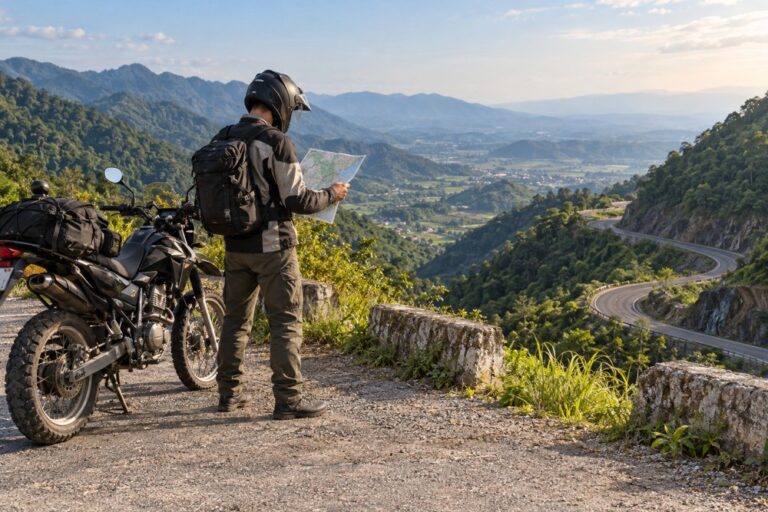
Maintain control and be prepared for traffic, bends and unexpected hazards. If the available route exceeds your riding ability or the bike’s condition is uncertain, take a safer route or another form of transport.
Do not over-rev the engine with a sudden downshift
Selecting a much lower gear while the motorcycle is moving fast can cause abrupt engine braking and potentially destabilise the rear wheel. The exact permissible speed for a gear is model-specific. Follow the owner’s manual and qualified instruction, rather than trying to copy a gear number recommended in a general blog post.
The Motorcycle Safety Foundation’s operator manual warns that a downshift at excessive speed can cause a lurch or rear-wheel skid. Smooth speed control and appropriate gear selection are essential, particularly in wet conditions.
When should you suspect overheated brakes?
A brake lever that feels unusually soft, a longer lever travel, a strong smell near the wheel or an unexpected reduction in stopping effect may indicate an issue requiring attention. Not all brake problems involve overheating, and a normal lever feel does not prove the brake system has no fault.
If you notice abnormal braking, use appropriate trained stopping techniques, move to a safe location if possible and request mechanical help. Do not deliberately test failing brakes by riding further downhill. Allow hot parts to cool naturally without touching or pouring water over them.
Heavy luggage or a passenger changes the situation
Additional load increases the energy that must be controlled when descending. It can also affect balance, braking distance, tyre demands and the way the engine responds to a lower gear. Keep within the motorcycle’s permitted load and only ride with a passenger if the bike and rental agreement allow it.
Do not apply a fixed “one gear lower” rule when carrying somebody. Speed, model limits, slope and safe traction all matter.
Know whether the shop permits the intended route
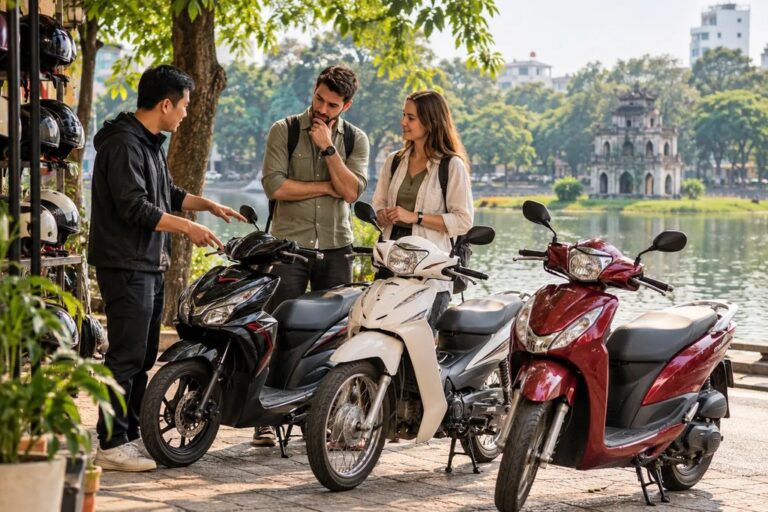
A motorcycle that is usable around Hanoi is not automatically approved for a mountain trip. Ask the rental provider whether travel outside the city, steep routes or a long-distance itinerary is covered by your specific agreement. Confirm the model’s availability and mechanical suitability rather than inferring them from this article.
For the separate issue of a manual clutch getting hot during hill stops, see our guide to a burning smell after extended clutch slipping. That is different from brake overheating during downhill use.
What to check at rental handover
- Confirm the actual motorcycle model and gear pattern.
- Ask for the manufacturer’s operating guidance on descending and downshifting.
- Inspect tyre condition and discuss any visibly low pressure or damage.
- Have staff explain the location and expected feel of both brake controls.
- Verify lights, indicators and mirrors before moving.
- Ask where the motorcycle may be used under the rental agreement.
- Save the shop’s phone number and breakdown-reporting procedure.
Do not depart on an unfamiliar or potentially faulty vehicle for a steep route simply because you have already paid for the rental.
A report to send if you notice brake weakness
“Hello, I am using rental motorcycle [plate] on [route] at [location]. I noticed [soft lever, smell, weak braking or another specific sign] during a descent. I have [safely stopped / taken an appropriate safe action] and will not continue until I know what to do. Please advise how the bike can be checked.”
Frequently asked questions
Does a lower gear always give safe engine braking?
No. The gear must match the speed and actual model; an abrupt downshift can cause instability or engine damage.
Can I release the brakes completely for every downhill stretch?
No universal braking pattern fits every road. Use appropriate trained control of both brakes and the drivetrain while maintaining a safe speed.
Does a semi-automatic engine brake exactly like a manual-clutch motorcycle?
Not necessarily. Clutch design and the operating speed can affect the connection between engine and rear wheel.
For the actual Nguyen Ha fleet and permitted travel area, contact 0334 699 969. No mountain-route availability or permission is guaranteed by this informational article.