Riding Skills & Safety Planning
Narrow Hanoi Alleys and Blind Corners: Ride or Give Way?
On this page
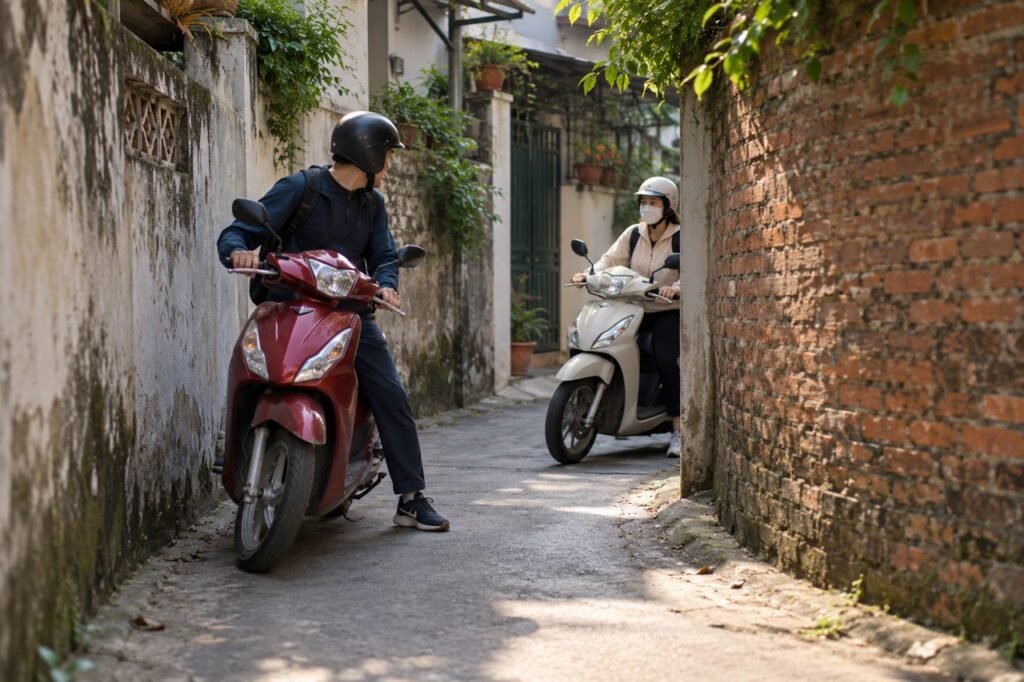
How should you ride a motorbike through narrow Hanoi alleys with blind corners, and who gives way when two bikes meet? Slow down before you turn in, keep to the right, ride at a speed that lets you stop within what you can see, and give a single short horn before a blind corner. When you meet an oncoming bike where only one fits, Vietnam’s traffic law says the vehicle nearer a passing place pulls in, a vehicle going downhill gives way to one going uphill, and pedestrians come first. Avoid reversing or turning around where you cannot see.
Hanoi’s alleys, called “ngõ”, can be just wide enough for one bike, with sharp bends, doorways opening straight onto the lane and children playing outside. Riding there needs a different approach from the main road: slower, more watchful and ready to give way.
Why alleys need a different riding style
| Feature | What to watch for |
|---|---|
| Narrow lanes | Little room to avoid anything; one parked bike or person can block the whole alley |
| Blind corners | You cannot see people or vehicles around the bend |
| Pedestrians, children, handcarts | They can step out of a doorway without warning |
| Rough or wet surfaces | Wheels slip or bounce more easily, especially when braking |
| Bikes parked along the sides | The usable width is narrower than the alley itself |
Every alley is different, so ride by what you actually see rather than assuming one is like the last.
Slow down before you turn in
- Lose speed while you are still on the main road instead of braking hard at the alley mouth.
- Look into the alley before turning: is anything coming out, is anyone walking?
- Ride slowly enough to stop within the distance you can see, and slower still where the view is blocked.
- Have your fingers ready on the brakes in a way that suits your bike and your reach; if you are not yet confident with the controls, get guidance before tackling alleys.
- Keep both hands on the handlebars, look ahead rather than at the front wheel, and keep the throttle smooth and light.
Blind corners: look, listen and warn
- Finish slowing down before the corner, not halfway round it while the bike is leaning.
- Keep to the right of the alley, leaving space from walls and doorways, so an oncoming rider has room.
- Use a convex mirror if the alley has one, but do not rely on it alone; the image can mislead you about distance.
- Give one short tap of the horn before a blind corner so anyone on the other side knows you are coming. A horn does not give you priority; be ready to stop.
Article 21 of the consolidated Law on Road Traffic Order and Safety allows the horn only to warn of a possibly unsafe situation or before overtaking, prohibits continuous use, and bans it from 22:00 to 05:00 in densely populated residential areas. Alleys are residential, so late at night slow down even more and let your headlight be seen at corners instead.
Meeting an oncoming bike: what the law says
Article 17 of the same law covers two vehicles passing in opposite directions on a road without separate carriageways. Both must slow down and keep to the right. Where the road is only wide enough for one vehicle and there is a passing place, the vehicle nearer that place must pull in and give way. A vehicle going downhill gives way to one going uphill, and a vehicle with an obstacle in front gives way to one with a clear path.
In practice:
- Slow down and stop early when you see an oncoming bike, rather than trying to squeeze past.
- Work out who is nearer a wider spot or doorway where one bike can tuck in.
- Once stopped, use a hand gesture or eye contact to agree who goes, instead of both edging forward.
- Give way to pedestrians. They have nowhere to go in a narrow lane, so stopping is the safest choice.
- A nod of thanks keeps everyone cooperative; only lift a hand once you are stopped and stable.
Reversing and turning around
The law restricts both. Article 16 says you must look to both sides and behind, signal and reverse only when it is safe, and prohibits reversing where visibility is blocked, at junctions and on pedestrian crossings, among other places. Article 15(4) prohibits U-turns on narrow roads, on slopes and on bends where the view is blocked, unless a traffic officer or temporary sign directs otherwise.
The simplest answer is to avoid riding into an alley you may not be able to leave. If a map or sign shows a dead end, park outside where parking is allowed and walk in. If you do end up in a dead end:
- Choose the widest, most visible spot, with nobody close by.
- Move at walking pace, with feet ready to touch the ground, and turn in several short movements rather than forcing one tight turn.
- On a slope or slippery surface, switch off and walk the bike round, or ask for help.
- Ask a companion to watch behind you if you have one.
Bike size matters here; the guide to handlebar width and turning circle in narrow alleys helps you pick a suitable model.
On a manual-clutch bike, tight turns need extra clutch control; see turning a manual-clutch motorbike in a narrow alley.
What not to do in narrow alleys
- Speed up to get out of the alley faster.
- Sound the horn continuously or use it to hurry pedestrians.
- Force your way through a gap that is too tight, especially past people or handcarts.
- Cut across to the left side on a blind bend.
- Look at your phone or map while moving; stop somewhere safe first.
- Park across a doorway or walkway.
Parking in an alley
- Find a spot that does not block pedestrians or other vehicles.
- Ask an attendant or a resident where parking is acceptable.
- Lock the steering, take the key and photograph where you left the bike.
- If the alley is very narrow, park at its mouth where allowed and walk in.
If you scrape something
Low-speed scrapes against walls, gates or parked bikes happen. Stop, make sure nobody is hurt, photograph the scene and contact the shop. The guide to a rental bike scratched in an alley lists what to record.
Questions to ask the rental shop
- Is this bike light and easy to turn in tight spaces?
- Does the horn work properly? Test it with one short tap at pickup.
- If the bike falls over or touches something in an alley, what should I report, and to whom?
Message to send the shop
Hello Nguyen Ha, my accommodation is down a very narrow alley with tight corners. Could you suggest a light, easy-turning bike and show me the horn and brakes when I collect it?
Frequently asked questions
Who gives way when two motorbikes meet in a narrow alley?
Under Article 17, both slow down and keep right; where only one fits, the bike nearer a passing place pulls in, and a bike going downhill gives way to one going uphill.
Should I use the horn at blind corners in alleys?
One short tap to warn is reasonable, but never continuously, and not between 22:00 and 05:00 in residential areas. Always be ready to stop.
What if I ride into a dead-end alley?
Turn round slowly at the widest point in several small movements, or switch off and walk the bike round. Avoid reversing where you cannot see.
Nguyen Ha Motorbike Rental: Ngõ 5 Nguyễn Văn Cừ, Bồ Đề, Long Biên, Hanoi, Vietnam, open 09:00–21:00 daily. Call +84 334 699 969 for a light, easy-turning bike for narrow alleys.