Riding Skills & Safety Planning
Reading Roundabout and Complex Junction Signs on a Motorbike
On this page
How do you read direction signs at a big junction or roundabout on a motorbike in Hanoi, and who gives way? Direction signs list the places a road leads to and their distances, often with a road number, so they may not match the street name your navigation app reads out. At a junction marked as a roundabout, Vietnam’s traffic law says you give way to vehicles coming from your left; at a junction without that signal, you give way to those from your right. Check the route before you set off, change one lane at a time with a signal, and never reverse if you miss an exit.
Picture it: your phone’s voice says “turn onto” a street, but the sign ahead shows a district name and a road number, while traffic pours in from several directions. This guide explains what the signs and the law say, and where you have to use your own judgement.
What direction signs show
Article 11 of the consolidated Law on Road Traffic Order and Safety describes guide signs as signs that show the direction of travel or other things road users need to know. Their detailed design is set by the national technical regulation on road signs, QCVN 41:2024/BGTVT, issued with Circular 51/2024/TT-BGTVT and in force since 1 January 2025, according to an official legal information page.
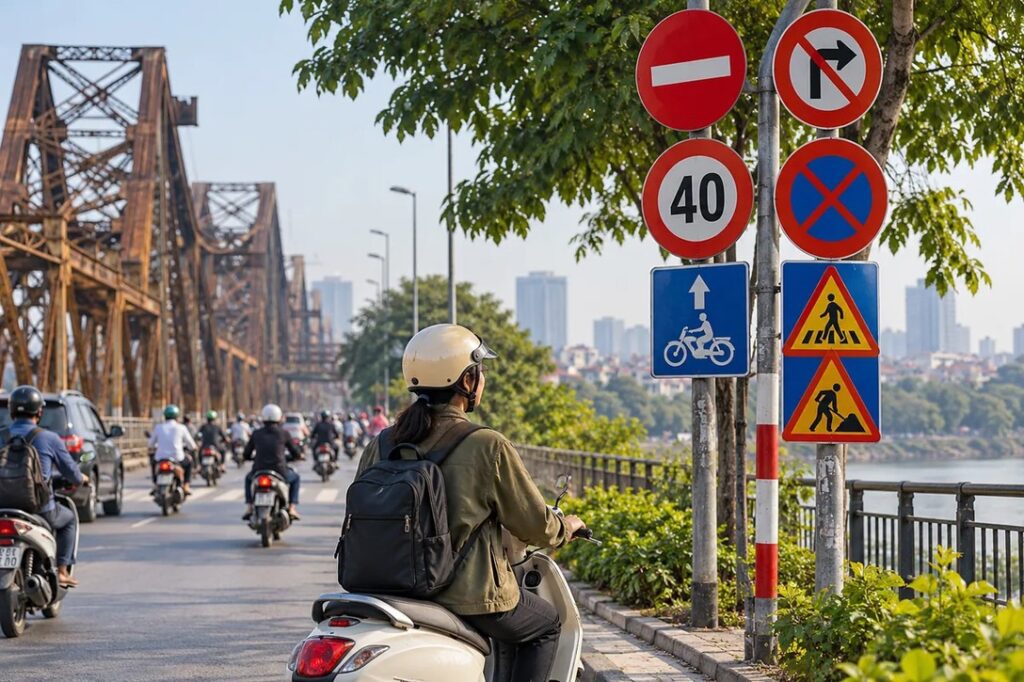
According to the published text of QCVN 41:2024, route-direction signs (I.414) stand at junctions and name places the road passes through, with at most three places per direction and the distance to the centre of each place. In built-up areas they may be placed only on the main directions. That is why a sign may name a district, town or landmark rather than the street your app calls out.
| Sign | What it tells you |
|---|---|
| I.414 Route direction | Places ahead in each direction, their distances and often a road number |
| W.206 Roundabout junction ahead | A warning that the junction ahead has a central island to go around |
| R.303 Roundabout | A mandatory sign: go around the central island in the direction of the arrows |
How much time you have to read a sign
The published regulation text places I.414 signs about 20 to 50 metres before the junction. At city speeds, that distance passes quickly:
| Speed | Time to cover 20 m | Time to cover 50 m |
|---|---|---|
| 20 km/h | 3.6 seconds | 9.0 seconds |
| 30 km/h | 2.4 seconds | 6.0 seconds |
| 40 km/h | 1.8 seconds | 4.5 seconds |
A few seconds is not enough to compare a sign with your phone and change lanes safely. Look at the route, the names of places along it and the shape of big junctions before you set off, while stopped somewhere stopping is allowed.
Who gives way at a roundabout
Article 22 of the law says that when approaching a junction you must observe, slow down and give way as follows:
- Where a minor road meets a priority road, or a side road meets a main road, vehicles on the minor or side road give way to vehicles on the priority or main road from any direction.
- At a junction without a roundabout signal, give way to vehicles coming from your right.
- At a junction with a roundabout signal, give way to vehicles coming from your left.
Traffic goes round the central island anticlockwise, following the arrows. Riders already on the roundabout come from your left as you enter, which is why you give way to them.
Choosing a lane and leaving the roundabout
On roads with several lane-marked lanes in the same direction, Article 13 allows you to move only into the adjacent lane each time, with a signal, after checking for a safe distance to vehicles ahead, behind and alongside. Before turning, Article 15 requires you to slow down, signal and move gradually into the lane nearest your turn.
The law does not tell you which lane to use inside a roundabout. Follow any lane markings and arrows. Where there are none, a practical approach is to stay towards the outside if you are taking an early exit, and to signal right just before your exit so others know you are leaving.
For more on lanes on wide Hanoi roads, see which lane a motorbike should use.
Your phone while moving
Article 9 prohibits holding and using a phone or other electronic device while riding on the road, and Article 33 prohibits motorbike riders from using audio devices other than hearing aids. Set your route before you start and stop in a permitted place to check it again. The guide to navigation apps for Hanoi riders compares routing and offline options.
What not to do
- Reverse to get back to an exit you missed: Article 16 lists junctions among the places where reversing is prohibited.
- Cut across several lanes in one move: Article 13 allows one adjacent lane at a time on lane-marked roads.
- Hold your phone to check the route while moving: Article 9.
- Rely only on the street name your app reads out: compare the place names and distances on the sign too.
If the sign does not match your app, or you miss an exit
No official source covers these situations directly, so the steps below are our suggestions.
- Stay in your lane, slow down as Article 22 requires when approaching the junction, and read the place names on the sign.
- At a roundabout, if you have not reached your exit, keep going round in the direction of the arrows until you do.
- At other junctions, do not reverse; carry on to a place where stopping is allowed and check the route there.
- If you need to call someone or re-enter the destination, stop first in a permitted place.
Not every kerb allows a short stop; the guide to stopping versus parking in Hanoi explains how to check.
When an officer is directing traffic
Article 11 sets the order of priority: an officer’s signals come first, then traffic lights, then signs, then road markings. If an officer is directing a junction, follow the officer even if the sign or light says otherwise. See traffic officer hand signals at junctions.
What the sources do not settle
- No official source compares sign names with the street names read out by navigation apps.
- We could not check the QCVN text against an official copy; the figures above come from a published text of the regulation.
- The law does not say exactly how “a roundabout signal” applies at a roundabout without W.206 or R.303 signs, or whether leaving a roundabout counts as a change of direction under Article 15.
Questions to ask the rental shop
- Which big junctions or roundabouts will my route pass, and which should I study on the map first?
- If I need to confirm the way, what is the best way to contact you once I have stopped?
Message to send the shop
Hello Nguyen Ha, I plan to ride from [start] to [destination]. Are there any large junctions or roundabouts on the way where I should pick my lane early?
Related guide: Map Says Turn Left, but a Median Blocks the Turn: What Next?
Frequently asked questions
Who has priority at a roundabout in Vietnam?
At a junction with a roundabout signal, Article 22 requires you to give way to vehicles coming from your left, which in practice means traffic already circulating.
Why does the sign show a different name from my navigation app?
Route-direction signs name places the road leads to, with distances and often a road number, rather than the street names most apps read out.
What should I do if I miss my exit at a roundabout?
Keep going round in the direction of the arrows until you reach it again. Never reverse at a junction.
Nguyen Ha Motorbike Rental: Ngõ 5 Nguyễn Văn Cừ, Bồ Đề, Long Biên, Hanoi, Vietnam, open 09:00–21:00 daily. Call +84 334 699 969 to check the big junctions on your planned route.