Riding Skills & Safety Planning
Map Says Turn Left, but a Median Blocks the Turn: What Next?
On this page
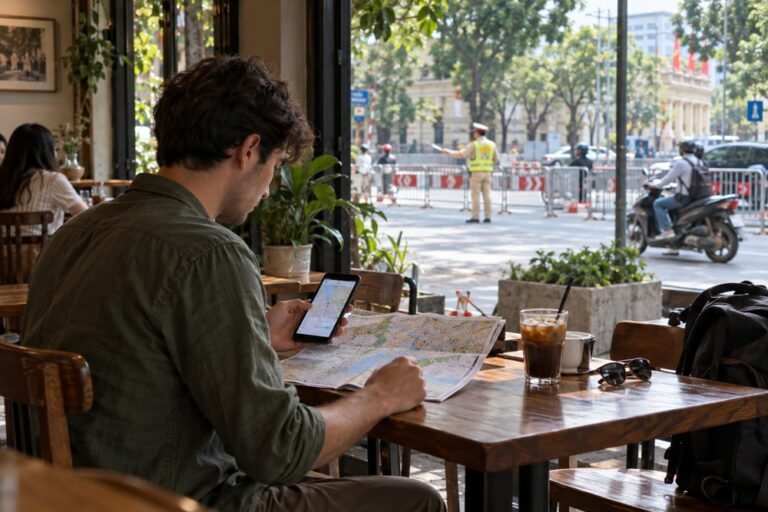
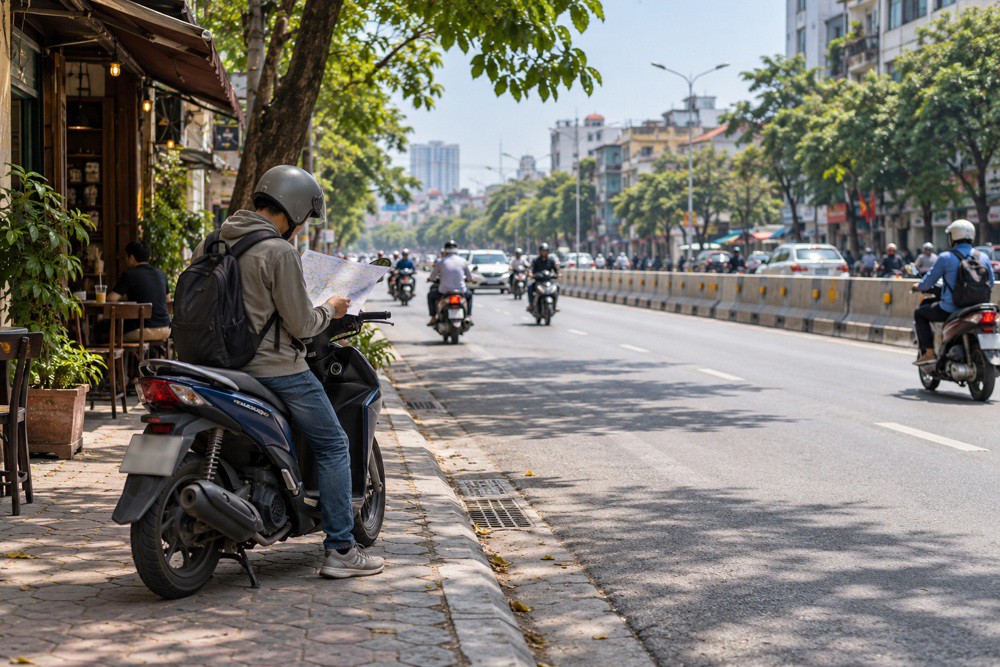
What should you do on a motorbike when your map app says turn left but a central median blocks the turn? Do not swerve or cut through a gap just because the app says so; an unmarked gap may be an illegal place to turn. Keep riding in the direction you are allowed to go, look for a junction or a signed U-turn point where turning is permitted, and check the signs there. Under Vietnam’s traffic law, an officer’s signals, traffic lights, signs and road markings decide where you may turn. Your navigation app does not.
It happens all the time: the voice says “turn left”, but there is a continuous median down the middle of the road and no obvious way across. You have a few seconds to choose between a gap ahead, an early U-turn or carrying on. This guide explains what the law and the signs say so you can make that choice calmly.
Your map is not part of the signal system
Article 11 of the consolidated Law on Road Traffic Order and Safety lists the road signals you must obey, in order of priority:
| Priority | Signal | What the law says about it |
|---|---|---|
| 1 | Signals from a traffic officer | Hand positions tell you to stop or go |
| 2 | Traffic lights | A red light means do not go |
| 3 | Road signs | Prohibitory signs show what is prohibited; guide signs show directions |
| 4 | Road markings | Lines show lane divisions, directions and where to stop |
| 5 | Bollards, guard walls, barriers and similar | Barriers stop people and vehicles from passing |
| 6 | Audible road signals | Warnings of danger |
A navigation app is not on the list. It can suggest a route, but it cannot authorise a turn that the signs, markings or barriers on the spot do not allow.
Signs that decide whether you may turn or make a U-turn
Under the national road sign regulation QCVN 41:2024/BGTVT, left turns and U-turns are controlled by separate signs, as VOV’s explainer sets out:
| Sign | What it means |
|---|---|
| P.123a No left turn | Prohibits turning left. On its own, it does not prohibit a U-turn. |
| P.124a No U-turn | Prohibits U-turns, except for priority vehicles. It does not prohibit turning left into another road. |
| P.124c No left turn and no U-turn | Prohibits both. |
| I.409 U-turn point | Shows a place where U-turns are allowed, sometimes with a distance plate. |
Read each sign together with its supplementary plates, lane markings and the traffic layout where you are. “P.123a does not prohibit U-turns” does not mean a U-turn is allowed everywhere: the rules below still apply.
What Article 15 requires for any turn or U-turn
Article 15 treats turning left, turning right and making a U-turn as a change of direction. Before and during it, you must:
- Look around, keep a safe distance from the vehicle behind and slow down.
- Signal and keep signalling throughout the manoeuvre.
- Move gradually into the lane nearest the direction you are turning.
- Give way to pedestrians, non-motorised vehicles and oncoming traffic.
- Turn only when it is safe and does not obstruct or endanger anyone.
Article 15(4) also prohibits U-turns on pedestrian crossings, on bridges and bridge approaches, under flyovers, at fords, at level crossings, on narrow roads, on slopes, on bends where the view is blocked, on expressways, in tunnels and on one-way roads, unless a traffic officer or a temporary sign directs otherwise.
Changing lanes before the turn
On roads with several lane-marked lanes in the same direction, Article 13 allows lane changes only where permitted, one adjacent lane at a time, with a signal and after checking it is safe. On a wide road, start moving across early rather than cutting over at the last moment. The guide to which lane a motorbike should use covers lane rules and dedicated lanes.
If you are not sure a gap in the median is a legal place to turn
No official source deals with this exact situation, so the steps below are our suggestions based on the articles above.
- Do not swerve to follow the map. Carry on in the lane and direction you are allowed to use, if it is safe. If barriers or a different layout lie ahead, follow the signals there.
- Look for proper signals. A signed U-turn point, a junction with lights or signs that permit your turn, and no sign prohibiting it for your vehicle. If you cannot confirm that a gap may be used, skip it and look for the next permitted place.
- Re-check the route only once stopped. Article 9 prohibits holding and using a phone while riding.
- Stop only where it is allowed. Article 18 prohibits stopping or parking at junctions and within 5 metres of them, on bridges, under flyovers and on bends with a blocked view, among other places.
The guide to stopping versus parking in Hanoi helps you find a place to pause and check the map.
When you do turn left at a junction
Where a left turn is allowed, it still means crossing oncoming traffic. Slow down, signal early, wait for a gap you can trust and give way to oncoming vehicles and pedestrians. The guide to turning left across Hanoi traffic walks through it.
What not to do
- Make a U-turn at any place Article 15(4) prohibits, such as a bridge, under a flyover, in a tunnel or on a one-way road, unless an officer or temporary sign directs it.
- Make a U-turn where a P.124a or P.124c sign applies, even if the map still shows that way.
- Reverse to get back to a missed turn where Article 16 prohibits reversing, such as at junctions, on one-way roads or where visibility is blocked.
- Ride against the traffic alongside the median looking for a gap: Article 10 requires you to keep to the right in your direction of travel.
- Hold your phone to check the map while moving, or stop to check it where stopping is prohibited.
When the map sends you onto a road you cannot use
Apps sometimes route motorbikes onto elevated roads or into underpasses where motorbikes are banned. Read the signs at the entrance, and see Hanoi overpasses, underpasses and elevated roads for what to look for.
Limits of this guide
- We cannot confirm whether any particular gap or U-turn point on your route is legal; that depends on the signs, lanes and conditions on the spot.
- An I.409 sign shows where a U-turn is allowed; Article 15 still sets how to make it safely.
- We do not assess how accurate any app is at a given moment, and we do not cover pushing a bike across a median.
Questions to ask the rental shop
- On my planned route, are there places where the map often suggests a turn that is not allowed?
- If I get lost, what is the best way to contact you once I have stopped?
Message to send the shop
Hello Nguyen Ha, I am riding from [start] to [destination] and the map wants me to turn left across a median at [place]. I have stopped safely. Do you know where I can legally turn around near here?
Frequently asked questions
Can I make a U-turn where there is a no-left-turn sign?
A P.123a no-left-turn sign does not by itself prohibit U-turns, but other rules still apply, including the places listed in Article 15(4) and any P.124a or P.124c sign.
Is it legal to turn through any gap in the median?
Not automatically. Check for signs, markings and lanes that permit the turn. If you cannot confirm it, carry on to a signed U-turn point or a junction where turning is allowed.
Do I have to follow my navigation app’s directions?
No. Officer signals, traffic lights, signs and road markings decide where you may turn. The app is only a suggestion.
Nguyen Ha Motorbike Rental: Ngõ 5 Nguyễn Văn Cừ, Bồ Đề, Long Biên, Hanoi, Vietnam, open 09:00–21:00 daily. Call +84 334 699 969 if you need help finding a legal place to turn on your route.