Day Trips from Hanoi
Chuong Village Conical Hats: What to Ask a Maker Before a Visit
About 14 minutes to read
Before you ride to Chuong village (làng Chuông) to watch conical hats being made, arrange a visit with a named maker or the village craft showroom and ask five things: will someone be working on the day you arrive, which hat-making stages you will actually see, whether you can try a step and for how long, what you may photograph, and where to leave the motorbike. Published sources describe households that welcome visitors and a showroom built with city support, but none of them gives a public timetable that guarantees a working household will be ready for walk-in visitors. The village hat market is a separate, early-morning event held on fixed lunar-calendar dates, so decide which experience you want before you set off.
This guide brings together what official tourism material and Vietnamese national newspapers document about the craft: the materials, the named stages, the number of rings in a Chuong hat and how the market works. Use it to write specific questions, so the person who receives you can say plainly what will and will not happen during your visit.
The questions to send before you leave Hanoi
Send these through whoever is arranging the visit, whether that is a guesthouse, a Vietnamese-speaking friend, a tour operator or the maker directly. Short, separate questions are easier to answer than one long paragraph, and they make any gaps obvious.
- Who will receive us, and where exactly? Ask for the host’s name, a current map pin and the place to park. The village now sits in a renamed commune, so an old address may point to the right place under a different label.
- Is this a working household, a showroom or a demonstration? All three exist, and each gives you a different visit.
- Which stages will be in progress that day? Leaf ironing, ring making, laying leaves on the mould and stitching do not necessarily all happen at once. Ask which ones you can expect to watch.
- Can visitors try a step, and which one? Ask how long the session lasts, whether there is a charge, and what the charge covers.
- Is there someone who can explain in English? If not, plan to bring an interpreter or prepare your questions in Vietnamese.
- What may we photograph? Ask separately about the workspace, the people and later publication online.
- Does weather change the plan? Leaves need the right drying conditions, so rain, harsh sun or very dry air can change which work is under way.
- Are the hats for sale made here? Ask whether the hats on display were made in that household, elsewhere in the village or bought in.
If a host cannot confirm a time and a meeting place, treat the trip as a general village visit rather than a workshop appointment, and keep expectations modest.
Where Chuong village is now, and why the address may look different
The rural tourism page of the Vietnam National Authority of Tourism places Chuong village around 30 kilometres southwest of central Hanoi and describes it as now part of Thanh Oai Commune. Older reporting uses a different address: a 2022 Nhân Dân report on the hat craft locates the village in Phương Trung commune, Thanh Oai district.
Both are correct for their dates. Hanoi reorganised its commune-level units from 1 July 2025 under Resolution 1656/NQ-UBTVQH15. The LuatVietnam list of Hanoi’s 126 new communes and wards shows the new Thanh Oai commune formed from Kim Bài town, the communes of Đỗ Động, Kim An, Phương Trung and Thanh Mai, and part of Kim Thư. Older articles, map labels and signs may therefore still say Phương Trung, while recent official material says Thanh Oai.
The practical consequence is simple: do not rely on a commune name alone. Ask your host for a pin at the actual door, and save it before you leave. A Voice of Vietnam report on the hat market says the market is held on the bank of the Day River in front of the old village communal house (đình), which gives you a recognisable landmark if you get separated from a host. For a route that does not depend on mobile data, read our guide to downloading offline Hanoi maps before a motorbike day trip.
Workshop, showroom, market or home: know which visit you are arranging
The 2022 Nhân Dân report is frank about how visits used to work. It describes craft-village tourism in Chuong as largely spontaneous and small-scale, with households receiving guests on their own. A visitor who wanted to see several crafts had to contact each address separately, and there was no packaged programme. In the same report, artisan Tạ Thu Hương lists what visitors could do: see the village communal house and pagodas, spend time in an old house, hear about village history and try hat-making directly.
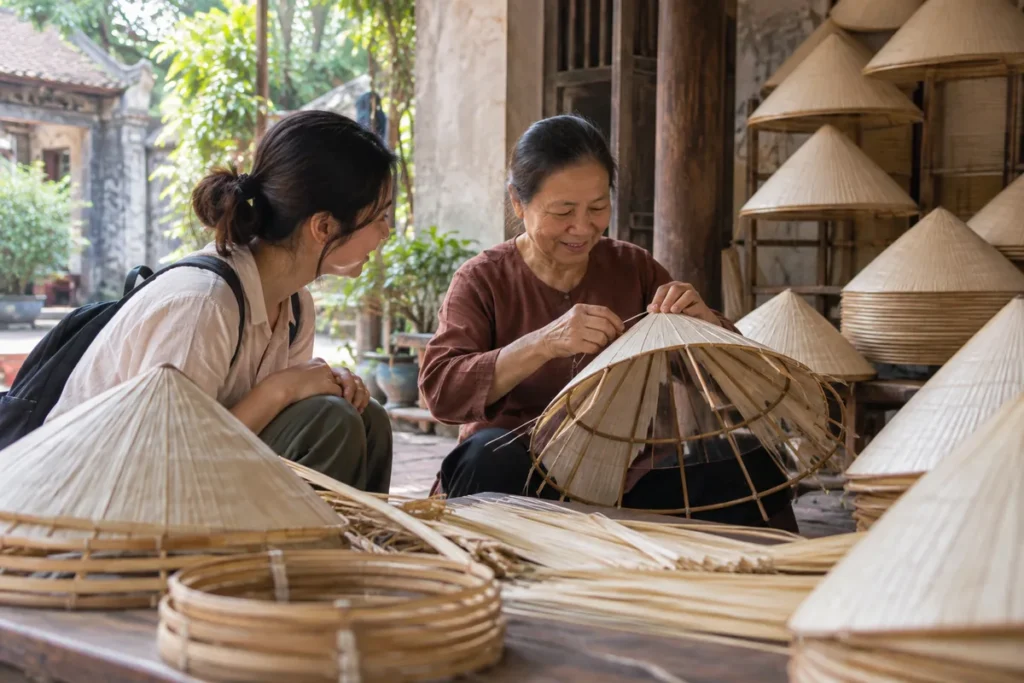
A 2025 Nhân Dân profile of artisan Lê Văn Tuy adds a newer element. From 2024 the Hanoi Department of Industry and Trade worked with the former Thanh Oai district authorities to build a creative design centre that introduces, promotes and sells OCOP products from the Chuong hat village. The article says the artisan’s family was one of two village households invited to display and sell there, and it describes a student trying several steps under his guidance. The tourism authority page, for its part, says many households now welcome domestic and international visitors to watch the process and attempt simple steps with an experienced artisan.
| Type of visit | What sources describe | What to confirm first |
|---|---|---|
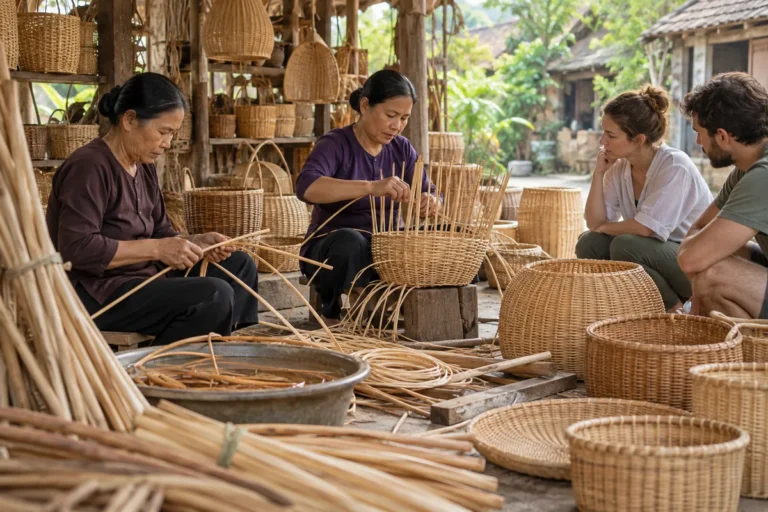
| Working household | Families making hats at home, with leaves drying in courtyards | A named host, an agreed time and permission to enter |
| Showroom or craft centre | A centre built from 2024 to introduce and sell OCOP hat products | Whether making is demonstrated there or only displayed and sold |
| Hands-on session | Visitors trying simple steps under an artisan’s guidance | Which step, how long, the charge and what is included |
| Hat market | Early-morning trading at the communal house yard on set lunar dates | The lunar date, the start time and where to wait without blocking trade |
None of these is better than the others. A showroom can explain the finished range well, while a working household shows process and pace. The mistake is booking one and expecting the other.
The documented hat-making stages, and what to ask at each
Sources describe the work in slightly different words, so treat the list below as a framework for questions rather than a fixed recipe. The 2025 Nhân Dân profile names the stages as ironing leaves (là lá), making the rings (bứt vòng), nức nón and coating or painting the hat (sơn nón). The 2026 Báo Văn hóa photo report on the Chuong hat market adds detail on leaves, rings and the hat mould, and the tourism authority page describes ironing, shaping, layering and sewing the leaves onto a bamboo frame.
| Stage | What sources document | A useful question |
|---|---|---|
| Preparing leaves | Lá lụi palm leaves bought from Nghệ An, Hà Tĩnh and Quảng Bình, rubbed with sand, dried and straightened | Where did this batch come from, and how long has it dried? |
| Ironing leaves (là lá) | Leaves chosen for whiteness and ironed flat without discolouring | How do you judge when a leaf is ready to use? |
| Making rings (bứt vòng) | Sixteen rings: fifteen of nứa splints and one bamboo ring for the brim | Can you show me a frame before any leaves go on? |
| Using the mould (khuôn nón) | Described as the first and a very important step for a round, even hat | Does the mould change for different hat types? |
| Laying leaves (quay nón) | Called the hardest step, deciding the hat’s appearance | How do you keep the tip closed and the leaves even? |
| Stitching | Hundreds of short, evenly spaced stitches, with thread joins hidden | Where are the joins on this hat, and how are they hidden? |
| Finishing (nức nón, sơn nón) | Named in the 2025 list of stages without further detail; decoration may include silk ribbons or chin straps | What does each finishing step do on this particular hat? |
Leaves: material, sand and sun
The 2022 Nhân Dân report names lá lụi as the main material and says it is bought from Nghệ An, Hà Tĩnh and Quảng Bình, then rubbed with sand, dried and straightened before use. Báo Văn hóa gives the drying period as two to three days and explains why it needs judgement: harsh sun can take away the leaf’s natural ivory white, while very dry air can make it brittle enough to tear. That is a good reason to ask about the weather on the day of your visit. It also explains why you may see courtyards full of drying leaves on one visit and none on another.
Rings and the frame
Báo Văn hóa reports that a Chuong hat has 16 rings: 15 made from nứa splints and one bamboo ring that forms the brim. The splints are shaved small and even, and a ring’s join should be round and smooth, without visible marks. Ask the maker to show you a bare frame on the mould. Counting the rings yourself, with permission, is a quick way to connect the published description with the object in front of you.
Laying leaves and stitching
The 2022 Nhân Dân report singles out quay nón, laying the leaves around the mould, as the hardest step and the one that decides how the finished hat looks. The maker has to avoid leaving the tip open and keep the leaves evenly placed so that nothing bulges. For stitching, the report says stitches must be short with small holes, the bamboo must be shaved round and even, and the sewing line (cước) must not snap. It credits Chuong makers with hiding the joins in the thread so that only even rows of stitches show. Ask where the joins are on a finished hat; a maker who can point them out is giving you a lesson in what quality looks like.
Finishing stages and the material you might not expect
Nức nón and sơn nón appear in the 2025 list of stages, but the sources do not describe them in detail, so let the maker explain what each involves in their workshop. Báo Văn hóa also calls lá mo one of the materials needed to finish a hat. Rather than guessing its role, ask the maker to point to where it is used. The tourism authority page notes that finished hats may be decorated with pink silk ribbons or green chin straps.
Questions about time, hands-on work and language
Set your expectations about what one visit can show. The 2025 Nhân Dân profile says some hats take only a few hours to complete while others take a full week, depending on the product. A short visit will therefore show you parts of a process, not a hat from raw leaf to finished brim. The student described in that article tried ironing leaves, laying them and stitching, which is a realistic picture of a guided session.
- Length and content. Ask how long the session lasts and which step or steps you will try. If you are visiting with children, ask whether an iron, needles or sharp tools will be involved and how the host handles that.
- Charges. Ask whether there is a fee and what it covers: materials, guidance, a finished item or a drink. No source gives a standard price for sessions, so do not assume one.
- What you take home. Ask whether your practice piece is yours to keep, or whether you are paying only for the experience.
- Language. Ask whether anyone can explain in English. A few Vietnamese words for the stages, such as là lá, quay nón and khâu nón (stitching), help even when interpretation is limited.
- Group size. Mention how many people are coming. A small household workspace is very different from a showroom floor.
When the host answers, write the details down: the name, time, pin, charge and what is included. Share them with everyone travelling with you so that nobody arrives expecting something else.
Market mornings versus workshop visits
The hat market is a long-standing part of village life, and it works differently from a workshop visit. Báo Văn hóa reports six sessions a month, on the 4th, 10th, 14th, 20th, 24th and 30th days of the lunar month, in the yard of the village communal house, starting in the half-light before dawn. The Voice of Vietnam report says the market becomes busy from about 5 a.m. and that each session lasts only about two hours.
A lunar month has 29 or 30 days, so check that the 30th exists in the month you are planning around, then convert the dates with a reliable lunar calendar and ask a local contact to confirm. Arriving after the session has finished means an empty yard.
It is a trading market for the village rather than a show for visitors. Báo Văn hóa notes that the materials for a complete hat change hands there, that most of the people shopping are middle-aged and older women from the village, and that finished hats are carried out to the communal house yard for sale. It reported hat prices between 40,000 and 150,000 VND each in May 2026, depending on how even and fine the work is. Treat that as a dated reference and expect it to change.
For a rider, the market means a very early start. Reaching Chuong near the start of a session means leaving Long Biên well before dawn and crossing the river in the dark, so read our comparison of legal river crossings from Gia Lam to central Hanoi and our departure-time worksheet before choosing a route. Stand at the edge of the yard, keep bags and tripods out of trading paths, and buy something if you have taken a lot of anyone’s time.
Photography, buying and respect in a working home
The tourism authority page describes courtyards filled with drying leaves and the sound of needles going through layers of leaf. Those courtyards are workspaces. Ask before stepping near drying leaves, never move them, and keep a camera out of the line between a maker’s hands and the work. Ask separately whether you may photograph faces and whether you may post the images online, because a host may be comfortable with one and not the other.
Buying is easier when you have watched the process. The 2025 Nhân Dân profile lists several products made by a single artisan, including nón chóp, nón quai thao, hats painted with oil colours and silk hats (nón lụa), and says some of his products have OCOP four-star recognition. OCOP is Vietnam’s One Commune One Product programme. If a seller mentions a rating, ask which product it applies to rather than assuming it covers everything on the shelf.
- Ask who made the hat you are holding and whether it was made in that household.
- Ask which hats are intended for everyday sun and rain and which are decorative or for performance.
- Look for the even stitching and hidden joins the maker described, and ask how to store the hat so it keeps its shape.
If you are planning a wider craft-village day south-west of the city, our Quang Phu Cau incense village guide covers its own photography checks. Keep the Chuong visit as the fixed appointment and treat any other stop as optional.
Planning the ride and your return
At roughly 30 kilometres from central Hanoi, according to the tourism authority, Chuong works as a half-day or day trip, but traffic, weather and your appointment time decide the real schedule. From Long Biên you also have the Red River to cross. Fill the tank, save the host’s pin offline and carry a rain layer, then leave enough margin that you are not riding fast to make a session or to get home before dark.
If you rent from Thuê xe máy Nguyễn Hà at Ngõ 5 Nguyễn Văn Cừ, Bồ Đề, Long Biên, near Gia Lâm bus station (0334 699 969), and a workshop session runs long, contact the shop before your agreed return time. Hourly extensions cost 20,000 VND per hour. More than 6 hours is charged as one rental day. Agree on the revised return time with the shop.
Finally, keep your own record of the visit: the maker’s name, the stage you watched, one technique explained in their words and the date. That short record is often more useful than a camera roll, especially if you want to recommend the host to someone else later.
Frequently asked questions
Can I visit Chuong village without booking a workshop?
You can visit the village, but a walk-in visit gives no guarantee that you will see hats being made. Sources describe households that receive visitors and a showroom centre, not a public schedule of open workshops. Arrange a named host in advance if watching the process matters to you.
Should I go on a market morning or arrange a workshop visit?
Choose by what you want to see. The market is village trading in hats and materials: Báo Văn hóa reports sessions on the 4th, 10th, 14th, 20th, 24th and 30th days of each lunar month in the communal house yard, and Voice of Vietnam says each lasts roughly two hours from about 5 a.m. To watch leaves being ironed, laid and stitched, arrange a separate visit with a named host. If you try to combine both, convert the lunar date and confirm it locally before riding out.
What should I ask to see to understand how a hat is built?
Ask for a bare frame on the mould before any leaves go on. According to Báo Văn hóa, a Chuong hat has 16 rings: fifteen made of nứa splints and one bamboo ring forming the brim. Seeing the frame first makes the later laying and stitching much easier to follow.
Will I be able to make a whole hat during a visit?
Probably not. Nhân Dân reports that a hat can take anywhere from a few hours to a week depending on the product. Guided sessions usually let visitors try individual steps such as ironing leaves, laying them or stitching.
Is Chuong village still in Phương Trung commune?
Not under the current administrative map. Phương Trung was merged into the new Thanh Oai commune from 1 July 2025, so older articles and some signs may still show the old name. Use a map pin from your host rather than a commune name.