Hanoi Museums & Collections
Ho Chi Minh Museum in Hanoi: Read the Exhibition Before Planning Your Visit
About 11 minutes to read
The Ho Chi Minh Museum in Hanoi is not the mausoleum. It is a separate building at 19 Ngọc Hà in Ba Đình, standing behind the mausoleum on the same historic ground, and it holds a large permanent exhibition about Hồ Chí Minh’s life, the Vietnamese revolution he led and the world events that shaped him. The mausoleum is a brief, silent walk past a preserved body; the museum is a reading experience that can take two hours if you follow the whole route. This Ho Chi Minh Museum Hanoi exhibition guide explains how the display is structured, what the eight biographical themes and the surrounding art installations are trying to say, and how to tell the two visits apart so you plan the right morning. Every structural fact below comes from the museum’s own pages and from the official site of the Mausoleum Management Board, which runs the wider Ba Đình complex.
Museum or mausoleum: three sites on one piece of ground
Visitors often arrive expecting one attraction and find a cluster. The museum’s general introduction to its permanent exhibition, published on baotanghochiminh.vn, describes the museum, the mausoleum and the relic site at the Presidential Palace as a single architectural and cultural ensemble commemorating the president on the ground where he read the Declaration of Independence in 1945. The Mausoleum Management Board’s English site at en.bqllang.gov.vn lists five mapped sites under its care: the mausoleum itself, the Monument to the Martyrs and Heroes, the Ho Chi Minh Museum, the K9 relic area outside the city and Ba Đình Square.
The practical difference is this. The mausoleum has a strict, morning-only visiting schedule, and the board states that it is open to visitors on Tuesday, Wednesday, Thursday, Saturday and Sunday mornings and closed on Mondays and Fridays. In the hot season from 1 April to 31 October the board lists 07:30 to 10:30, extended to 11:00 on weekends and holidays; in the cold season from 1 November to 31 March it lists 08:00 to 11:00, extended to 11:30 on weekends and holidays. The board also warns that the memorial ceremony can be suspended for annual renovation work, so check its site in the week you travel. The museum is a conventional exhibition building with its own ticket desk; its pages do not publish an opening schedule in the sections captured for this guide, so treat the museum’s hours as something to confirm by phone rather than assume from the mausoleum’s timetable.
If your interest is the exhibition rather than the ceremony, plan the museum on its own. If you want both, the mausoleum’s morning window makes the museum the natural second stop.
How the museum came to be
The museum’s director’s welcome page on baotanghochiminh.vn dates the institution to 25 November 1970, when a board responsible for building a Ho Chi Minh museum was set up, and records that the finished building opened to visitors on 19 May 1990, the hundredth anniversary of the president’s birth. The Mausoleum Management Board’s site fills in the political steps between: a 1977 resolution of the Political Bureau formally establishing the museum, approval of the design task in 1978 and a decision at the end of 1982 that construction should begin. The exhibition introduction adds that ground was broken on 31 August 1985 and that the building was a gift from the people of the Soviet Union to the people of Vietnam.
The building reads as a white lotus. The exhibition page gives its height as close to 20 metres and explains the symbolism the designers intended: the lotus stands for a simple, refined life. The director’s page describes the museum as one of six national-level museums in Vietnam and reports more than 30 million visits since opening, including millions of international visitors. Knowing that this is a state memorial museum built in the late Soviet period helps you read what follows: the galleries combine documents and objects with large-scale symbolic art, and the tone is commemorative throughout.
How the permanent exhibition is organised
The display begins in what the museum calls the opening hall, or solemn hall, a 360-square-metre space built around a statue of Hồ Chí Minh. On the two wings of this hall are artworks that summarise Vietnam’s tradition of founding and defending the nation, using the legendary images of the sack of a hundred eggs and the golden dragon, the hero Thánh Gióng and the golden turtle receiving the returned sword. Those legends are a useful key: they tell you the exhibition will place one biography inside a long national story.
From the opening hall the museum’s content divides into three linked parts. According to the exhibition introduction, they are the biography of Hồ Chí Minh from childhood to his death and the carrying out of his Testament; the life, struggle and victories of the Vietnamese people under his leadership and the party he founded; and a set of major world events from the late nineteenth century onwards that influenced his activity and the course of the revolution. The museum insists that these three parts form one inseparable whole, and the layout reflects that: the biography is the main route, the second part sits to its right, and the third part is a series of side rooms.
Part A: the biography in eight themes
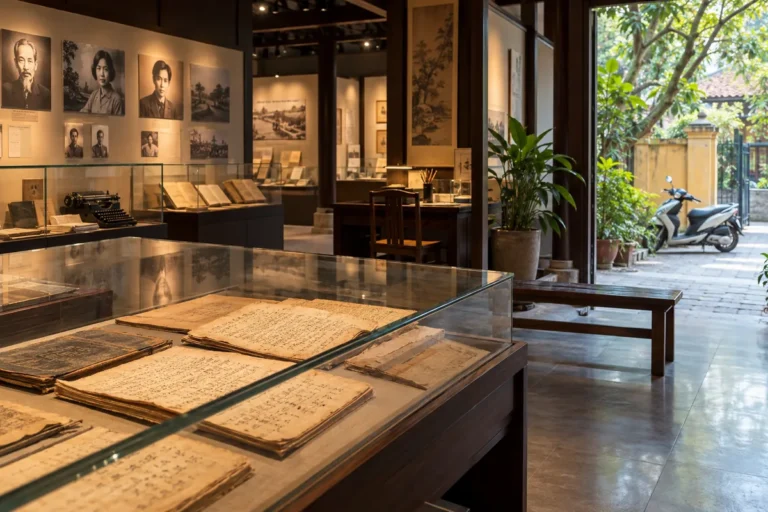
The biography is the main visiting route and the part most visitors follow from start to finish. The museum explains that it is arranged on a chronicle-and-problem principle: themes are set out in the order of the president’s life, and within each theme the material is grouped into clusters and specific issues. Each cluster is presented in three layers. The first layer is a backdrop of one-metre-square photographs or artistic illustrations for each historical period. The second layer is the core of the biography: selected photographs, handwritten documents and physical objects connected to his activity. The third layer is a system of open books, which the museum calls turnstiles, holding further documents sorted to match the theme beside them. If you want depth, those open books are where it is; if you have limited time, the second layer carries the story on its own.
The museum lists the eight themes as follows:
- Theme 1: childhood and youth, and the first patriotic and revolutionary activity (1890 to 1911).
- Theme 2: finding Marxism-Leninism, described by the museum as the truth of the age (1911 to 1920).
- Theme 3: defending and creatively applying Lenin’s line on national and colonial questions (1920 to 1924).
- Theme 4: founding the party of the Vietnamese working class (1924 to 1930).
- Theme 5: leading the national liberation movement and the August Revolution with the Party Central Committee, and founding what the museum calls the first worker-peasant state in Southeast Asia (1930 to 1945).
- Theme 6: leading the defence of the revolutionary government and the resistance against the French colonial return and American intervention (1945 to 1954).
- Theme 7: leading the socialist revolution in the North and the war against the United States to liberate the South and unify the country (1954 to 1969).
- Theme 8: forever following the path of Hồ Chí Minh, covering the years after his death.
The themes are separated visually by different display treatments, so you feel the change of chapter before you read a caption. Along the main axis the museum has placed eight video screens showing eight documentary films keyed to memorable periods: leaving to find a way to save the country, the first time on Lenin’s soil, the August Revolution and 2 September in Hanoi, the president’s visit to France in 1946, the Việt Bắc resistance base, his international activity between 1954 and 1960, a film titled Uncle Ho lives forever, and Total Victory. Budget a few minutes for the films that interest you; together they add real time to a walk-through.
Part B: the image-space complexes
To the right of the main route the museum presents the second part in a form it calls image-space complexes. These are artistic installations rather than document cases, and the exhibition page is candid that each one uses its own design approach to suit the event it depicts. Each complex is joined to the biography by a piece of sculpture that the museum’s script calls an emotional and ideological accent, portraying a Vietnamese victory. The seven complexes listed by the museum are the president’s homeland; the revolutionary high tide of 1930 to 1931 and the Nghệ Tĩnh Soviets; Pác Bó, the border base where he returned to Vietnam; the resistance against the French and the victory at Điện Biên Phủ; Uncle Ho writing his Testament; the memorial room to the president; and the resistance against the United States and the spring 1975 victory.
These rooms can disorient first-time visitors because the scale and symbolism change abruptly from the document layers next door. Read them as deliberate stage sets, each paired with the chapter of the biography it illustrates.
Part C: eight rooms of world context
The third part is a sequence of eight rooms that the museum describes as small lecture halls, each expanding on world events that bore on the president’s life and the Vietnamese revolution. The museum lists them in order: the world situation at the end of the nineteenth and start of the twentieth centuries; the Russian October Revolution and its influence on revolutionary movements; the struggle against fascism; the world after the Second World War; Hồ Chí Minh and the national liberation movement; Vietnam in the struggle for peace, independence, democracy and social progress; Uncle Ho and the younger generation; and Vietnam today. The museum presents this part as inseparable from the rest, but it is the section to trim if your time is short, since the biography and the image-space complexes carry the main narrative.
A reading plan for a two-hour visit
A sensible plan is to treat the opening hall as a ten-minute orientation, then commit most of your time to the eight biographical themes in order. Read the second-layer captions as you go and dip into the open books only where a theme catches you. When a sculpture marks the entrance to an image-space complex on your right, step in, look at the room as a whole, and return to the main route; that rhythm keeps the chronology intact. Leave the eight world-context rooms for the end and choose two or three that connect to what you have just read, for example the October Revolution room after Theme 2 or the anti-fascism room after Theme 5.
The museum’s site lists an automatic audio guide among its services, alongside a museum shop, so ask at the desk about availability and languages. The homepage of baotanghochiminh.vn also advertises temporary thematic exhibitions and an online 3D virtual museum, which is a good way to preview the layout before you travel.
Practical notes before you go
The museum’s pages give its address as 19 Ngọc Hà, Ba Đình, Hanoi. Online ticket registration is described on the site as a feature still being completed, and visitors are asked to phone 024 38463757 to buy tickets. This guide does not quote a ticket price or opening hours for the museum because the captured official pages do not state them; a phone call or the museum’s social channels will settle both. The Mausoleum Management Board’s site lists the utilities it provides across the complex, including the stilt house, a cinema, a luggage deposit counter, a camera deposit counter, a souvenir point and restrooms. Pack light if you combine the two visits.
Because the museum, the mausoleum, the Presidential Palace relic area and Ba Đình Square sit together, it is easy to add the Imperial Citadel of Thang Long a short ride away; the parking and walking route in our Imperial Citadel of Thang Long by motorbike guide fits well with an afternoon here. If you would rather follow the museum with greenery than with more history, the Hanoi Botanical Garden walking plan covers a park on the same side of the city.
Riding to Ngọc Hà from Long Biên
From Thuê xe máy Nguyễn Hà at Ngõ 5 Nguyễn Văn Cừ in Bồ Đề, Long Biên, the ride to Ba Đình means crossing the Red River and continuing west across the old city. Ngọc Hà is a small street; the museum, at number 19, and the board’s visiting-ceremony committee, at number 17, both list addresses on it, so set your map to the museum rather than the square if the exhibition is your goal. If you use an attended parking point, keep any ticket you are given; our Hanoi motorbike parking tickets checklist explains what to record at drop-off so collection is simple. The shop is open 09:00 to 21:00 daily and the hotline is 0334 699 969 if you need to confirm a bike for the morning; policies and rates are confirmed directly with the shop at booking.
If you are building a wider museum circuit, the chronology here pairs naturally with the modern-history floor described in our guide to the Vietnam National Museum of History, which covers the same decades from a national rather than a biographical angle.
Frequently asked questions
Is the Ho Chi Minh Museum the same as the Ho Chi Minh Mausoleum?
No. The mausoleum is the building on Ba Đình Square where the president’s body lies, with a morning-only visiting schedule set by the Mausoleum Management Board. The museum is the lotus-shaped exhibition building behind it, at 19 Ngọc Hà, with its own ticket desk and a permanent exhibition in three parts.
How long does the exhibition take?
Following the eight biographical themes alone is a comfortable hour; adding the seven image-space complexes, a selection of the eight documentary films and two or three of the world-context rooms brings a thorough visit to around two hours.
What are the eight themes of the exhibition?
They follow the president’s life in order, from childhood to 1911 through the founding of the party, the August Revolution, the two resistance wars and his death in 1969, closing with a theme on following his path afterwards. The full list with dates is in the Part A section above.
Can I visit the museum on a Monday or Friday?
The closed days published by the Mausoleum Management Board apply to the mausoleum. The museum’s own captured pages do not publish an opening schedule, so phone 024 38463757 or check the museum’s social channels before planning a Monday or Friday visit.