Booking, Deposits & Handover
Collecting a Bike in the Rain: What to Inspect and How to Plan the Photos
About 7 minutes to read
A pickup slot that lands in a downpour puts two jobs under pressure: checking the bike and photographing it. This guide to inspecting a rental motorbike in the rain at pickup in Hanoi draws on pages read on 26 October 2026: the Motorcycle Safety Foundation’s checklist, Kymco Vietnam’s rainy-season page, the UK government’s Vietnam advice, Apple’s iPhone water-resistance page and two Vietnamese weather pages. None of them describes a rental handover or says how to photograph a bike, so the walk-round, photo and waiting sections are general guidance and are labelled that way.
Read the forecast before the slot
Check the NCHMF ten-day Hanoi weather page for the actual pickup date and note its issue time. The entries change as the page updates, so check again on the day and look for any shorter-range warning before leaving. A brief daily description does not establish whether the precise pickup hour or the Long Biên pickup point will be wet; compare it with the latest local warnings and observed conditions.
What a short-range bulletin adds
The website of the Cục Khí tượng Thủy văn (hydrometeorology department, under the Ministry of Agriculture and Environment) carries short-range warnings. One titled as a thunderstorm, whirlwind, lightning and hail warning for Hanoi on 7 October 2026 (page time stamp 15:00) said that from now to 3 hours ahead, showers and thunderstorms would continue over areas already wet and then spread to wards and communes including Phú Nghĩa, Xuân Mai and Quảng Bị, with rain from showers to moderate, heavy in places for a short time. It listed whirlwinds, lightning, localised heavy rain and strong gusts as examples of the dangerous weather that comes with a storm, and said people should limit travel or outdoor activity when thunderstorms are present. For the difference between an alert and a daily forecast, see Thunderstorm Alerts Versus Daily Rain Forecasts in Hanoi: Read the Issue Time.
What the pages say to check on the bike
Two pages give inspection lists. The Motorcycle Safety Foundation (MSF) T-CLOCS checklist covers tyres, controls, lights, fluids, chassis and stands; some of its lines, such as chain or belt and spokes, may not fit an automatic scooter. Kymco Vietnam’s page, dated 05/06/2026 and written for 50cc riders, opens with a quick check before riding on a rainy day. The UK Foreign, Commonwealth and Development Office (FCDO) gives the short form in its Vietnam advice, updated 21 September 2026: its motorbike-safety list includes checking the motorbike thoroughly and renting from a reputable organisation.
| Item | MSF T-CLOCS wording | Kymco rainy-day list |
|---|---|---|
| Tyres | Tread depth, wear, bulges, embedded objects; pressure checked cold | Listed; worn tyres or unsuitable pressure reduce grip |
| Brakes | Each brake alone keeps the bike from rolling; pads and discs checked for wear | Front and rear brakes listed |
| Lights | Brake lamp activates when the front brake or the rear brake is applied; turn signals flash correctly | Lights and indicators listed |
| Mirrors | Cracks, tight mounts; adjust when seated on the bike | Listed |
| Horn | Not on the page | Listed |
| Lenses | Cracks and excessive condensation | Not on the page |
| Side stand | Cracks, bends, cut-out switch or pad if fitted | Not on the page |
Why the pages tie these items to rain
Kymco’s page says grip falls considerably on a wet road and that braking distance in heavy rain tends to be longer than on a dry road. It adds that the lights need to work so the rider can see more easily and other vehicles can recognise the bike in rain and poor light. MSF’s checklist is not specific to rain, but its lens line names excessive condensation, so the two pages overlap on lights. A related page, Motorbike Headlight Condensation or Water Inside: Photograph and Report the Difference, covers that case. For the road itself, FCDO’s rain-season advice is to stay away from flooded areas, monitor weather reports and follow local media for updates on road conditions.
A covered walk-round (general guidance)
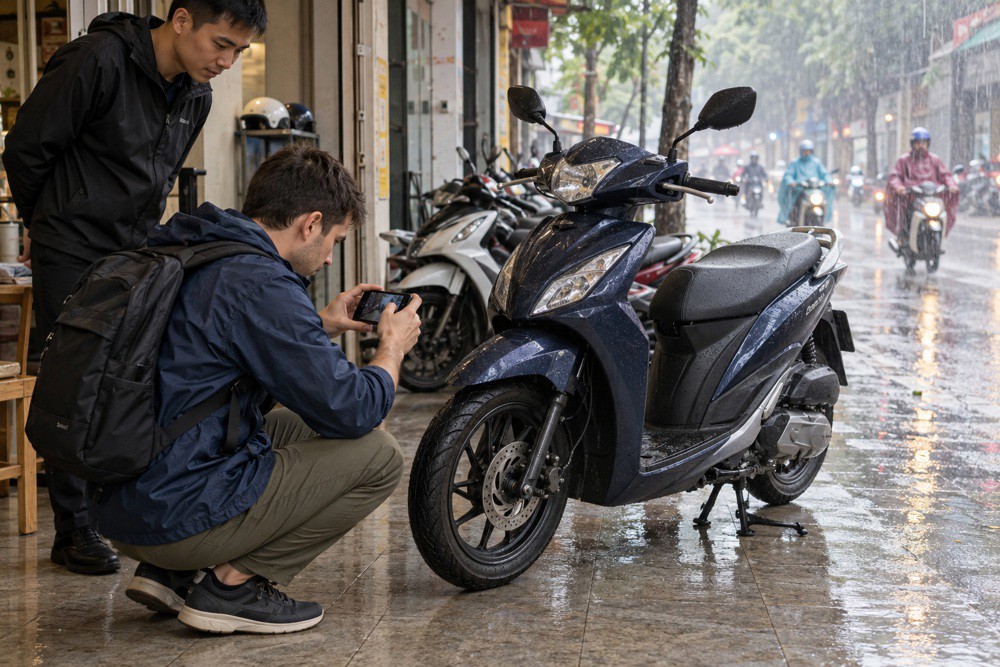
This section and the next two are general guidance, not statements from the pages above. Asking where the check can happen under a roof or awning comes first, because levers, switches and lights need hands-on checks that are hard to do in a downpour. Water on a panel can also make a mark hard to judge, so wipe a patch dry before deciding what it is. A sequence that follows the two lists:
- Tyres: look at the tread and sidewalls, and ask the shop what pressure the tyres should have.
- Brakes: squeeze each lever and see whether either brake, used by itself, holds the bike still, which is the point of MSF’s line.
- Lights: switch on the headlamp, indicators and horn, and have someone watch the brake lamp while a brake is applied.
- Mirrors and throttle: set the mirrors while seated and check that the throttle returns closed, as MSF’s lines describe.
- Lenses and stand: look for cracks and fogging inside the lenses, and check the side stand and its cut-out switch if the bike has one.
Photographing in the wet (general guidance)
Apple’s iPhone page, published 17 March 2026, says splash, water and dust resistance are not permanent and might decrease with wear, and its advice for a wet iPhone includes wiping it with a soft, lint-free cloth such as a lens cloth. It also says an iPhone exposed to liquid should not be charged until completely dry, and that at least 5 hours should pass before charging with a Lightning or USB-C cable or connecting an accessory. No page read covers other phone makers. With that as the only phone source, a few habits are general guidance: shoot from under cover, wipe the lens and your hands before each set, and take a wide frame first so the whole bike and its number plate share one picture, then close-ups of each panel, the mirrors, the lenses and the tyres. A shot list is on Rental Bike Damage Photos: A Hanoi Handover Shot List. How a shop treats photos is a question for the shop.
When waiting is reasonable (general guidance)
None of the pages says to postpone a pickup. They do state conditions for caution: the hydrometeorology department’s bulletin advises limiting outdoor activity during thunderstorms, FCDO advises staying away from flooded areas, and Kymco says wet roads cut grip and lengthen braking in heavy rain. As a general test, if a bulletin’s 3-hour window covers the slot and there is no sheltered place for the check, asking for a later slot is a more careful choice than shortening the inspection. Only the shop can say whether a slot can move. Questions to put to it:
- Is there a covered place at the pickup point for the check?
- Can collection move by a few hours, and by what time must the shop be told?
- Does a later slot change the rental dates or the price?
A go-or-postpone checklist for rainy-season riding is at Hanoi Rainy-Season Riding: A Go-or-Postpone Decision Checklist.
What the pages leave out
No page describes a rental handover, gives photography advice for a bike or says how a shop treats photos, or tells whether any shop lets the check happen under cover, moves a slot or changes a booking after a delay. The NCHMF page covers Hoàn Kiếm at day level, with no hours and nothing for Long Biên, and the 7 October bulletin is an example of the format rather than a current alert. That bulletin’s page stamp reads 10/07/2026 while its title says 7/10/2026, so the stamp appears to put the month first. The MSF checklist is for motorcycles in general, Kymco’s page is a maker’s advice for 50cc riders, and Apple’s page covers iPhones only. No page gives a rain-specific brake test, a tyre-pressure figure or a rule on postponing a pickup.
Sources checked
- MSF: T-CLOCS checklist
- Kymco Vietnam: 50cc rainy-season riding
- UK FCDO: Vietnam safety and security
- NCHMF: Hoàn Kiếm ten-day weather
- Hydrometeorology department: Hanoi thunderstorm warning, 7 October 2026
- Apple Support: iPhone water resistance
Thuê xe máy Nguyễn Hà is open 09:00–21:00 daily at Ngõ 5 Nguyễn Văn Cừ, Bồ Đề, Long Biên, Hà Nội (near Gia Lâm bus station). Phone: 0334 699 969.
Related guide: What Time to Collect a Rental Motorbike in Hanoi, and Inspect It.