Parking in Hanoi
Getting Your Bike Out of a Parking Spot on a One-Way Street: What Is Banned and How to Leave
On this page
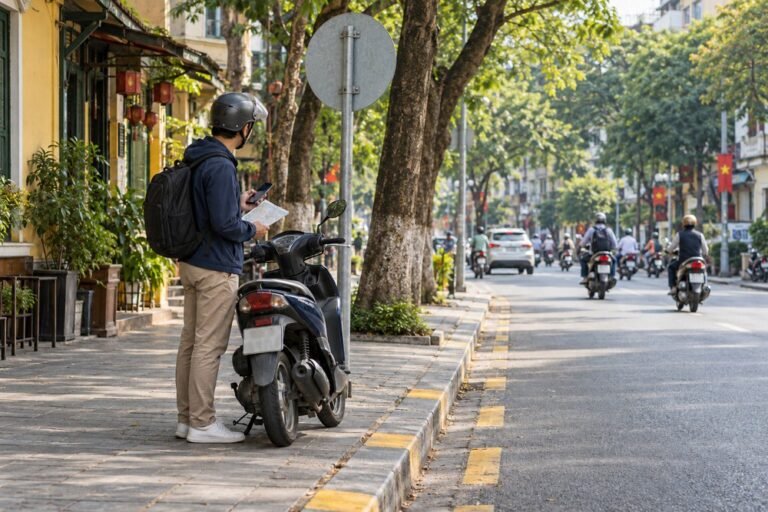
Your scooter is parked tight on a one-way street, and the quickest way out looks like rolling backwards into the traffic lane or turning round. Is that allowed? No. Vietnam’s road law bans reversing on a one-way street and bans U-turns there too, unless an officer or a temporary sign directs otherwise. A gap in the traffic does not make either move legal. Ask the attendant or the owners of the bikes blocking you to rearrange the row so you can leave in the direction of traffic, then signal, watch and join the flow.
This guide does not explain how to reverse into one-way traffic. It sets out what the law says, how to get out within it, and what to do when there is no legal way out yet.
What the law bans on a one-way street
- Reversing: Article 16(2) of Law No. 36/2024/QH15 bans reversing on one-way streets, in no-stopping areas, on pedestrian crossings, at junctions and level crossings, where visibility is limited, in tunnels and on expressways. Article 16(1) says that wherever reversing is allowed, you must look to both sides and behind, signal and reverse only when it is safe.
- U-turns: Article 15(4) bans U-turns on one-way streets, among other places such as bridges, narrow roads, slopes and blind bends, unless a traffic officer or a temporary sign directs otherwise.
Signalling, or someone standing outside to help, makes the move easier to see but does not give you permission to reverse or turn on a one-way street. Never take the bike backwards into the part of the road where traffic is moving. For finding your way out of the Old Quarter’s one-way grid afterwards, see leaving the Old Quarter by motorbike.
Getting out the right way
- Keep the bike steady where it is, and watch for pedestrians, approaching vehicles and the surface before you move.
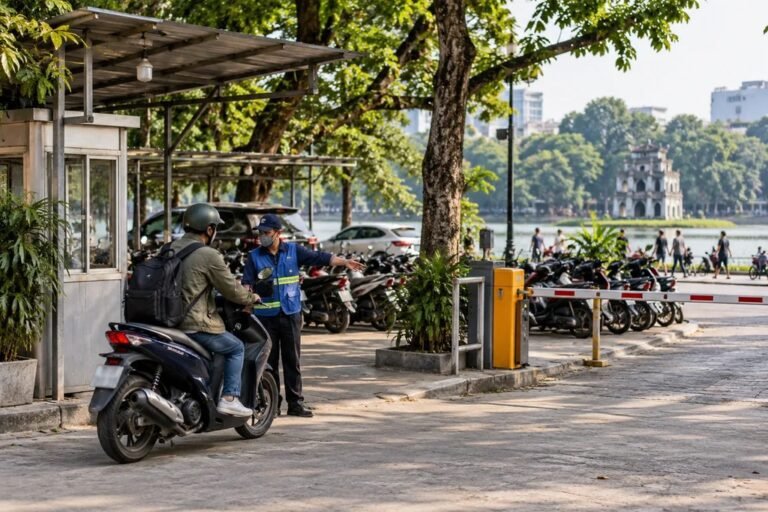
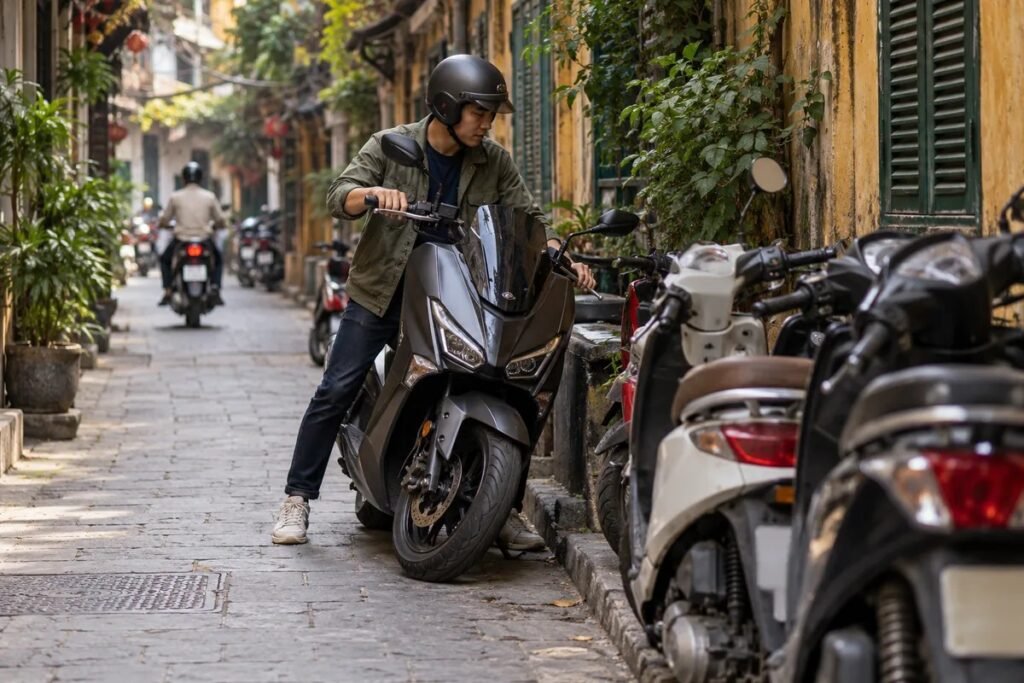
- Ask the attendant, or the owners of the bikes blocking you, to rearrange the row so you have a way out in the direction of traffic. Do not drag other people’s bikes yourself.
- Move only when you have a legal way out and full control of the bike. Techniques for manoeuvring in a yard or car park do not carry over to a one-way street.
- If there is no legal way out, wait for the lot’s staff or the authorities to help; do not trade it for reversing into traffic, riding on the pavement or a U-turn.
- Before joining traffic in the right direction, look behind and to both sides, signal and give way as the rules require.
Our guide to retrieving a scooter from a packed parking row shows how to fold mirrors and walk a bike out of a tight row.
Look and signal
- Use your eyes and ears: check the mirrors, turn your head to look behind and listen for approaching traffic.
- Switch on the indicator for the direction you will go once you are ready to pull out, if the bike has one.
- Give any hand signal while the bike is still; do not let go of the bars to signal while moving.
- If a rider behind stops to let you out, wait for their signal, and nod or raise a hand in thanks once the bike has fully stopped.
- Do not count on others giving way; be ready to stop.
Someone helping you watch
- Ask someone you trust to stand to one side behind the bike, out of its path, where you can still see them, and never in a moving traffic lane.
- Agree a signal first, such as one raised hand for stop. It only helps you watch during a move that is already legal; it does not permit a banned one.
- Stop at once if your helper signals stop or if you lose sight of them.
- You remain responsible for looking; the helper only assists. Do not ask a child to guide you.
When the bike is boxed in by other parked bikes
- Do not push or tilt other bikes yourself to make room.
- Find the attendant or the owners of nearby bikes and ask them to move theirs.
- If your bike is touched while you get it out, photograph the spot and any scratches as soon as it is safe. Our guide to a rental bike damaged in parking explains what to record.
- Tell the shop when you can, describing what happened.
At night or in the rain
After dark, other road users struggle to see a bike emerging from a parked row. Switch the lights on before you move so the headlight and tail light show something is moving. On a dark, busy street, walk the bike to the edge of the road in the direction of traffic, stand and watch for a moment, then get on and start the engine.
In rain, the ground around parking spots is often more slippery, especially tiled pavements, drain covers and painted lines. Walk the bike slowly, keep the bars straight as you come down a kerb, and avoid sharp turns on wet surfaces. People under umbrellas or raincoats may not see or hear you, so let them pass before you bring the bike out.
Do not ride a short way against a one-way street to reach the main road faster because of the rain. Go with the flow even if the route is longer: traffic coming the right way will not have time to avoid you in poor visibility.
Choose the spot with the exit in mind
Before parking on a one-way street, think about leaving. Choose a spot near the end of the row or near the exit in the direction of traffic, and avoid being wedged between two large bikes. Ask the attendant when the busiest time is and when the lot is rearranged, so you are not trying to leave when the street is most congested or after your bike has been moved deep into the row.
What not to do
- Do not reverse into moving traffic on a one-way street, quickly or slowly.
- Do not open the throttle while walking or rolling the bike backwards.
- Do not look at a phone or map while moving the bike.
- Do not move while pedestrians are passing behind the bike.
- Do not force the bike through a gap that is too narrow to avoid asking for other bikes to be moved.
What the sources do not say
- The law does not describe how to leave a parking space on a one-way street; it only bans reversing and U-turns there.
- No source sets out what a parking attendant must do to help, or how long you should wait.
Sources checked
- Law No. 36/2024/QH15, Official Gazette text; Articles 15(4) and 16 re-checked on 18 November 2026. Consolidated text published in the Official Gazette, April 2026: congbao.chinhphu.vn
Message to send the shop
Hello Nguyen Ha, the bike (plate [number]) is boxed in at a parking spot on [street] and the attendant is not here. I do not want to reverse into the one-way traffic. What do you suggest, and is there anyone you can call?
Frequently asked questions
Can I reverse a motorbike out of a space on a one-way street?
No. Article 16(2) of Law 36/2024 bans reversing on one-way streets. Ask for the row to be rearranged so you can leave in the direction of traffic.
Can I turn round to go back the way I came?
Not on a one-way street, unless an officer or a temporary sign directs you to. Article 15(4) bans U-turns there.
What if nobody is around to move the other bikes?
Wait for the lot’s staff or ask the shop for help. A gap in the traffic does not make reversing or turning legal.
Nguyen Ha Motorbike Rental: Ngõ 5 Nguyễn Văn Cừ, Bồ Đề, Long Biên, Hanoi, Vietnam, open 09:00–21:00 daily. Call +84 334 699 969 if the bike is boxed in and you need advice.