Automatic Scooters
Combined Braking Systems on Rental Scooters: Understand the Controls

On this page
On a scooter with combined braking (CBS), should you squeeze only the left lever or both? Use both levers together and build pressure progressively. On a CBS scooter the left lever, which normally works the rear brake, also sends some braking force to the front wheel, but how much depends on the model. The manufacturer’s advice is still to use the front and rear brakes at the same time for the best result. Check whether your rental actually has CBS, and remember that CBS is not the same as ABS.
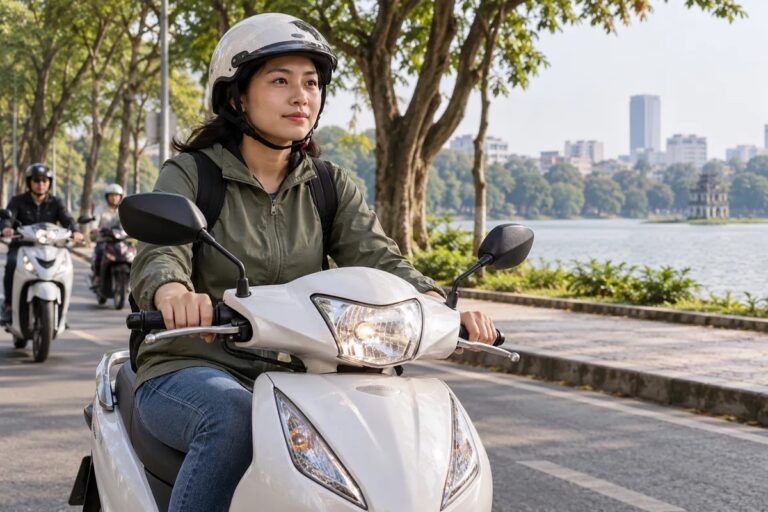
On a manual or semi-automatic motorbike, your right foot works the rear brake. Climb onto an automatic scooter and that foot suddenly has nothing to do, while both hands now control brakes. This guide explains what combined braking does, how to tell whether the bike in front of you has it and how to get used to the controls safely.
What a combined braking system does
CBS stands for combined braking system. Instead of two completely separate brakes, applying one lever also activates part of the other brake. On most scooters sold in Vietnam, the right lever operates the front brake and the left lever operates the rear brake; with CBS, the left lever shares some of its force with the front wheel.
Honda Vietnam’s owner’s manual for the Vision (model code NSC110CBF) describes a combined braking system that distributes braking force between the front and rear brakes. It notes that the force reaches each wheel differently depending on whether you use only the front lever or only the rear lever, and it recommends using the front and rear brakes together for optimal braking. You can read that passage in the Honda Vietnam Vision owner’s manual (PDF).
The exact split of force is a design choice for each model, and some scooters have two fully independent brakes instead. That is why you should treat the bike in front of you as the reference, not a general rule about all scooters.
How to tell whether your rental scooter has CBS
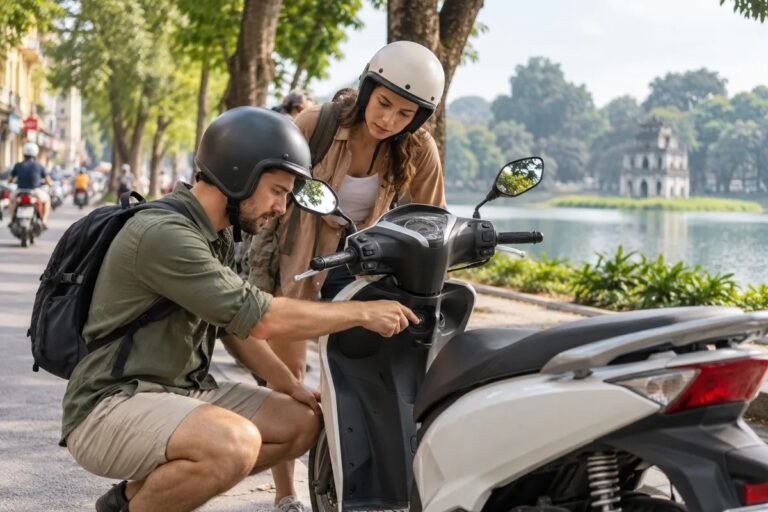
- Look for a label: some scooters carry a “CBS” or “Combi Brake” sticker near the handlebars, on the front cover or with the feature badges.
- Check the owner’s manual: if the shop can show you the manual for the model, the brake section states which system is fitted.
- Ask at pickup: “Does this bike have combined braking, and which lever controls which wheel?”
- Do not guess from feel: if you are not sure, simply use both levers and ask the shop when you collect the bike.
Do not test the system by braking hard at speed to “see what happens”. Until you know how the bike responds, a sudden hard squeeze on a single lever can unsettle it.
Which lever, and how hard? A practical guide
| Situation | Suggested technique |
|---|---|
| Normal slowing in traffic | Squeeze both levers lightly at the same time, then increase pressure smoothly |
| Stopping at a red light | Use both levers evenly as the bike slows, then hold one lever once stopped |
| Emergency stop on a dry road | Use both levers, building pressure quickly but steadily, with the bike upright and eyes ahead |
| Wet road, sand or gravel | Brake earlier and more gently; avoid a sudden grab on one lever |
| Approaching a bend | Finish slowing before the bend; do not brake hard while leaning |
Even with CBS, keep the habit of using both hands. If you rely only on the left lever, the share of force reaching the front wheel may be less than you need in a real emergency. The Honda manual also warns against braking continuously down long, steep slopes, because overheated brakes become less effective.
If you usually ride a manual bike, a semi-automatic or drive a car
- There is no foot brake: riders used to a rear brake pedal may find their right foot searching for it. Keep both feet flat on the floorboard.
- The left hand is a brake, not a clutch: riders of manual motorcycles may reach for a clutch on instinct. On an automatic scooter, squeezing that lever slows the bike.
- The levers may be more sensitive than you expect: brake feel varies between bikes, so get used to it with gentle squeezes in a quiet place.
- Hard front braking makes the nose dive: weight shifts forward and the rear wheel gets lighter on any motorbike. Brake progressively rather than in one grab.
Some scooters also have a small rear brake lock on the left lever for parking or starting. The Honda manual says not to apply it while riding, so make sure it is fully released before you set off.
CBS is not ABS
The two are easy to confuse. CBS shares braking force between the wheels. An anti-lock braking system (ABS) helps prevent a wheel from locking during hard braking by modulating the pressure automatically. A scooter can have CBS, ABS, both or neither, and on many scooters ABS works only on the front wheel. The guide to combined braking and ABS on scooters explains what ABS does and does not do.
With a passenger, luggage or a wet road
A passenger or heavy luggage adds weight, so the bike needs more distance to stop, with or without CBS. Start braking earlier and increase pressure gradually. On wet roads, painted markings and metal covers are especially slippery, so try to finish most of your braking before you reach them.
Leave a larger gap to the vehicle ahead in the rain. A combined system helps share the braking, but it cannot create grip that the tyres do not have.
Getting used to the brakes in suitable conditions
First confirm that you meet the legal requirements for the bike, and ask an experienced rider or instructor to help if you are out of practice. Use a quiet, permitted area away from traffic and practise smooth stops from walking pace before trying anything faster. The guide on practising emergency braking in an empty car park sets out a sensible sequence.
- Release the brake lock and check both levers move freely.
- Roll forward slowly and squeeze both levers gently until the bike stops.
- Repeat a few times, noting how each lever feels.
- Only then try a slightly firmer stop, still upright and in a straight line.
Questions to ask when you collect the scooter
- Does this bike have combined braking, or two independent brakes?
- Which lever controls which wheel on this model?
- Does it have ABS, and how would I notice it working?
- Is there a brake lock lever, and how do I release it?
- Are the brakes in good condition, and is there any noise or feeling I should know about?
When the brakes feel wrong
If a lever feels soft, travels further than before, the bike pulls to one side or you hear grinding, stop riding as soon as it is safe and contact the shop. Do not keep testing the brakes in traffic. The guide on soft or weak brakes on a rental scooter explains what to describe when you call.
Frequently asked questions
Can I brake with only the left lever on a CBS scooter?
The left lever on a CBS scooter applies some front braking too, but the manufacturer advises using both brakes together for the best result. Make both levers your habit.
Does CBS stop the wheels from locking?
No. Preventing wheel lock is the job of ABS. CBS only shares braking force between the front and rear brakes.
Is the left lever on a scooter like a clutch?
No. On an automatic scooter, the left lever is a brake. Squeezing it slows the bike, so riders used to manual motorcycles should be careful at first.
Nguyen Ha Motorbike Rental: Ngõ 5 Nguyễn Văn Cừ, Bồ Đề, Long Biên, Hanoi, Vietnam, open 09:00–21:00 daily. Call +84 334 699 969 to ask which brake system your rental scooter uses.