Hanoi Routes & Sightseeing
Dinh, Den, Chua, Mieu or Phu? How the First Word on the Sign Tells You What Kind of Place You Are Visiting
On this page
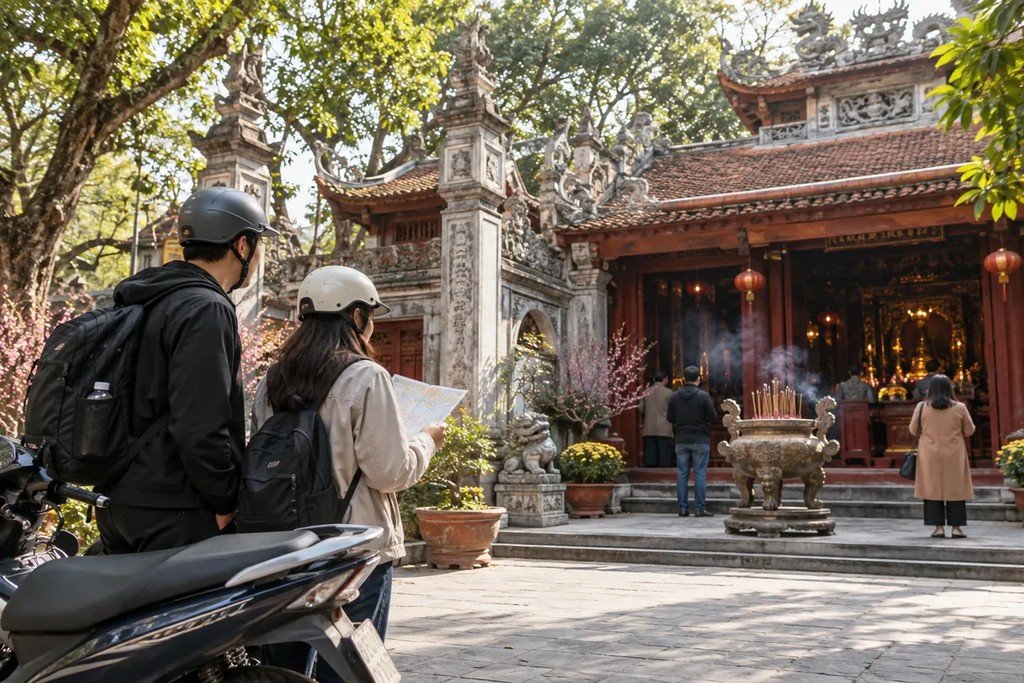
Out with your children or grandchildren in Hanoi, you pass one sign after another reading Đình, Đền, Chùa, Miếu or Phủ, and the questions start: who is worshipped here, and where do we go first? The first word of the name is a first clue: a chùa is a Buddhist pagoda, a đình a village communal house for the tutelary deity, a đền a temple to a saint or deified hero, a miếu a smaller shrine, and a phủ is linked to the worship of the Mother Goddesses. Then ask the keeper or a monk on the spot.
This guide sets the first word of a site’s name beside the sources’ definitions, adds the order of worship in a pagoda that one article describes, and says whom to ask on the spot. Eight pages were read on 27 October 2026, five of them from state bodies. It does not teach how to pray, does not replace what the keepers of communal houses and pagodas tell you, and has not been checked at each site.
What the first word on the sign says: a table from the sources
The table pairs the first word of a site’s name with the definitions in a PLVN newspaper overview (21 April 2019) and on the Department of Cultural Heritage page; the column on who is there also draws on a Hanoimoi article (11 June 2022).
| First word | What the place is, according to the sources | Who is there, according to the sources |
|---|---|---|
| Chùa (pagoda) | A place where Buddhism is practised and taught, where monks and nuns live and practise; people who are not Buddhist may also visit and enjoy the scenery (PLVN) | Monks and nuns (PLVN) |
| Đình (communal house) | Where the village’s tutelary deity (Thành hoàng) is worshipped, and also where villagers meet and discuss affairs (PLVN) | Elderly keepers and incense keepers, called cụ từ and thủ nhang (Hanoimoi) |
| Đền (temple) | Where a saint from folk legend, or a historical figure revered as a deity, is worshipped (PLVN) | Keepers such as cụ từ and thủ nhang (Hanoimoi) |
| Miếu (shrine) | Smaller than a đền; named after what it worships: miếu Sơn thần (mountain spirit), miếu Thủy thần (water spirit), miếu thổ thần (earth spirit) (PLVN) | Also cụ từ and thủ nhang (Hanoimoi) |
| Phủ | The page does not define a phủ; it says only that the rituals, festivals and spirit mediumship (lên đồng) of the Three Palaces Mother Goddess religion take place at phủ and Mother Goddess shrines, and that people worship the Holy Mother Lieu Hanh and the Mother Goddesses who govern the realms of heaven, forests and water (Department of Cultural Heritage) | Incense keepers (thủ nhang), who perform the daily rituals at Mother Goddess shrines (Department of Cultural Heritage) |
Two notes from the sources themselves. PLVN says a tutelary deity is someone who served the people or the country, founded the village or founded a craft, and that people who settled elsewhere built shrines or temples to the tutelary deity of their home village, so the first word is only a first clue. The PLVN article does not explain phủ even though the word is in its title; the Phủ row relies on the Department of Cultural Heritage, which describes the Three Palaces worship of the Mother incarnated in the realms of heaven, water, and mountains and forests, practised at phủ and Mother Goddess shrines.
If you see the word Điện, PLVN says it is a form of đền where saints of the Three or Four Palaces belief are worshipped, smaller than a đền or a phủ but larger than a miếu.
Same place name, different first word: examples from commune, ward and department pages
- Thach Da: Yen Lang commune’s page (Hanoi) has two articles of 6 July 2025. Thach Da communal house (Đình Thạch Đà) worships General Chu Dai, who fought the Wu invaders, with his two wives; Thach Da temple (Đền Thạch Đà) worships three ladies, A Nuong, La Nuong and My Nuong, descendants of the Hung kings who helped the Trung sisters’ uprising. With the same two words Thach Da, only the first word tells you whether you are at the general’s place of worship or the three ladies’.
- One site, more than one name: the commune page says that in the relic records, Dai Thanh is the Sino-Vietnamese name, while locals call it Dai Thanh temple or the temple of the three places (2 July 2025); Linh pagoda (Chùa Linh Tự) is also given the name Kim Giai Tu (27 June 2025).
- Chinese characters on the gate: the Hanoi Department of Culture and Sports portal says the main gate of the Temple of Literature is a three-entrance gate bearing the three characters “Văn Miếu Môn” in old Chinese script.
- Miếu in a proper name: the word does not necessarily indicate size (our observation, not the source’s). The same page says the Temple of Literature (Văn Miếu) worships Confucius, Confucian sages and Chu Van An, was built in 1070, and that the whole Temple of Literature – Imperial Academy complex covers 54,331 m². For the gates and tickets, see our page on the Temple of Literature.
- A phủ in the heart of Hanoi: Tay Ho ward’s page (9 July 2025) says Phu Tay Ho worships the Lady Lieu Hanh, and that the 3rd day of the third lunar month is the anniversary of the Mother Lieu Hanh. For the area, see our guide to West Lake and Tay Ho temple.
The order of worship in a pagoda, and what about communal houses, temples and phủ
Only one of the eight pages discusses an order of worship: the PLVN article on how to worship correctly at a pagoda (17 November 2016). It acknowledges that people do it differently, some paying respects to Duc Ong first and some going straight to the Three Jewels, then sets out five steps. This guide only reports them and does not teach how to worship:
- Place offerings and light incense at the altar of Duc Ong.
- Place offerings on the main altar of the main hall and pay respects to the Buddhas and bodhisattvas.
- Light incense at the other altars of the worship hall; if the pagoda has a Mother Goddess or Four Palaces shrine, offer incense there.
- Pay respects at the founders’ hall (the rear hall).
- Go to the monks’ quarters or reception room to greet the monks.
The article quotes the nun Thich Nu Minh Tam of the Vietnam Buddhist Academy in Soc Son, Hanoi: in folk belief, Duc Ong is the guardian spirit of the pagoda and protects children, and his feast day is the 4th of the first lunar month. You could tell children this in front of the altar (our suggestion). This is a newspaper article, not official guidance from any Buddhist organisation. For communal houses, temples, shrines and phủ, no page gives an order of worship, so ask the keeper rather than applying the pagoda’s five steps.
Whom to ask before you go in
- At a pagoda: the monks (our suggestion). The PLVN article mentions the monks’ quarters or reception room only at the last step, after worship, to greet the monks; it does not say that is where to ask before going in.
- At a communal house, temple or shrine: the keepers (cụ từ or thủ nhang). Hanoimoi (11 June 2022) says the upkeep of relics in Hanoi owes much to the keepers at communal houses, temples and shrines, and describes the keeper of the communal house, temple and shrine cluster in Yen Bo village (Ba Vi) guiding residents and visitors who come to offer incense.
- At a phủ or Mother Goddess shrine: the thủ nhang; the Department of Cultural Heritage says they perform the daily rituals at Mother Goddess shrines.
Hanoi’s code of conduct in public places, posted on pbgdpl.hanoi.gov.vn on 31 March 2017, applies to visitors too; its Article 6, on places of belief and religion, says to follow the instructions at the place of worship. Questions worth asking (our suggestion): who is worshipped here, which altar to go to first, and whether young children may go into the inner hall.
What not to do with young children
The general part of the code says to care for, give way to and help older people and children. The things not to do that matter most on an outing with children:
- Do not talk loudly or make noise; Article 6 says to walk softly, speak quietly and keep order and cleanliness.
- Do not wear revealing clothing or clothing at odds with good customs (Article 6); if you are unsure about a child’s clothes, ask the keeper (our suggestion).
- Do not scribble on or dirty public structures (general part), or damage the landscape or the space of belief (Article 6).
- Do not push, shove, or eat and drink anywhere you like (Article 11, on tourist sites; the code does not mention pagodas, temples or relics, so this is only a reference).
- Do not choose a crowded day while the children are small: Tay Ho ward’s page says people crowd to Phu Tay Ho on the 1st and 15th of each lunar month, and avoiding those days is our suggestion.
If you are not sure who is worshipped where you are standing
- Read the first word and compare it with the table; for a miếu, read the words after it too, such as Sơn thần, Thủy thần or thổ thần.
- Do not rely on the place name alone: Thach Da shows one place name attached to two different places of worship, and Kim Giai Tu shows a pagoda can have a second name, so ask the keeper who is worshipped there.
- Look it up before you go: the Yen Lang commune page (the two articles on Thach Da) and the Tay Ho ward page (Phu Tay Ho) have introductions that say clearly who is worshipped, though the readable parts of the two articles on Dai Thanh temple and Linh pagoda do not; other commune and ward pages may have similar sections (not checked by this guide).
- A child accidentally touches a ritual object: stop, apologise to the keeper and do what they say (our general suggestion).
- You plan several places in one day: leave room in the plan so the family is not rushed; see our guide to why motorbike day plans run late.
What the sources do not say
- No page covers signage or how to read a site’s name board; apart from the three characters on the Temple of Literature gate, the pages do not describe what is written on gates. Reading the first word is this guide’s own way of matching names to definitions.
- No page gives an order of worship at a communal house, temple, shrine or phủ; the five steps above apply only to pagodas and come from a 2016 newspaper article.
- No page defines a phủ as a type of building.
- No page says whether children may enter the main hall or worship rooms, and none covers taking off shoes, photography, opening hours or parking.
- The Yen Lang commune page does not call General Chu Dai a tutelary deity and does not explain the word Tự in the name Kim Giai Tu.
- The Hanoimoi article describes keepers at a few places (Ba Vi, Thanh Oai); it does not say that every communal house, temple or shrine has one.
- The page carrying the code of conduct gives no document number, and this guide has not checked whether the code has been amended since 2017. No page mentions rental bikes.
Sources checked
All read on 27 October 2026; the dates below are the pages’ own dates.
- PLVN (published under the Ministry of Justice), distinguishing pagodas, communal houses, temples and shrines (21 April 2019): baophapluat.vn
- PLVN, the order of worship at a pagoda (17 November 2016): baophapluat.vn
- Department of Cultural Heritage, the Three Palaces Mother Goddess religion (undated): dsvh.gov.vn
- Hanoi’s code of conduct in public places (posted 31 March 2017): pbgdpl.hanoi.gov.vn
- Yen Lang commune page, historical and cultural relics (27 June to 6 July 2025): yenlang.hanoi.gov.vn
- Tay Ho ward page, article by the Tay Ho culture, information and sports centre (9 July 2025): tayho.hanoi.gov.vn
- Hanoi Department of Culture and Sports portal, the Temple of Literature – Imperial Academy (mentions 19 July 2016 and 17 July 2018): sovhttdl.hanoi.gov.vn
- Hanoimoi, the keepers of relics (11 June 2022): hanoimoi.vn
A day out with children on a rental bike
If a child will ride with you, see our guide to carrying a child on a rental motorbike.
Message to send the shop
Hello Nguyen Ha, I am taking my [child / grandchild] to visit a few temples and pagodas on [date]. Do you have a helmet that fits a [age]-year-old, and what time should I return the bike?
Frequently asked questions
What is the difference between a đình and a đền?
According to PLVN, a đình is where a village’s tutelary deity is worshipped and villagers meet, while a đền worships a saint from legend or a historical figure revered as a deity.
What is a phủ in Vietnam?
The pages do not define it as a building type. The Department of Cultural Heritage says the rituals of the Three Palaces Mother Goddess religion take place at phủ and Mother Goddess shrines, such as Phu Tay Ho, which worships Lieu Hanh.
Where should I pay respects first in a pagoda?
One 2016 PLVN article describes starting at the altar of Duc Ong and then the main altar, but notes that people do it differently, so ask a monk on the spot.
Nguyen Ha Motorbike Rental: Ngõ 5 Nguyễn Văn Cừ, Bồ Đề, Long Biên, Hanoi, Vietnam, open 09:00–21:00 daily. Call +84 334 699 969 to ask about a helmet for a child before a day of temple visits.