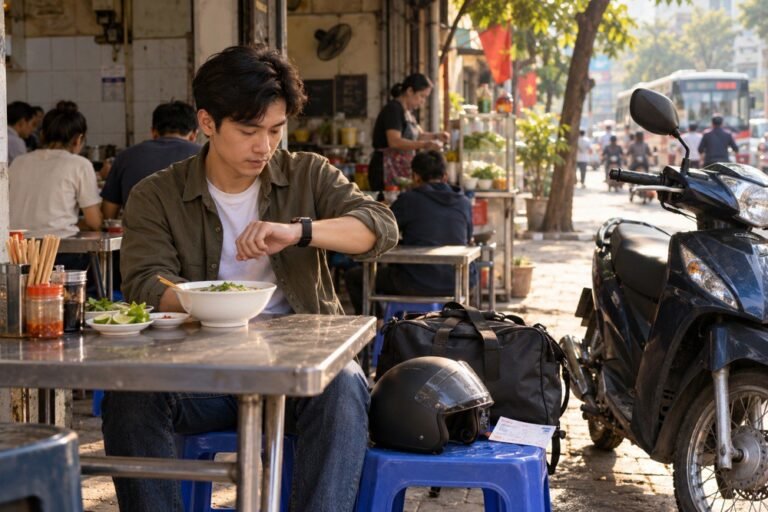
Trip Planning & Practicalities
Why Motorbike Day Plans Run Late: Building in Time for Traffic, Rest Stops and Photos
On this page
Your motorbike plan for the day looks fine on paper, but by evening you are well behind: traffic, long breaks, a wrong turn, more photo stops than planned. Why does it keep happening? Usually because the plan counts only riding time, and everything that happens in between is left out. Add time for traffic, rest, parking and each stop, put the must-see place first and the optional one last, and fix a time to head back. When you do fall behind, cut a stop rather than ride faster.
This guide is practical advice; the figures in it are examples to show the arithmetic, not timings for any real route.
The time that gets forgotten
| Item | Why it gets forgotten |
|---|---|
| Traffic and red lights | The map may show the time for clear roads |
| Rest, drinks and toilet stops | It is easy to think you will not need to stop until you are tired |
| Photos, views and meals | Each stop sounds short, but together they add up |
| Parking, finding a space and walking in | Not part of the riding time on the map |
| Getting lost, detours and closed roads | Impossible to predict |
| Refuelling and checking the bike | Only a few minutes, but enough to shift the plan |
Adding buffer time, step by step
- Take the riding time from the map for each leg between stops.
- Add an allowance for traffic, for example a third or a half of the riding time on city legs at busy times; this is only an example, so adjust it to the time and route.
- Add rest time: for example about ten minutes for each hour of riding, and more in hot weather or on long legs.
- Add the time at each stop: parking, walking, photos and food.
- Add a buffer at the end of the day for the unexpected, so you do not have to rush home.
- Compare the total with the time you must return the bike or the time it gets dark, and drop stops if it does not fit.
Pinning the stops you will need before you leave helps with steps 3 and 4; see our guide to pinning fuel, drink and toilet stops.
A worked example with invented figures
| Leg | Riding time (example) | Buffer added (example) | Total |
|---|---|---|---|
| Home to stop one | 40 minutes | 15 minutes for traffic | 55 minutes |
| At stop one | — | 45 minutes to park, walk and take photos | 45 minutes |
| Stop one to stop two | 30 minutes | 10 minutes’ rest | 40 minutes |
| At stop two | — | 60 minutes for lunch and a rest | 60 minutes |
| Stop two to home | 50 minutes | 20 minutes for traffic and 10 minutes’ rest | 80 minutes |
| Total | 120 minutes of riding | 280 minutes, or 4 hours 40 minutes |
The figures only illustrate the sum. Counting just the 120 minutes of riding, you would badly underestimate: the day in this example needs 280 minutes, more than twice as much. Our guide to how far is realistic in one day applies the same idea to distance.
A plan with room to breathe
- Put the most important stop early in the day, while you are fresh; if possible, choose a departure time that avoids the rush hour.
- Put stops you could skip at the end of the day, so if you are late you can drop them without ruining the plan.
- Avoid arriving close to a stop’s closing time or to nightfall.
- Leave at least one gap between stops for rest or for things that come up.
- Set a time to start heading back, and keep to it rather than letting the day drift.
Weather time
Weather is the buffer most often forgotten. Rain does not just slow you down; it adds stops to put on and take off a raincoat and to shelter when it is too heavy. Strong sun works the other way: you need more frequent breaks and more water, and you may want to avoid riding at midday. Check the forecast on the morning you leave, and if rain is possible in the afternoon, add a separate allowance for it. Our guide to reading a Vietnamese rain forecast explains what to look for.
Planning around the shop’s opening hours
Nguyen Ha Motorbike Rental is open 09:00–21:00, so collecting and returning the bike are two fixed points in the day. If you want to leave before 09:00, ask the shop about collecting the bike the afternoon before rather than planning right up to opening time. When you count back from the return time, include refuelling, finding your way into the lane and checking the bike with the shop at return.
When you are already behind
- Stop somewhere safe and look at the plan again rather than riding faster to catch up.
- Decide which stop to drop based on the time left and what matters most.
- Tell anyone waiting for you if you have an appointment.
- If you must return the bike on time, message the shop as soon as you see you will be late; see running late on return day.
- Keep to a safe speed; a few minutes are not worth the risk.
What not to do
- Do not ride faster to make up time.
- Do not skip rest stops to keep up with the plan when you feel tired.
- Do not pack in stops just because they look close together on the map.
- Do not plan to get back just before the bike is due.
- Do not change the plan on your phone while riding.
Record real times so the next plan is better
The best way to get buffers that fit you is to write down what actually happened. At the end of each day, note how long each leg took against the plan, how long you stayed at each stop and where the plan slipped most. After a few days you will see your own pattern: some people always stay longer at photo spots, others lose time finding parking. Next time, use your own figures. Our motorbike trip log gives a simple format.
What this guide does not cover
- It gives no real journey times for any route; check a map app on the day.
- It does not cover sights’ opening hours or sunset times; check those for your date and places.
Message to send the shop
Hello Nguyen Ha, I am planning a day ride on [date] to [places] and want to be back by [time]. If I am running late, what is the best way to let you know, and could I collect the bike the evening before to leave early?
Frequently asked questions
How much buffer time should I add to a motorbike day trip?
There is no fixed figure. Add an allowance for traffic, about ten minutes’ rest per hour of riding as an example, the time at each stop and a buffer at the end; in the worked example the day needed more than twice the riding time.
What should I do if I am running late?
Stop somewhere safe, drop the least important stop and tell the shop early if the return time is at risk. Do not ride faster to catch up.
Can I collect the bike before the shop opens?
The shop opens at 09:00. If you need an earlier start, ask about collecting the bike the afternoon before.
Nguyen Ha Motorbike Rental: Ngõ 5 Nguyễn Văn Cừ, Bồ Đề, Long Biên, Hanoi, Vietnam, open 09:00–21:00 daily. Call +84 334 699 969 to plan pickup and return times around your day.