Riding Skills & Safety Planning
Giving Way to an Ambulance or Fire Engine in Dense Hanoi Traffic: Which Side, Which Lights, and Red Lights
On this page
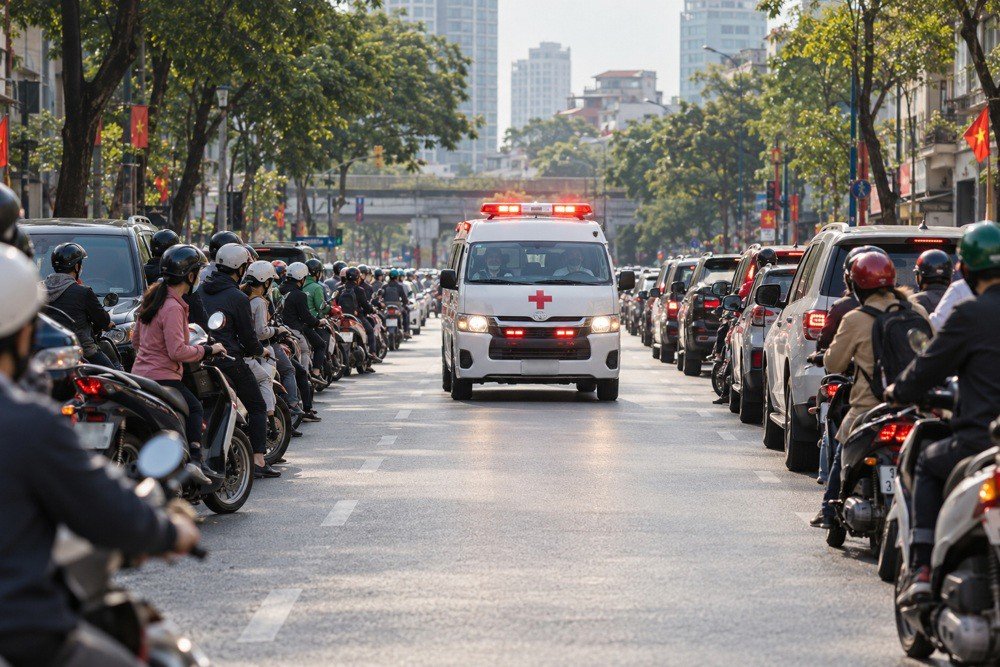
You are riding in a solid stream of motorbikes when an ambulance or fire engine siren starts behind you. Which way do you move, do you stop, and what if you are waiting at a red light? Slow down, move over to the right or stop to let it through, and do not get in its way. That is what Article 27 of Vietnam’s road traffic law requires. The law does not mention red lights in this context; officials have said that crossing the stop line only as far as needed to let a priority vehicle through can count as acting in an emergency, but they describe the conditions differently.
This guide compares seven pages: Law No. 36/2024/QH15, a Ministry of Public Security Q&A, three local government or police pages and two newspaper reports. What the pages say is kept apart from our own suggestions. It is not legal advice and it gives no fine amounts.
One principle runs through all of it: a priority vehicle’s right to ignore signals does not pass to the people giving way. A siren behind you is not permission to run a red light or ride onto the pavement. Follow any traffic officer’s directions, and give way only by a path you can see is safe.
Which vehicles have priority, and their lights
Article 27(2) of Law No. 36/2024/QH15 gives priority vehicles the right to go before other traffic through a junction from any direction, in this order, and Article 27(3) sets the colour of their flashing lights:
| Order in Article 27(2) | Vehicle | Flashing light (Article 27(3)) |
|---|---|---|
| Point a | Fire engines (fire police and other forces called in) | Red |
| Point b | Military, police and procuracy vehicles on urgent duty; convoys led by a traffic police vehicle | Military: red. Police, procuracy and escort vehicles: blue and red |
| Point c | Ambulances on an emergency call | Red |
| Point d | Dyke-protection vehicles; rescue, disaster and epidemic response, or other urgent duties | Blue |
Funeral processions also appear in the list of priority vehicles, last in order, but the light colours apply only to points a to d. The National Legal Database marks parts of Article 27(3) as amended without displaying the new wording, so the table follows the text as shown. A Ho Chi Minh City traffic police page (15 January 2025) gives the same colours.
What Article 27(5) asks of you
When a priority vehicle signals, Article 27(5) says road users must slow down, keep close to the right-hand side of the road or stop to give way, and must not obstruct it. So the side named in the law is the right.
Article 27(4) lets priority vehicles proceed regardless of traffic lights, enter roads against the flow and use any passable road. Our own inference: the siren may come from in front of you or from a side road, not only from behind. A Dong Nai ward page (26 March 2026) adds that people must never tailgate a priority vehicle, push in or ride in its lane, and that giving way should be done early and decisively.
In packed motorbike traffic: a sequence
These steps are our suggestion for following Article 27(5) on two wheels; the sources do not set them out.
- Slow down under control and keep your line steady. Look before changing position and avoid sudden movements; do not brake hard if nothing ahead forces you to stop.
- Work out where the siren and lights are coming from, using your mirrors and a look to each side.
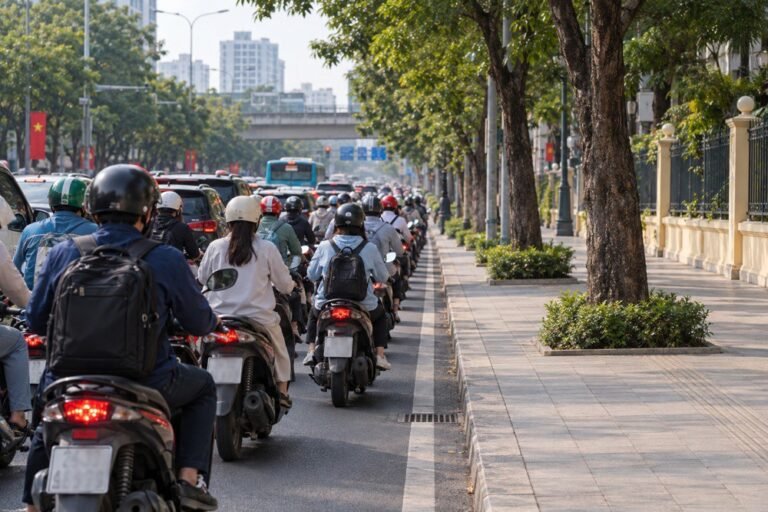
- If there is room on the right, signal right, check the mirror and ease across. If there is no room, keep your line and slow down; the law also allows you to stop, so stop behind the vehicle in front without blocking the lane sideways.
- Wait until the priority vehicle has passed completely, check your mirrors and then rejoin the traffic.
For how horns, lane changes and flashing lights are used in Hanoi traffic generally, see our guide to horns, lanes and flashing lights.
Waiting at a red light: what the sources say
Article 11(4)(c) of the law says a red light means stop, and Article 27(5) does not mention red lights. The pages that discuss red lights all rely on the idea of acting in an emergency under the law on administrative violations, as explained by police officials:
| Source and date | What it says | Conditions to note |
|---|---|---|
| Ministry of Public Security Q&A, 2 June 2023 | For the case described (stopped at a red light and forced to cross it to let an ambulance through), the rider would not face an administrative penalty | Based on the old road law; the rider must be able to prove it was necessary, and giving way must be safe for other traffic |
| Ministry of Public Security via Nhan Dan, 23 January 2025 | Crossing a red light to let a priority vehicle on urgent duty through is treated as acting in an emergency | For camera fines, the full clip is reviewed before a violation is recorded |
| Nghe An traffic police via the Ha Tinh portal, 11 February 2025 | Vehicles stopped at a red light with an ambulance behind may cross to let it through without penalty | Only “in the right lane, on the right part of the road and for a legitimate reason” |
| Traffic Police Department via Dan Tri, 20 September 2026 | Being forced across the stop line or into another lane, only to let a properly signalling priority vehicle through and with no other option, counts as an emergency and is not penalised | Only as far as necessary; after crossing, stop and wait for green before turning left |
The sources do not agree on one point: Nghe An police speak of staying in the right lane, while the national traffic police describe cases where you may have to move into another lane. We do not choose between them. The 2023 answer was based on the old Road Traffic Law, which Article 88(3) of Law 36/2024 replaced. None of this assesses your particular situation. Our page on turning right at a red light covers a different red-light question.
What not to do
- Do not follow close behind a priority vehicle or slip into its lane; the Dong Nai ward page says never.
- Do not treat “emergency” as a reason to cross a red light when it is not needed; Dan Tri reports that riders should act only as far as necessary.
- Do not turn left straight after crossing the stop line; Dan Tri reports that you must stop and wait for green before turning left.
- Do not stop abruptly in the middle of the lane or across the priority vehicle’s path (our suggestion): the riders behind may not have time to slow down.
If an officer is directing traffic at the junction
Article 11(2) ranks a traffic officer’s directions above traffic lights, and Article 27(4) says priority vehicles must also obey those directions. Our inference from that order: when an officer is present, look at the officer before the lights. Our guide to traffic officer hand signals explains what each gesture means.
Other short answers for renters are on our rental FAQ page.
What the sources do not say
- Neither Article 27 nor the other pages say that the person giving way must signal with an indicator or by hand.
- No page gives a distance in metres at which you must start giving way, or mentions rental bikes; Article 27 does not single out motorbikes.
- We give no fine amounts: Decree 168/2024/ND-CP was not among the pages read, and the pages that quote amounts do not cite the clause.
- No source explains how to reconcile “the right lane” with “another lane”.
Sources checked
- Law No. 36/2024/QH15, National Legal Database, in force, updated 29 March 2026: vbpl.vn
- Ministry of Public Security, Q&A, 2 June 2023: bocongan.gov.vn
- Nhan Dan, crossing a red light to give way to a priority vehicle, 23 January 2025: nhandan.vn
- Ha Tinh provincial portal, citing VOV, 11 February 2025: hatinh.gov.vn
- Dan Tri, 20 September 2026: dantri.com.vn
- Ho Chi Minh City traffic police, priority vehicles, 15 January 2025: csgt-congan.hochiminhcity.gov.vn
- Tri An ward, Dong Nai, rules when meeting priority vehicles, 26 March 2026: trian.dongnai.gov.vn
Message to send the shop
Hello Nguyen Ha, I am new to riding in Hanoi traffic. Before I set off on [date], could you point out any stretches near your shop or on the way to [destination] where ambulances or fire engines often pass, and is there anything you would like me to know about riding through busy junctions?
Frequently asked questions
Should I move left or right for an ambulance?
Article 27(5) says slow down, keep close to the right-hand side or stop, and do not obstruct the vehicle. If there is no room on the right, slow down and stop behind the vehicle in front.
Can I cross a red light to let an ambulance through?
Officials have said that doing so only as far as necessary, with no other option, can be treated as acting in an emergency, but they describe the conditions differently. A red light still means stop under the law, and the priority vehicle’s right to ignore it does not pass to you.
What do blue lights mean?
Under Article 27(3), police, procuracy and escort vehicles use blue and red, and disaster, rescue and other urgent-duty vehicles use blue. Give way to any of them in the same way.
Nguyen Ha Motorbike Rental: Ngõ 5 Nguyễn Văn Cừ, Bồ Đề, Long Biên, Hanoi, Vietnam, open 09:00–21:00 daily. Call +84 334 699 969 to ask about busy junctions on your route.