Motorbike Rental Guides
Motorbike Stalls Just After Refuelling: Keep the Receipt and Report It
On this page
You fill a rented motorbike at a petrol station, ride a short distance and notice a sudden jerk, hesitation or engine stall. The timing may make you wonder whether the petrol was wrong or poor-quality. But a motorcycle can stop for several unrelated reasons, so a refill followed by a stall is not proof of fuel contamination. Your priorities are to stop safely, preserve the receipt and record what happened without making an unverified accusation.
This guide is written for Hanoi renters who are away from the shop when an engine behaves unexpectedly after refuelling. It focuses on evidence and communication—not draining the tank, diagnosing an injector or proving the station is at fault. If there is a petrol smell, active leak or smoke, keep people away and seek suitable help immediately.
First deal with the loss of power
Do not open the throttle aggressively to force the engine to recover. Focus on steering and reaching a safe stopping place as conditions permit. Signal when appropriate, avoid sudden changes of direction and remain aware of vehicles behind you. Once stationary, switch off the ignition if safe, secure the bike and move yourself away from moving traffic.
Do not try repeated restarts to gather evidence. If the tank contains the wrong fuel or another fault exists, repeated attempts may worsen the situation. Contact the rental provider before deciding whether a restart or further movement is appropriate.
What should you keep from the petrol station?
| Evidence | Useful information | Safe way to preserve it |
|---|---|---|
| Paper receipt | Time, amount and station details, where printed | Photograph and store it dry |
| Card or phone payment | Amount and transaction timestamp | Save a screenshot for your own records |
| Pump label | Fuel grade you intended to buy | Photograph only if you can do so safely after stopping |
| Station name and address | Identifies the exact stop | Record the name or map location |
| Odometer | Distance since the refuel | Use a stationary photo if the display is safely available |
| Warning indicators | May assist inspection | Describe or photograph without triggering a suspected faulty system |
Not every receipt lists the fuel product or litres, and a transaction record cannot prove fuel quality on its own. Keep the records because they help reconstruct the timeline, not because they automatically establish liability.
Write the sequence, not a conclusion
Note whether the bike was operating normally before the station stop. Record the fuel product selected, time, approximate quantity, whether there was a queue, and when the first abnormal response occurred. State whether it was a single jerk, repeated hesitation, loss of power or a complete stall.
If the bike was already difficult to start, leaking or showing a warning light before refuelling, include that too. Leaving out an earlier symptom can make the event look more conclusive than it is. A complete account helps the shop make a fair assessment.
Why “it was the petrol” may be premature
An electrical fault, fuel-delivery issue, ignition problem, mechanical condition or incorrect fuel type may produce overlapping symptoms. The timing matters but is not a diagnosis. A trained technician and, in some cases, formal testing are needed before attributing a fault to the petrol or the station.
Do not confront the attendant or post a claim about contaminated fuel as fact solely because the bike stalled nearby. A receipt and description are useful evidence; they do not establish misconduct or a defective product.
Ask what grade belongs in the actual bike
Petrol labels can include RON and biofuel blend designations, and Vietnam’s product range has changed. A Vietnamese Government report dated 1 June 2026 describes the nationwide E10 rollout, with E5 RON92 continuing under the stated timetable. That national policy does not mean every older motorcycle automatically has identical fuel compatibility.
Use the motorcycle’s manufacturer guidance and ask the provider for the grade required by the specific bike. If you suspect the wrong fuel was used, do not switch the ignition on repeatedly or attempt to flush the system yourself.
What if the motorbike starts again?
A successful restart does not prove the issue has disappeared. If it has jerked or stalled unexpectedly, especially in traffic, speak to the rental shop before continuing. Avoid deliberately accelerating, climbing a hill or riding farther to see whether the fault returns.
Consider how the surrounding road and traffic would affect any attempt to move it. If continued riding cannot be assessed as safe, ask the owner about suitable inspection or transport arrangements rather than assuming a free recovery service is included.
Petrol odour, leaks and smoke require extra caution
A strong fuel smell or visible liquid can create a fire risk. Keep away from smoking, flames and sources of sparks. If the bike is leaking or smoking, switch it off if possible without increasing danger, move away and alert the appropriate service or responsible people. Do not unscrew the fuel cap to smell the contents or lean close to a potential spill.
Seven facts to give the shop
- The registration plate and rental contact information.
- The station name, approximate time and location.
- The grade and quantity of fuel purchased, if known.
- Whether the motorbike was normal before refuelling.
- When the first jerking, hesitation or stall occurred.
- Any warning icon, new sound, smell or visible leak.
- Where the motorbike is parked and whether you need assistance.
A straightforward message is: “I refuelled at [station] at [time] with [grade, if known]. After [distance or minutes], the bike jerked twice and stalled. It is parked at [location]. I saved the receipt and have not tried to restart. Please advise the next step.”
What not to attempt at the roadside
- Drain petrol into bottles, drains or open containers.
- Add an unidentified chemical or fuel treatment.
- Disconnect hoses, a battery or an injector.
- Lean over the tank to identify fuel by smell.
- Repeatedly crank the engine to reproduce the stall.
- Ask a stranger to repair the bike without contacting the owner.
Improvised work can introduce new hazards and make it harder to assess the original condition. A renter’s job is to protect people, preserve straightforward information and obtain instructions.
Why the receipt matters even when fuel is not the cause
It provides a timestamp that can be compared with the motorcycle’s behaviour and the rental log. It may also show the amount paid or identify the station. If there is a later question about what was put in the tank, the receipt is a better starting point than a reconstructed guess.
Do not assume a printed total is a laboratory measure of quality. Nor can it prove the operator dispensed a specific product unless the record clearly identifies it and further facts support the conclusion.
Preparing before the next refuelling stop
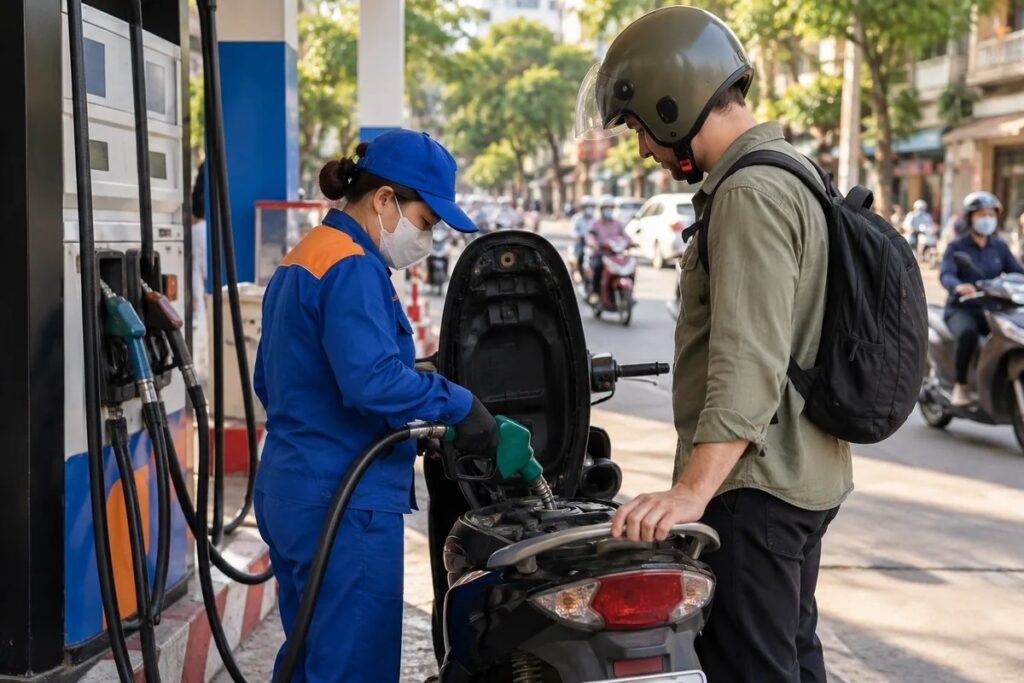
Confirm the correct fuel with the rental shop at collection and keep a short note on your phone. Before filling, look at the product label, the display and the price. Ask the attendant to confirm the grade if you are uncertain, and do not start fuelling until that uncertainty is resolved.
Our petrol-pump checklist</a gives a broader view of the information a renter can see at the dispenser.
What if you cannot get a receipt?
Write down the station, date, time and the method of payment. An available bank transaction or station photo can supplement your account. Avoid returning to a busy roadside location solely to take a picture when the bike is already stopped somewhere safe.
When to contact Nguyen Ha
Report unexpected stalling promptly, particularly if it happens right after a fill-up or the motorcycle cannot be operated confidently. The shop can clarify the model’s recommended fuel and discuss an appropriate next step for the specific rental. For general booking details see Nguyen Ha’s rental information, or call 0334 699 969 with your location and the receipt details.