Trip Planning & Practicalities
Phone Battery Dies on a Long Ride: A Paper Backup of Contacts and Addresses So You Do Not Get Lost

On this page
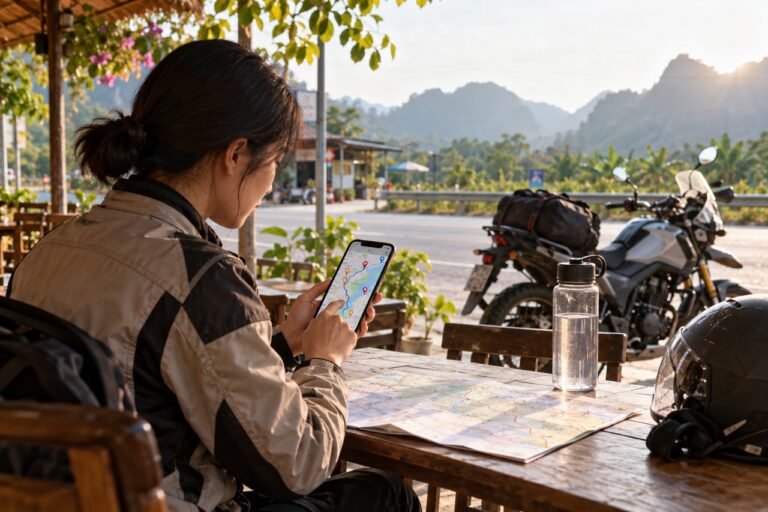
You are on a long ride out of Hanoi and your phone, which is doing your navigation, messages, photos and maybe payments, is running out of battery. What happens when it dies? Prepare a small paper card before you leave with two contact numbers, your accommodation, the rental shop and the main roads of your route, and carry a power bank. When the phone goes dark, so do your contacts and your map. A card a stranger can read lets them help you call the right person, and a few road names let you ask the way.
Why the battery drains fast on a motorbike
A motorbike trip piles several drains on the battery at once. The screen runs at full brightness to be readable in sunshine. The map app uses location constantly. Outside the city or along the dykes the signal is weaker, so the phone works harder to stay connected. And a phone sitting in a mount in the sun gets hot, which drains it faster still. Our guide to a phone overheating on a mount covers the heat problem.
The paper card: what to write
Write it by hand before the trip. It does not need to be long, just enough for a stranger to read and help you call the right person.
| Item | What to write | Why |
|---|---|---|
| Family or friends | Two phone numbers, every digit, with names | When the phone dies, so does your contact list, and few people remember others’ numbers |
| Where you are staying | Hotel or guesthouse name, address and phone number | To ask the way back or have someone call for you |
| The rental shop | Nguyen Ha Motorbike Rental, Ngõ 5 Nguyễn Văn Cừ, Bồ Đề, Long Biên, Hanoi (near Gia Lam Bus Station), +84 334 699 969, open 09:00–21:00 daily | To reach the shop quickly if the bike has a problem, and so a helper knows where the bike belongs |
| Your bike | Number plate and model | To describe the bike when asking for help or reporting a problem |
| Destination and main roads | The place you are heading and one or two main roads on the way | To ask directions without a map |
| Health information (optional) | Allergies or regular medicines, if any | Useful if you cannot speak for yourself after an incident |
Never write passwords, bank card numbers or PINs on this card: it is meant to be read by others. For a fuller emergency card, see emergency information to carry.
Make it readable when you are flustered
Write in large letters, one item per line, phone numbers as unbroken digits and road names in full. Fold it small, put it in a plastic bag so rain cannot smudge it, and keep it in the same pocket of your jacket or bag every time; tell your companion where it is. Photograph it too, so it is on your phone while the battery lasts.
A short message before the trip is worth more than it looks. Tell someone where you are going, which way, when you expect to be back, and a time by which you will message “arrived” or “heading back”. If they hear nothing by then, they know to call, and if you cannot be reached they know roughly where you are.
Keeping the phone going all day
- Charge fully before leaving and carry a power bank with a cable that fits your phone.
- Turn on battery saver, switch the screen off when you are not reading the map, and silence unnecessary notifications.
- Download offline maps for the area before you leave, somewhere with a good connection, if your map app offers it.
- Keep the phone out of strong sun and out of hot enclosed spaces. If you use a mount, check it holds the phone firmly before riding.
- Charge during stops: at lunch or a café, ask whether you can plug in, and do not leave the phone or power bank behind.
- Carry enough cash for fuel and a snack in case you cannot pay by phone.
If the bike has a USB port, our guide to charging your phone on a rental motorbike explains what to check first.
Two riders: split the phone jobs
If you are riding with someone, agree roles for the two phones. One does the navigation with the screen on when needed; the other stays in battery-saving mode and is kept for calls. When the navigating phone runs low, swap roles. That is far simpler than both phones running maps and dying at the same time.
If the phone dies anyway
- Pull over somewhere safe before doing anything else; do not fiddle with the phone while riding.
- Try charging at the nearest café or from a power bank; a few minutes is often enough to make one call.
- Use the card: call someone on the café’s phone or a phone lent by someone you trust, reading the details from the card.
- Ask directions using the destination and main road names you wrote, rather than relying on memory.
- Call the rental shop if the bike has a problem, and let them know if you will be back later than agreed.
No signal is not the same as a dead battery
On some stretches outside the city, the phone still has battery but no signal, so online maps will not load and calls will not connect. Offline maps downloaded in advance and the road names on your card are the two most useful things then. When the signal drops, do not ride on by instinct: stop somewhere safe, check the offline map, and carry on only when you know which way to go.
What not to do
- Do not set off on a long ride with a half-charged phone and no power bank.
- Do not keep the screen at full brightness with the map open all day.
- Do not write sensitive information such as PINs or card numbers on the paper card.
- Do not handle the phone while riding; stop first.
Message to send the shop
Hello Nguyen Ha, I am riding to [destination] on [date] and expect to be back by [time]. If my phone runs out of battery and I am late, I will call you from another phone. Is this the best number to reach you on that day?
Frequently asked questions
What should I write on a paper backup card?
Two contact numbers with names, your accommodation’s name, address and phone, the rental shop’s address and number, the bike’s plate and model, and your destination with one or two main roads.
How can I stop my phone dying on a long ride?
Charge fully, carry a power bank, use battery saver, download offline maps, keep the screen off when not navigating and keep the phone out of strong sun.
What if I lose signal rather than battery?
Stop somewhere safe, use offline maps if you downloaded them, and ask the way using the road names on your card.
Nguyen Ha Motorbike Rental: Ngõ 5 Nguyễn Văn Cừ, Bồ Đề, Long Biên, Hanoi, Vietnam, open 09:00–21:00 daily. Call +84 334 699 969 if your phone dies and you need help with the bike.