Trip Planning & Practicalities
Pin Fuel, Drink and Toilet Stops on Your Map Before a Long Motorbike Ride
On this page
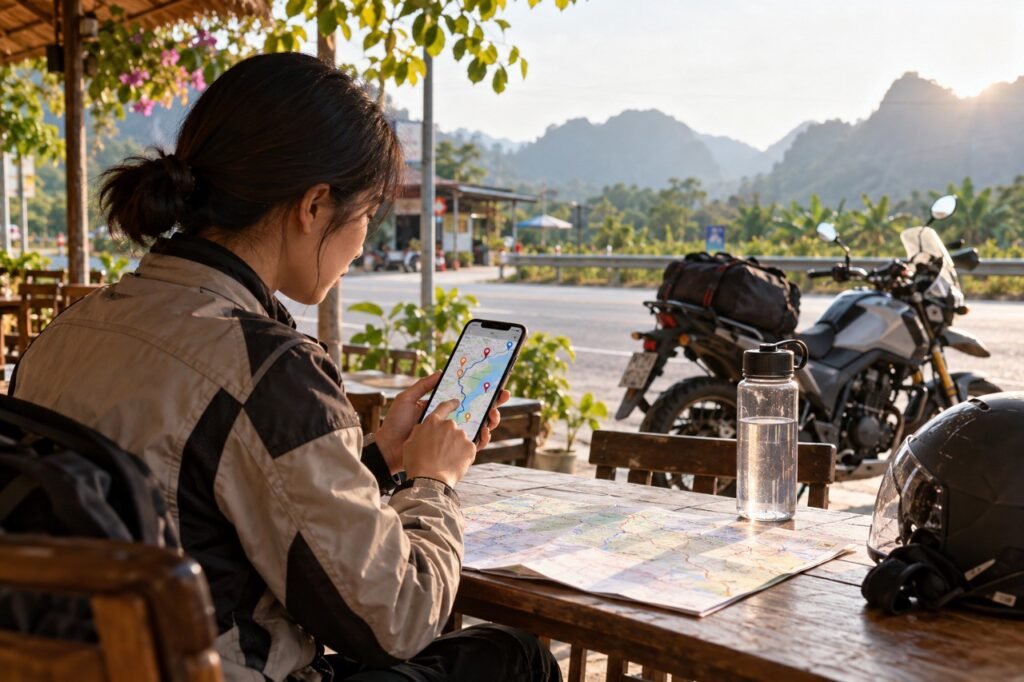
Heading out of Hanoi on a longer motorbike ride and worried about finding fuel, a drink or a toilet on unfamiliar roads? Pin those stops on your map before you leave, label them by leg, add a second option for each leg and keep a copy that works without signal. On a road you do not know, it is hard to search for a stop while riding, and when the fuel is low or you are tired, not knowing where the next stop is adds stress. A few minutes of pinning the night before takes that pressure away.
This guide explains how to choose and pin stops, check opening hours, split the ride into sensible legs, prepare for losing signal or battery, and what not to do. It does not describe a particular route; apply it to yours. Before any ride beyond the city, confirm with the shop that the bike may leave Hanoi; our guide on whether a rental bike can leave the city lists what to agree.
Why pin your stops in advance
| Type of stop | What pinning it in advance gives you |
|---|---|
| Petrol station | You know where to refuel and are not tempted to run the tank down to the last mark |
| Café or roadside eatery | A place to rest, drink and get out of the sun at the point you expect to be tired |
| Toilet | You avoid having to stop somewhere unsuitable |
| Shade or a safe resting place | Somewhere to recover when you are tired or the weather turns |
Pinning stops also helps you split the ride into legs instead of riding until you are exhausted and only then looking for a break.
How to pin your stops
- Look at the whole route first, then divide it into legs that suit your stamina.
- Search the map for petrol stations along the route and save them to a list.
- Find cafés, eateries and toilets near the end of each leg.
- Give each pin a short label such as “Fuel 1” or “Rest 1” so you, or a passenger, can find it quickly once stopped.
- Pin more than one option for each leg in case a place is closed.
- Share the list with anyone riding with you.
Check opening hours and details
- Read the opening hours on the map, remembering that they may be out of date or incomplete.
- Look at recent photos and reviews to see whether a place still seems to be operating.
- If a stop matters to your plan and lists a phone number, call ahead.
- Allow for late hours: some petrol stations may close early. Our guide to choosing the last petrol station before the hills explains how to build a fuel reserve.
- Note the street name and address so you can ask locals if the map is wrong.
Split the ride into sensible legs
- Refuel early, while the needle is still well above the last mark, rather than waiting for it to reach the bottom.
- Rest regularly, for example after every one to two hours of riding, and adjust to how you feel.
- Rest more often in hot weather, on rough roads or when you carry a passenger.
- Make the last leg shorter if you expect to be tired by then.
- Choose stops that are safe and have space to park, rather than pulling up on a dangerous verge.
For routes where petrol stations thin out, our guide to long gaps between petrol stations shows how to measure the longest gap and set a turnback point.
A backup for lost signal or a flat phone
- Download an offline map of the area if your app allows it.
- Screenshot the list of stops and the main route.
- Write the names and addresses of the key stops on paper, with the phone numbers you may need.
- Carry a power bank and do not let your phone run flat mid-ride.
- Ask local people when the map can no longer help.
Our guide to downloading offline maps before a day trip walks through the setup and an airplane-mode test.
What not to do
- Wait until the fuel warning light comes on before looking for a station.
- Pin only one stop for each leg.
- Search the map while riding; stop somewhere safe first.
- Trust a map’s opening hours completely without a backup.
- Skip rest stops to arrive sooner.
If a pinned stop is closed
- Stop somewhere safe and check the alternative stops in your list.
- Look for the next stop on the map or ask local people.
- If fuel is low, only ride on to a station you have confirmed is open when the bike is running normally and you have good reason to think the fuel will last. If the bike hesitates, splutters or you are not sure you will make it, stop safely and contact the shop; a pin on a map does not prove the bike will get there or that the pump is open.
- If needed, call a relative or the rental shop for advice.
Also pin shelter and tyre repair
Besides petrol stations and cafés, two more types of stop are worth pinning: shelter from rain and a tyre repair shop. Shelter can be a café with a wide awning, a petrol station with a canopy or a rest area, as long as you can wheel the bike out of the traffic. When heavy rain arrives suddenly, knowing that shelter is a few kilometres away helps you decide quickly instead of pressing on through the downpour.
Pin roadside tyre and repair shops as backup information, not so that you can repair the rental bike yourself. If the bike has a problem, call the shop first and only use the nearest repair shop if it agrees; having the location on your map makes that call short and clear. Our guide to sending a useful breakdown location pin explains what to share.
With a passenger or children
Passengers often tire faster than riders, because they have no handlebars to hold and find it harder to change position. If you are riding with children or an older person, pin rest stops more closely than usual and prefer places with clean toilets, seats and shade. Ask your passenger before each leg whether they need a stop, rather than waiting for them to say so.
After the ride: keep the stops you can trust
Back home, go through the list and mark the places that actually worked: the petrol station open at the stated time, the café with space for the bike, the clean toilet. Delete places that were closed or hard to reach. Next time you ride that route, or recommend it to a friend, a list you have tested is far more useful than a set of pins you never visited.
Questions to ask the shop before a longer ride
- What is the fuel tank capacity of this bike, and which fuel should I use?
- How is fuel handled at pickup and return?
- May this bike leave Hanoi for the route I am planning, and whom do I call if there is a problem far from the shop?
Message to send the shop
Hello Nguyen Ha, I would like to rent a [model] from [date] to [date] for a ride from Hanoi to [destination], about [distance] km. May the bike be used for this route? What is the fuel tank capacity and which fuel should I use, and how is the fuel level handled at pickup and return? If the bike has a problem on the way, should I call you before going to a local repair shop?
Frequently asked questions
Which stops should I pin before a long motorbike ride?
At least petrol stations, cafés or eateries for rest, toilets and shade, plus shelter from rain and a tyre repair shop as backup. Pin two options for each leg.
How often should I stop?
A common rhythm is every one to two hours of riding, more often in heat, on rough roads or with a passenger. Adjust it to how you and your passenger feel.
What if I lose signal?
Use the offline map, screenshots and the paper list you prepared, and ask local people for directions to the next pinned stop.
Nguyen Ha Motorbike Rental: Ngõ 5 Nguyễn Văn Cừ, Bồ Đề, Long Biên, Hanoi, Vietnam, open 09:00–21:00 daily. Call +84 334 699 969 to check the bike’s fuel tank and your route before a longer ride.