Motorbike Rental Guides
Semi-Automatic or Scooter Rental for Older Riders Used to Manual Gears?
On this page
Your mother or father has ridden a geared motorbike for decades and is visiting Hanoi for a few weeks. Would an automatic scooter reduce effort in city traffic, or would a familiar semi-automatic motorcycle feel easier and safer? There is no answer based on age alone. It depends on the person’s current riding ability, habits, physical comfort and the exact bike. An unfamiliar scooter can require different braking and throttle habits, while a familiar semi-automatic may be the more confident choice for shorter everyday journeys.
The most useful approach is to let the actual rider decide without pressure. Compare the controls, seat height, weight and parking arrangements, then ask what models are available for the dates. You can read the Vietnamese terms for semi-automatic, manual and scooter models before explaining the difference to someone who is new to local names.
Clarify what “geared bike” means
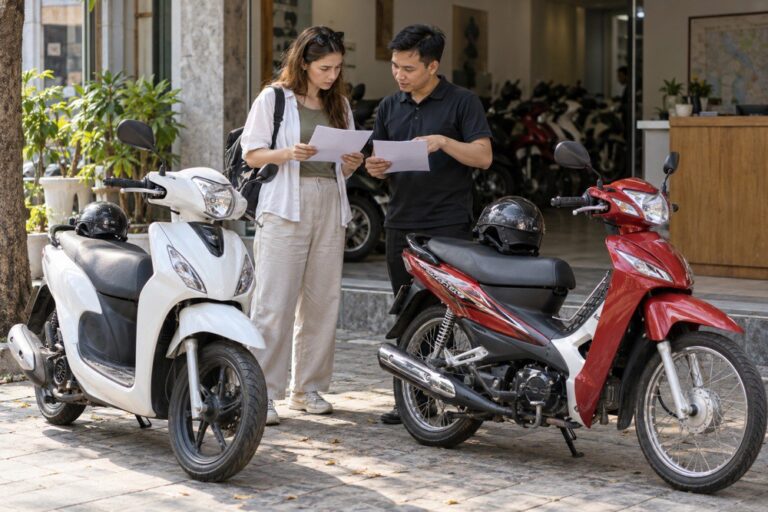
Semi-automatic step-through motorbike
Many Vietnamese riders are familiar with step-through bikes that have foot-operated gears but no conventional hand clutch lever. The exact pattern and controls vary by model, so demonstrate them on the actual motorcycle. For someone who has used a similar vehicle for years, these movements may feel natural.
Manual-clutch motorcycle
A manual-clutch bike involves coordinating the clutch and gear selection, and it is not identical to a semi-automatic. A rider accustomed to a hand clutch should not assume a scooter’s left-hand lever has the same function. Always explain the controls while parked rather than asking someone to figure them out in traffic.
Fully automatic scooter
Automatic scooters generally do not require foot gear changes, but their brake lever layout, throttle response, weight and geometry may differ from the bike the rider knows. Familiarity with one scooter does not guarantee immediate comfort on another. The user manual and the model-specific handover demonstration matter.
Why old riding habits matter during a change
Automatic movements happen without much thought
After years of riding one type of motorcycle, an experienced person may instinctively reach for a clutch or move a foot as if changing gears. On a different type of vehicle, that movement may operate something else or have no effect. This is a reason for careful familiarisation, not a reason to assume older riders cannot adapt.
Brake controls deserve special attention
On many scooters, the left-hand lever operates a brake, whereas a manual-clutch bike uses a clutch lever there. A rider who confuses these functions can react incorrectly when surprised. Explain the model’s actual controls and allow the rider to practise only under safe, legal, supervised conditions appropriate to their skill.
Confidence is not the same as refusing new technology
Some riders love trying a scooter; others prefer the vehicle they have used for years. Either preference can be rational. Ask what the rider feels comfortable handling rather than assuming that automatic transmission is always an improvement or that a familiar bike is always safest regardless of its condition.
Does an automatic scooter actually reduce fatigue?
Less gear changing in stop-and-go traffic
An automatic scooter can remove repeated foot gear changes, which some riders may find convenient. But different braking, unfamiliar seating and a heavier parked vehicle can introduce effort elsewhere. The overall result depends on the specific bike and person, not the transmission alone.
Weight while parking
A scooter may feel stable on the move but awkward when being pushed through a narrow gate or placed on a stand. Ask the rider to assess the actual vehicle’s weight and balance while stationary. Do not assume the more modern or higher-priced model is easier to park.
Seat and reach
The rider should be able to sit comfortably, reach the levers without awkward stretching, look over both shoulders and handle the bike at a stop. Seat height, foot placement, standing support and the effort required to operate the stand are often more important than the model’s name.
A side-by-side comparison
| Question | Familiar semi-automatic | Automatic scooter |
|---|---|---|
| Gear operation | Foot selection may already be familiar | No routine gear shifting |
| Brake and throttle habits | Controls familiar to experienced rider | Requires model-specific familiarisation |
| Parking and pushing | Check actual weight and stand | Check actual weight and stand |
| Seat and access | Compare height and step-through clearance | Compare height and floorboard layout |
| Carrying items | Storage varies with bike | Storage varies with scooter |
| Rider comfort | May benefit from existing habits | May reduce gear-changing effort |
| Decision rule | Choose the actual bike the rider can lawfully and confidently control | |
This is not a ranking of safety by transmission type. Roadworthiness, correct use, traffic conditions and rider competence remain essential for either choice.
How to help a parent choose without pressure
Ask the rider what feels tiring
Rather than guessing that someone is tired because of their age, ask whether foot gear changes, parking, seat discomfort or traffic concentration is the real concern. Different answers point to different solutions. A person who feels fit and comfortable on a familiar bike may have no reason to change.
Let them inspect before promising a rental
Ask the provider which models can be inspected and whether any supervised familiarisation or permitted trial is offered. Do not assume a free test ride or automatic exchange is included. A look at the stationary motorcycle and explanation of controls can already reveal whether the model is unsuitable.
Use a private, safe space when practice is permitted
If an actual ride is proposed, confirm legal rider eligibility, the owner’s permission and a safe location. Never send an inexperienced rider onto a busy public street to “try a few turns.” If the rider cannot operate the vehicle confidently, choose another model or another means of transport.
Check the person, not their birth year
There is no universal birthday after which someone must switch from a geared bike to a scooter. Assess current balance, comfort, vision, attention and familiarity without diagnosing a person’s health from their age. If a rider has symptoms that could affect safety or is unsure whether they should ride, professional medical advice may be appropriate.
Legal requirements also apply regardless of preference. Verify age, licence category where required, and the ability to operate the exact vehicle. A family member booking or paying for the motorcycle cannot replace the actual rider’s qualifications.
What if the rider has been away from motorcycling?
Relearn the basic controls first
Someone who has not ridden for several years should not assume their skills have remained unchanged. A clear handover demonstration and appropriately supervised practice can help assess readiness, subject to the rental provider’s permission. Avoid combining a new bike with an unfamiliar, high-traffic route on the first journey.
Choose shorter, simpler journeys initially
Where riding is lawful and the rider is competent, short journeys on familiar routes may be easier to manage than a long trip through central Hanoi. Plan parking and avoid times or routes the rider finds overwhelming. No amount of route planning fixes an inability to control the bike safely.
Accept the option not to ride
If both models feel uncomfortable, a bus, taxi or licensed ride service may be preferable. The goal is convenient and safe travel, not proving that a parent can adapt to a vehicle they do not want to use.
Check the actual bike’s condition
Before collection
Inspect tyres, lights, mirrors, starting controls and brake response in a safe stationary context. Ask about existing marks and photograph the vehicle. Request professional attention if a safety-critical item seems wrong.
At the first parking stop
Confirm the rider can put the vehicle on its stand and turn it by hand without strain. If the rented bike is too heavy to manage at the planned accommodation, it may not be a good fit even if it rides comfortably.
Before a longer rental
Ask what service visits, fault reporting and any model exchange would involve. The published Hanoi rental prices can be used for orientation, but the exact quote must match the available vehicle and dates.
Questions to send the rental shop
- Which semi-automatic and automatic models are available?
- What are their seat heights, weights and control differences?
- May the actual rider inspect the model and receive a controls explanation?
- Are any practice or change-of-bike options allowed, and under what terms?
- What documents, rental fee and security deposit apply?
- What happens if the selected bike is uncomfortable at handover?
Frequently asked questions
Should an older rider always use an automatic scooter?
No. Age alone cannot determine which motorcycle a person can ride confidently. Familiarity, comfort, control and legal eligibility are more useful measures.
Can a semi-automatic rider switch to a scooter immediately?
Some may adapt quickly, but differences in controls require explanation and practice appropriate to the person’s ability. Do not assume an unfamiliar vehicle is automatically safe.
Is a newer scooter necessarily lighter?
No. Compare the actual models and how they feel when pushed or parked; do not infer weight from the transmission or age of the bike.
Does Nguyen Ha guarantee a free trial ride or exchange?
No such blanket arrangement is claimed here. Ask directly about inspection, availability, any permitted trial and the terms for changing models.
Ask Motorbike Nguyen Ha about both options
Motorbike Nguyen Ha is located at Alley 5 Nguyen Van Cu, Bo De, Long Bien, Hanoi, with standard hours 09:00–21:00. Call +84 334 699 969 or use Zalo/WhatsApp to ask which actual semi-automatic or scooter models are available and suitable for the rider’s experience and planned journeys.