Manual & Semi-Automatic Motorbikes
Emergency Braking on a Manual Motorcycle: Brakes, Clutch and Control
On this page
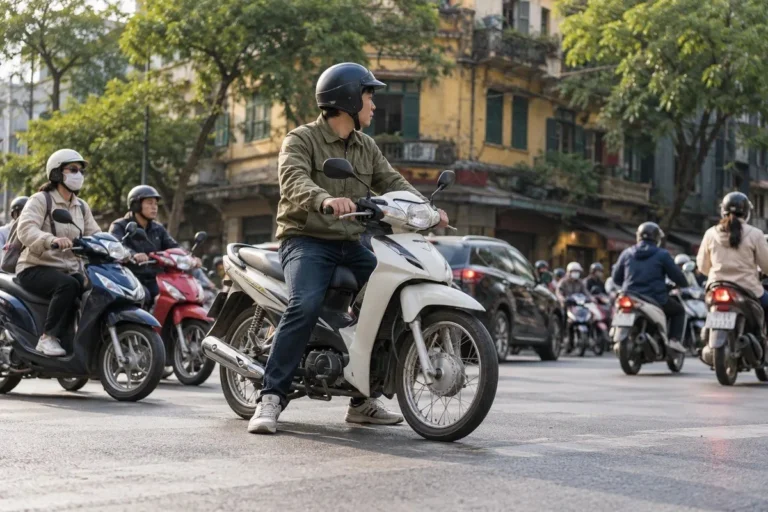
When a pedestrian suddenly enters the road, a manual-clutch motorcycle rider has to slow urgently while managing the throttle, front brake, rear brake and clutch. The priority is to maintain control and stop safely, not to keep the engine running at all costs. Proper emergency-stop training teaches riders to roll off the throttle, use both brakes progressively and operate the clutch as part of the stop. There is no useful rule that says the rider must wait until the engine almost stalls before touching the clutch.
For a rental motorcycle in Hanoi, however, this guidance is not permission to experiment in traffic. Your reaction should be based on training, the bike’s braking system and its owner’s manual. An unfamiliar bike, wet road, obstacle in a bend or ABS-equipped motorcycle may require a different response than a simplified online checklist.
Emergency braking: the real priorities
Braking is about reducing speed without losing tyre grip. A motorcycle’s tyres can transfer only so much force to the road, and available grip changes with the surface, load and cornering angle. An urgent stop demands attention to the road ahead and smooth, coordinated control; trying to memorise a rigid split-second sequence can distract from those essentials.
The Ontario official motorcycle handbook advises riders on clutch-equipped bikes to pull in the clutch and apply both brakes quickly and smoothly, avoiding wheel lock. It recommends practising emergency stops in a suitable environment with a qualified instructor. It is a training reference, not Vietnamese traffic legislation or a substitute for the instructions of your actual motorcycle.
What each control contributes
| Control | Purpose during an urgent stop | Avoid |
|---|---|---|
| Throttle | Reduce engine power | Continuing to accelerate while braking |
| Front brake | Provide substantial stopping force as weight transfers forward | Grabbing abruptly beyond available grip |
| Rear brake | Contribute to controlled deceleration | Stamping hard enough to lock the wheel |
| Clutch | Disconnect engine drive during a stop on a manual motorcycle | Treating prevention of an engine stall as more important than stopping |
| Eyes and steering | Keep awareness of obstacles, space and the intended stopping area | Looking down at the gear pedal or dashboard |
Front and rear braking do not deliver an identical share of force. Weight normally transfers forward as the bike decelerates, but actual balance depends on the motorcycle, road conditions and rider. Do not assume the front brake should be ignored or that squeezing it as hard as possible is always safe.
Should you squeeze the clutch before or after the front brake?
For a trained rider bringing a manual motorcycle to a quick stop, clutch use and appropriate braking are coordinated rather than separated into a long series of tasks. The Saskatchewan Government Insurance motorcycle handbook similarly describes both brakes applied progressively while pulling in the clutch. The key lesson is that the clutch must not become a reason to postpone effective braking.
A rider who concentrates solely on finding neutral, shifting down through several gears or keeping the engine from stalling may lose precious attention. If the engine stalls as the bike reaches a stop, that concern can usually be dealt with after the motorcycle is secured. The immediate hazard is failing to stop or losing grip.
Why a stalled engine is not the same as a skid
When road speed becomes very low while a manual bike remains engaged, its engine may stall. That is different from a tyre losing traction and sliding on the road. A stall may inconvenience the rider when trying to move away; a locked or sliding wheel can directly affect stability during the stop.
Do not mix up these two events or assume a single corrective manoeuvre fits both. How to respond to front-wheel lock, rear-wheel lock, ABS operation or instability while leaning requires proper training on the relevant kind of bike. Some rider manuals differ in how they address an already locked rear wheel, depending on the situation. Do not rehearse these scenarios by deliberately locking a wheel.
What changes when the bike has ABS?
Anti-lock braking systems are designed to reduce the risk of wheel lock under braking, but not every motorcycle has ABS, and it is not a guarantee of a short stop on every surface. System behaviour, warning lights and the correct technique can vary between models. Check the manufacturer’s guidance before riding.
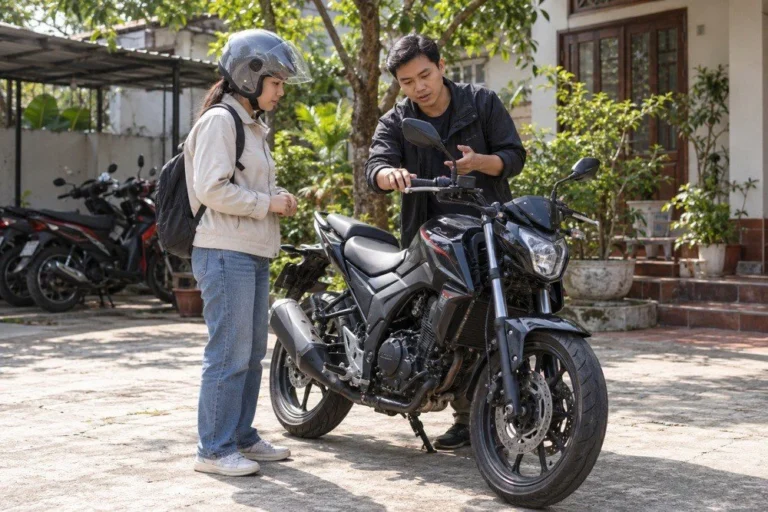
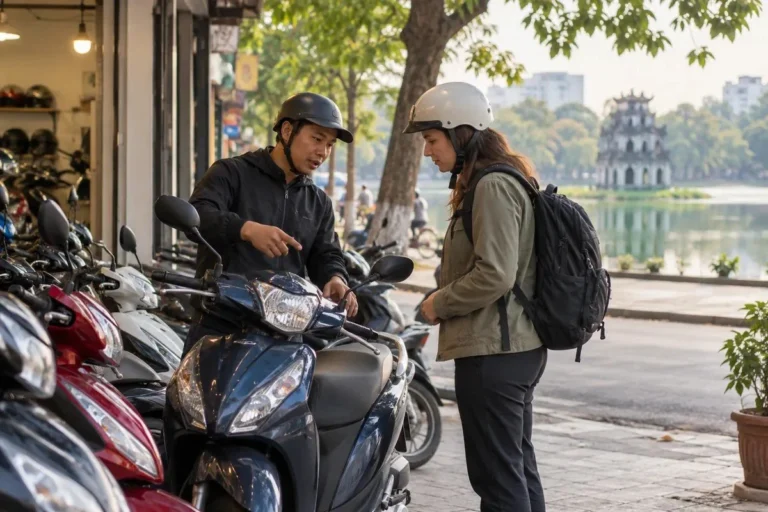
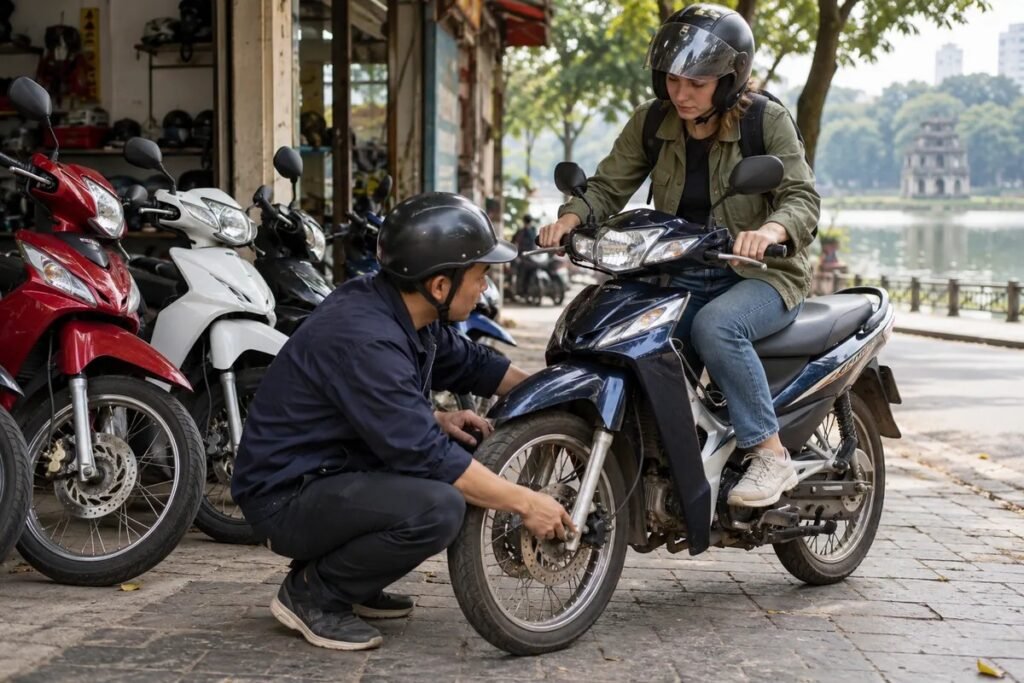
Do not assume a borrowed motorcycle has ABS because a similar model or newer model year does. At handover, ask the shop to identify the actual equipment and explain any unfamiliar instrument lights. A defective braking system is grounds to stop the handover and request an inspection.
What if a hazard appears while cornering?
A motorcycle leaning through a bend has some tyre grip committed to turning. Sudden, aggressive braking or steering can be especially difficult in that condition. Trained riders practise selecting appropriate speed before a bend and understanding how to respond if they unexpectedly need to slow while leaned over.
Do not assume an instruction meant for a straight-line emergency stop can be copied word for word while cornering. The specific bike, road width, traction and emergency matter. If you lack the necessary skills, slowing earlier and creating more space is far safer than counting on a difficult emergency manoeuvre.
How wet roads affect your stopping plan
Wet paint, steel road covers, mud and water may provide less reliable traction. Avoid abrupt control inputs and increase your following distance. Braking and shifting should be smoother, not simply stronger. The road may remain slippery after visible rain has stopped, especially on polished surfaces.
For a related but distinct issue, see our guide to drizzle, visibility and road grip in Hanoi. That article addresses changing road conditions; this one focuses on manual-clutch braking controls.
The role of posture and vision
Keep your eyes up and look toward the space you intend to use. A tight grip that locks your elbows can make it harder to respond smoothly. With the rider’s body supported and the controls within reach, the hands can focus on operating the motorcycle instead of holding up the entire upper body.
A bike that is too tall or heavy for a rider to support at a stop may create another risk immediately after braking. Before renting, check whether you can reach the controls and support the motorcycle without stretching dangerously.
Why practice belongs in a controlled setting
Emergency braking is a physical skill. Watching a video or reading a paragraph cannot train the reflexes needed for sudden weight transfer, tyre grip and clutch use. A qualified instructor can choose a lawful, low-risk practice area and adjust exercises for the student’s skill and equipment.
Do not increase road speed deliberately, lock a wheel or practise an emergency stop on a public road to test yourself. A seemingly empty Hanoi alley may contain children, parked vehicles or blind exits. Stop an exercise immediately if the motorcycle behaves abnormally or the rider loses confidence.
What to ask a rental provider before collection
- Is this a manual-clutch, semi-automatic or fully automatic bike?
- Where are its front and rear brake controls, and how do they normally feel?
- Does this exact unit have ABS or another braking feature, and what does the manual say?
- Are there any warning indicators or faults that require inspection?
- Is the rider appropriately licensed, experienced and comfortable with the actual bike?
A semi-automatic underbone normally has no hand clutch lever. For the control differences, see our semi-automatic versus manual-clutch comparison. It would be unsafe to tell a renter to squeeze a clutch lever on a motorcycle that has none.
Does Nguyen Ha offer manual-clutch rentals?
This educational article does not establish that any particular manual-clutch motorcycle is currently available. If you are comparing the types of bikes listed, read the semi-automatic rental category, which covers a different control arrangement. Confirm actual availability and terms before making plans.
Five mistakes worth avoiding
- Prioritising a running engine over a controlled stop.
- Using only one brake as an assumed universal emergency technique.
- Grabbing a brake abruptly without regard to traction or cornering.
- Looking down to change gear instead of assessing the road.
- Testing emergency braking limits on a rented vehicle in live traffic.
For information about a specific available rental motorbike, contact Nguyen Ha on 0334 699 969. If the brake system feels abnormal at pickup, do not depart until the issue has been assessed.