Fuel & Running Costs
Rental Bike Suddenly Uses More Petrol: Checks Before You Touch Anything

On this page
If your rented motorcycle suddenly seems to drink more petrol, the fuel gauge alone cannot tell you why. A different commute, a passenger, tyre condition, a dragging brake or even the way the bike is parked when you read the gauge can influence your impression. Start by comparing what actually changed. If the scooter smells strongly of fuel, has an obvious leak, feels unusually resistant to movement or produces a burning smell, stop using it and contact the rental company rather than carrying out your own tests.
This guide is for riders renting motorcycles in Hanoi who want to describe increased fuel use accurately without opening the engine, adjusting brakes or blaming a component prematurely. It does not offer a mechanical diagnosis or a fuel-economy guarantee for any particular model.
First check whether the comparison is fair
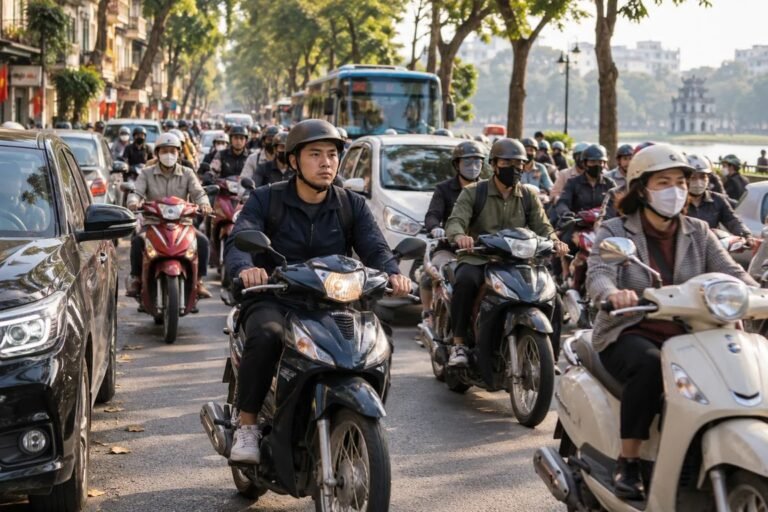
A ride from Long Bien to central Hanoi on a quiet morning may consume a different amount from the same distance in evening congestion. More stopping and starting, an extra passenger, different road surfaces and a headwind are all relevant. A small gauge movement after one trip is not a reliable measurement of litres used.
| What changed? | Why it matters | What to write down |
|---|---|---|
| Route or traffic | Repeated acceleration and longer queues change the workload | Roads used, time of day and unusual congestion |
| Load | A passenger or heavy luggage adds demand | Number of people and approximate luggage |
| Weather and terrain | Rain, wind and slopes can alter effort | Wet surfaces, strong wind or long climbs |
| Tyre condition | Improper pressure or damage may increase resistance | Any visibly flat or damaged tyre |
| Braking feel | A component that fails to release normally may create resistance | Whether the bike feels difficult to move |
| Gauge position | Indicated fuel level may vary with tilt | Whether the motorcycle was on level ground |
Check your records from comparable journeys rather than assuming yesterday and today were identical. The US Department of Energy’s efficient-driving overview explains why aggressive acceleration and braking affect vehicle fuel efficiency. Its numerical estimates are not motorcycle-specific and should not be copied as a promised percentage saving for a Hanoi rental.
What can you observe without touching mechanical parts?
Look at the tyres while the bike is securely parked. A tyre that is obviously low, cracked or visibly damaged needs attention before the vehicle is used again. Correct pressure depends on the actual model, tyre and load. Do not inflate to an arbitrary high pressure simply because someone says that reduces fuel use.
When parked on a flat, safe surface, you may notice whether the bike has become unusually hard to move compared with the handover. A constant scraping sound or resistance could merit brake or wheel inspection, but do not force the wheel, lift the bike or take another ride to reproduce a suspected fault.
Why brakes deserve particular attention
A brake that does not release normally can oppose the motion of the wheel. That may affect fuel use, but it can also be a direct safety issue. The rider might notice a new scraping sound, drag while moving the parked bike or an unusual smell. These are reasons to stop and request a qualified check, not to adjust the cable, calliper or brake lever yourself.
Brake discs, drums and the exhaust may become very hot after normal use. Never touch them to see which part feels hotter. If you notice smoke, severe resistance or abnormal braking, keep the motorcycle parked and inform the shop promptly.
How to measure fuel use more reliably
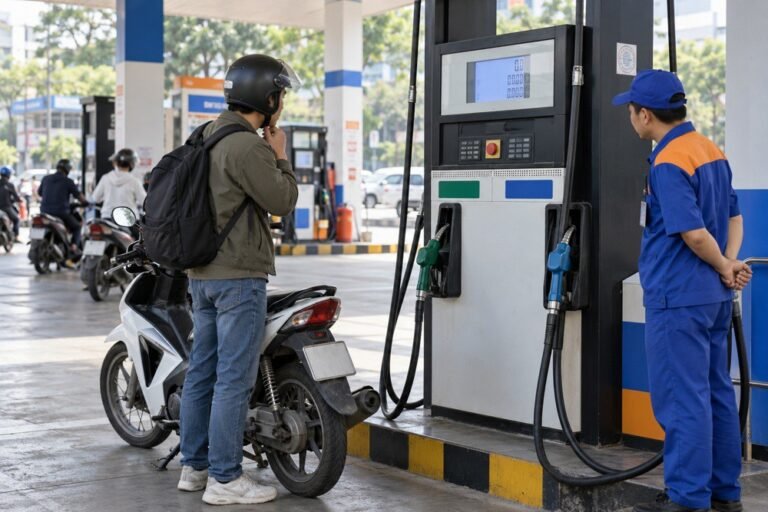
With no suspected fuel leak or safety fault, a rider can keep a simple log during ordinary travel. Record the odometer when refuelling, note the litres purchased and compare the distance covered before the next similar refuelling level. Use the same filling procedure consistent with the manufacturer’s instructions; never fill beyond a stated safe limit to make the measurements “exact”.
The calculation is: litres used ÷ kilometres travelled × 100 = litres per 100 km. For illustration only, 2 litres over 100 km equals 2.0 L/100 km; 3 litres over 100 km equals 3.0 L/100 km. Those are hypothetical examples, not a claim about a Honda Wave, Yamaha Sirius, scooter or Nguyen Ha’s actual fleet.
One refill is not enough to diagnose a sudden mechanical change. Small differences in refill level, stop-start traffic and gauge accuracy can distort the result. Keep several ordinary journeys in your log and show the context to the rental company.
How a monthly renter can keep useful records
Longer rentals often provide more observations, but only if the rider records them consistently. A short phone note with the date, odometer, fuel grade, litres and route is usually sufficient. Photographing the pump and receipt can help if the numbers are later questioned. If the motorcycle is behaving unsafely, do not continue driving for the sake of completing the log.
When a fuel smell changes the situation
A strong petrol smell, fresh liquid below the tank or visible dripping is not just a cost question. Petrol vapours can ignite. Stop the engine if it is safe to do so, avoid smoking, flames and sparks, move away from the hazard and report it. If there is an immediate fire risk, seek appropriate emergency assistance.
Do not start the motorcycle to locate the leak, put your hands underneath a hot engine or rinse a suspected petrol spill into a drain. The shop or responsible professional should decide how the bike can be inspected and moved.
What if the dashboard shows a warning light?
A new warning icon can be important, but its meaning varies by model. Take a photo when stopped, note whether the engine is running normally and describe any loss of power, hesitation or stalling. Do not clear a warning light or disconnect the battery to “reset” the motorcycle before notifying the rental company.
Some bikes have a fuel gauge with coarse bars; others have a moving needle. Neither can show you exactly how many litres a trip consumed without an actual measured refill. Avoid making claims based only on the position of the last bar.
Five questions to ask the shop
- What fuel and tyre pressures does this exact model require?
- Has the normal consumption or fuel-gauge behaviour of this bike been recorded?
- What is the correct way to report a suspected dragging brake or low tyre?
- Should the bike remain parked if it feels difficult to move or smells of petrol?
- How will a qualified inspection or possible alternative bike be arranged under our agreement?
A useful report might say: “My rental has used noticeably more petrol across several comparable trips. It has covered approximately [distance] for [litres], compared with [previous observation]. The route and load were similar. I also noticed [specific symptom, if any]. Please advise whether the bike needs inspection.”
Maintenance is not the renter’s repair project
A rental customer can report unusual sounds and document the current vehicle condition. That does not authorise them to remove covers, clean fuel injectors, adjust a carburettor, tighten brakes or add unknown additives. Repairing the wrong component may cause damage, obscure the actual fault and complicate the rental agreement.
For a different problem, see our guide to an unexplained puddle beneath a parked scooter. When a new wet patch is visible, reporting the vehicle safely is more important than completing a fuel-efficiency comparison.
What if the bike has no obvious fault?
Driving patterns may still explain variations. A commute with repeated stops, steep inclines or heavy loads can use more petrol than a calm route. You can plan a more predictable journey and avoid unnecessary rapid acceleration, but no single speed or throttle pattern guarantees the best result for every motorcycle.
If a visible safety problem is ruled out by the provider, ask whether the difference is within the expected range for that individual bike. A shop familiar with its maintenance record may have better context than a generic online consumption figure.
Where should you turn for an actual rental assessment?
For questions about a currently rented Nguyen Ha motorcycle, call 0334 699 969 from a safe place. Explain the symptoms without dismantling or testing a suspected fault.